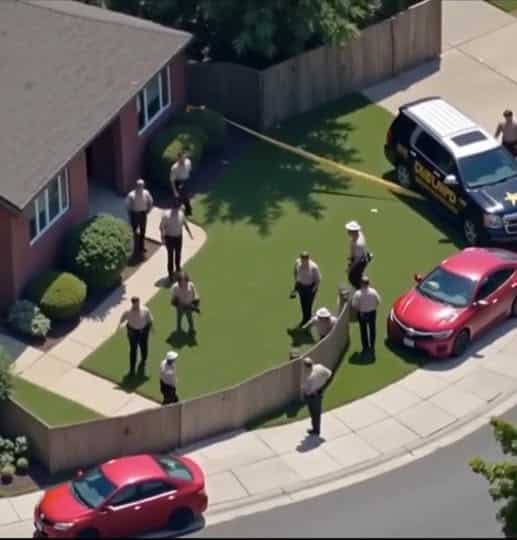
When the police car stopped in front of the house and the door opened, the neighborhood seemed to hold its breath. For months, the street had lived in quiet worry — ribbons tied to fences, posters softened by rain and sun, hope stretched thin but never gone. Now the girl was home.
There was no perfect moment of celebration.
Only her parents reaching for her with a force born of fear, love, and relief all at once — holding as though letting go might tempt fate. It wasn’t joy alone. It was gratitude tangled with grief for everything that had been taken.
And the child who returned carried more than her small body could show.
Her face was thinner. Her eyes watched the world carefully, as if danger might still be hiding in ordinary places. Words came slowly, if at all. Behind closed doors, the family began the hardest work — not the search, but the healing. Learning again what safety feels like. Moving gently through nightmares, sudden silences, and moments when comfort didn’t quite reach.
While the home turned inward, the investigation moved forward.
Authorities began piecing together where she had been, who had taken her, and how something so terrible was allowed to happen. It wasn’t driven by anger alone, but by responsibility — the understanding that protecting one child means making sure others never face the same harm.
The community shifted too. The urgency of searching gave way to a quieter determination. People asked hard questions about response times, about systems meant to protect children, about how warning signs can be caught sooner. Not to assign blame recklessly — but to grow wiser.
Those who work with trauma know that rescue is only the beginning. Fear does not leave the body all at once. The mind stays alert long after danger has passed. Healing comes slowly, in patient steps — learning that home is safe again, that laughter can return, that the world is not only what hurt you.
Some days will feel lighter.
Others will feel heavy without warning.
That rhythm is part of recovery.
The girl’s strength is already visible — not in dramatic gestures, but in quiet courage: meeting each day, trusting little by little, allowing care back in. Her family surrounds her not with pressure to “be okay,” but with steady presence.
Justice will take its course. Those responsible will be sought. Systems will be examined. That work matters.
But so does something quieter.
The work of restoring a childhood.
The return of a missing child is a gift — but it is also a reminder of how fragile safety can be, and how deeply it must be guarded. Survival does not end when someone comes home. It continues in every breath taken without fear, every night slept in peace, every moment trust slowly returns.
The posters may come down.
The street may grow ordinary again.
Yet the lesson remains.
Evil exists — but so does care, vigilance, and the power of a community that refuses to look away.
And the bravest part of this story is not the rescue itself.
It is a child learning, day by day, that the world can still hold goodness — and a family walking beside her with patience, strength, and love steady enough to rebuild what was shaken.
Quietly.
Gently.
One moment at a time.