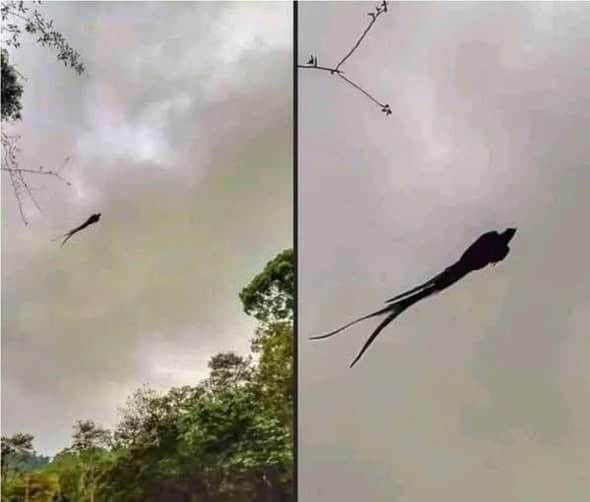
The quetzal has long been admired not only for its beauty, but for what it quietly represents across Mexico and Central America — freedom, vitality, and the fragile balance between humans and the natural world. Its emerald feathers and flowing tail seem almost unreal when caught in flight, as though the forest itself briefly takes wing.
For ancient civilizations, this bird was never just an animal. The Maya knew it as Q’uk’umatz, linking it to Kukulkan, while the Mexica associated it with Quetzalcóatl — figures tied to the sky, the sun, and the idea of sacred movement. To them, the quetzal was not owned by the earth. It belonged to the air.
That reverence still echoes today.
When a quetzal was photographed in an unusual silhouette over Frontera Corozal, the image spread quickly across social media. From a distance, its shape looked almost unreal — dark wings stretched wide, drifting like a shadow through the sky. Some joked it resembled something mythical, but what people were really responding to was awe. A rare moment of wild beauty caught in motion.
Not long before, another quetzal had been carefully relocated from Mexico City to the Miguel Álvarez del Toro Zoo, part of ongoing conservation efforts meant to protect a species whose numbers continue to decline.
In full light, the quetzal looks like something painted rather than grown — shimmering greens, deep reds, hints of gold and blue. Males carry the famous flowing tail feathers that can reach extraordinary lengths, while females remain more modest in color, blending gently into the forest.
They live in cloud forests and dense tropical highlands, feeding on fruit, insects, and small creatures. Their world is quiet, elevated, and delicate. And that delicacy is exactly what makes them vulnerable.
Deforestation continues to shrink their habitat. Some are still captured for trade — though most do not survive long in captivity. The quetzal, quite literally, cannot live confined. It stops eating. Its body weakens. Its spirit fades. What ancient cultures understood symbolically, biology now confirms.
Freedom is not optional for this bird.
It is life itself.
Rescue and reintroduction efforts have saved some individuals, but the greater battle is preserving the forests that allow the species to exist naturally. Without those mist-covered ecosystems, no amount of care can replace what is being lost.
The quetzal’s power has never been in dominance.
It has always been in grace.
It moves without noise, shines without force, and survives only where balance is respected. Its presence is a reminder that beauty thrives where restraint exists — where humans protect rather than consume.
When one rises into the air, long feathers trailing behind like living ribbons of green, it feels less like watching a bird and more like witnessing a moment of harmony between earth and sky.
Not spectacle.
Not magic.
Just nature at its most quietly breathtaking.
And perhaps that is why the quetzal has endured so long in story and symbol — not as something to possess, but as something to honor.
A living reminder that some things are meant to remain free.
{"post":96084,"page":1,"next":[{"id":96061,"title":"The Dad Who Rewrote His Identity for His Daughter A Story of Pain Love and Becoming Someone New","url":"https:\/\/new24.info\/96061"},{"id":96058,"title":"UNSENT MESSAGE \u2013 Police have found a seven-word message on Savannah Guthrie mother phone","url":"https:\/\/new24.info\/96058"},{"id":96055,"title":"Why Are Tree Trunks Painted White?","url":"https:\/\/new24.info\/96055"},{"id":96052,"title":"The Anniversary Dinner Joke That Backfired And The Party That Taught Him A Lesson In Respect","url":"https:\/\/new24.info\/96052"},{"id":96049,"title":"The 3 AM Rescue: How a Group of Bikers Saved a Dog Shelter From a Silent Killer","url":"https:\/\/new24.info\/96049"},{"id":96046,"title":"The Restaurant Snob\u2019s Costly Mistake: How a Mother\u2019s Frugal Attire Exposed Her Son\u2019s Manipulative Fianc\u00e9e","url":"https:\/\/new24.info\/96046"},{"id":96042,"title":"Curious Objects Found by Children During a Day at the Beach","url":"https:\/\/new24.info\/96042"},{"id":96039,"title":"How a Brief Moment Turned Into a Widely Shared Digital Story","url":"https:\/\/new24.info\/96039"},{"id":96036,"title":"The Real Reason Public Bathroom Doors Stop Short And What They Are Quietly Designed To Do","url":"https:\/\/new24.info\/96036"},{"id":96032,"title":"The Neon Retribution: A Lesson in Boundaries and Bridal Shine-","url":"https:\/\/new24.info\/96032"},{"id":96029,"title":"The Hidden Guardian: A Stepson\u2019s Secret Legacy","url":"https:\/\/new24.info\/96029"},{"id":96026,"title":"The Invisible Draft: 5 Signs Your Body Rejects Sleeping with a Fan","url":"https:\/\/new24.info\/96026"},{"id":96023,"title":"The $75 Million Inheritance and the Divorce Clause That Backfired","url":"https:\/\/new24.info\/96023"},{"id":96019,"title":"The Foundation of Absence: Survival, Betrayal, and the Gift of a New Start","url":"https:\/\/new24.info\/96019"}]}