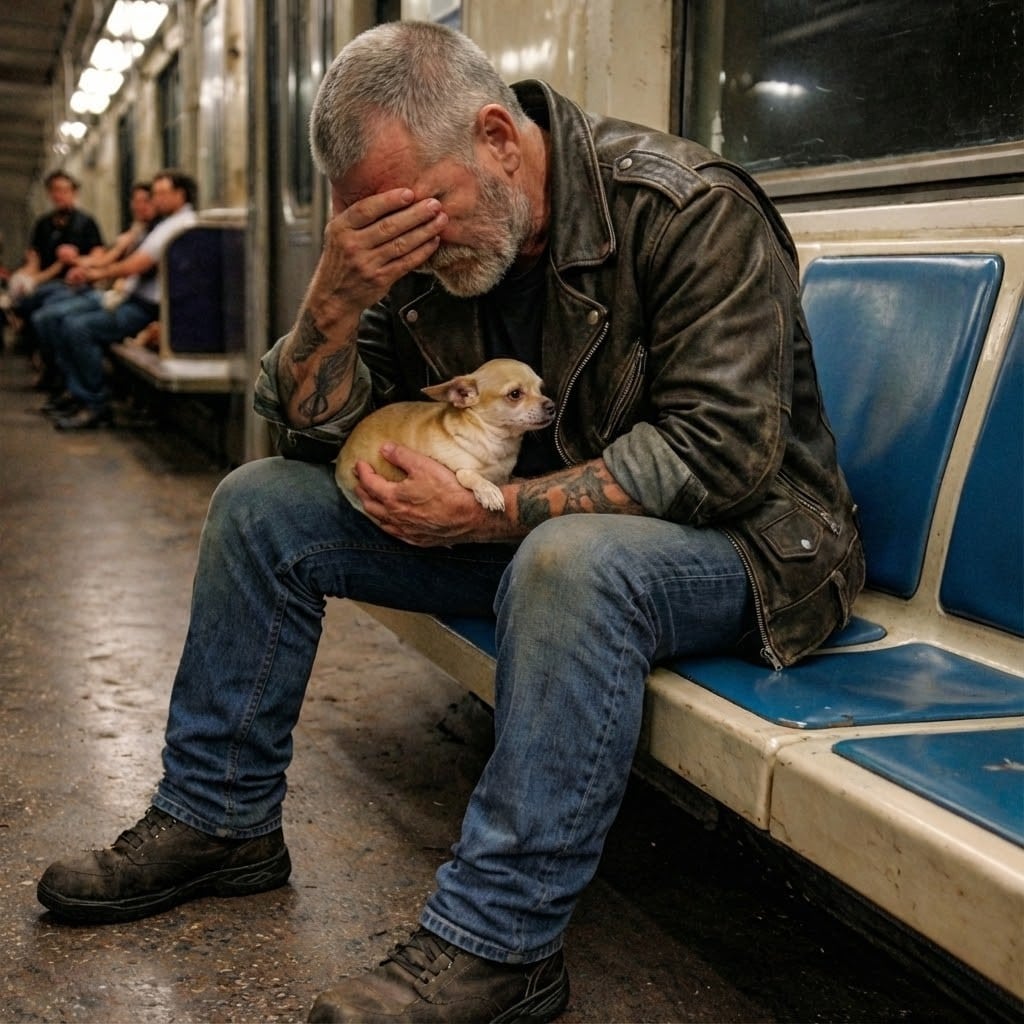
The subway felt colder that morning, though the chill had little to do with the air. People were quietly shifting away from a man who seemed to take up too much space — broad shoulders wrapped in leather, arms covered in ink, posture folded inward as if he were trying to shrink himself smaller. In his arms he held a small terrier mix, gray around the muzzle, tucked into a thin blanket. The dog’s breathing was slow and uneven, each rise of its chest a quiet effort.
Eyes glanced. Whispers passed. Seats emptied.
What most people saw was someone intimidating.
What was there, in truth, was a man holding the last moments of someone he loved.
I stayed.
Up close, the contrast was impossible to miss. His hands were careful, almost reverent, smoothing the fur again and again as though touch alone could keep life steady. His voice was low and shaking, filled with promises — that he was there, that he wouldn’t leave, that everything was okay even though it wasn’t. When I sat beside him, he looked up in surprise, the kind that comes when you expect distance and are met with nearness instead.
He told me the dog’s name was Sergeant. He’d found him years earlier, during a time when life had been rough and empty. Sergeant had become his routine, his comfort, the reason he got up when days felt heavy. Not just a pet — a companion who had quietly held him together.
As the train rolled on, something softened in the car.
An older woman took a seat nearby.
Then a teenager.
Then a mother with her children.
No one spoke much. They didn’t need to. Loss makes its own space, and when people recognize it, barriers tend to fall.
When the train reached the last stop near the ocean, we followed him without planning to — strangers moving together simply because it felt right. On the beach, under pale light and cold wind, he knelt in the sand and held Sergeant toward the waves, letting him feel the breeze one last time. There was no performance in it. Just gratitude. Presence. Love.
And then the small body went still.
The sound that came from the man was not loud, but it was deep — the kind of grief that rises from the chest and carries years of attachment with it. Hands reached out naturally, resting on his shoulders, his back, not to fix anything, only to share the weight of the moment.
Later, people offered help quietly. Numbers exchanged. Gentle words. Stories of their own goodbyes.
What stayed with me wasn’t only the sadness.
It was how quickly fear had turned into care.
A train car that had pulled away became, for a short while, a community — simply because someone chose closeness over judgment. The man who had seemed threatening was never dangerous at all. He was just hurting.
It reminded me how often pain wears faces we misunderstand, and how easy it is to miss someone’s humanity when we decide who they are before seeing what they carry.
Sometimes the bravest thing in a crowded world is not stepping back.
It’s sitting down.
Staying present.
And letting compassion do the quiet work it has always done best.