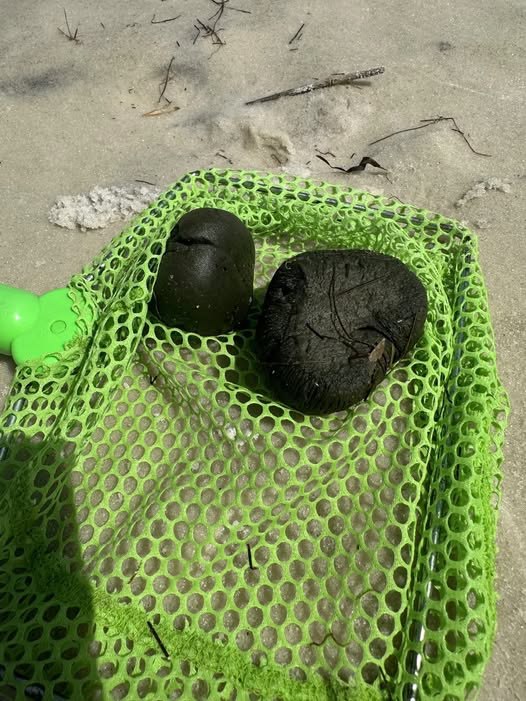
Anyone who has spent time along Pensacola Bay with children knows how quickly a simple walk can become a small adventure. A child spots something round and soft in the sand, rushes over with excitement, and proudly holds up the discovery. The playful names people give these objects usually bring laughter, but what’s being found is something quietly natural — mudballs, shaped by the bay itself. They may look odd at first glance, yet they’ve been part of this shoreline for as long as people have been wandering it.
Mudballs form where calm water, soft sediment, and marshy ground meet. Unlike the restless waves of the open ocean, the bay allows fine mud and clay to settle. Over time, small chunks loosen — from shifting tides, storms, or simple movement along the shore. Once freed, they begin to roll gently along the bottom, slowly rounding out as water and sand smooth their edges. Nature, patient and unhurried, does its work without noise.
The process isn’t so different from how stones become polished in a river. Each soft fragment is shaped little by little, compacted into a firm, rounded form. Their dark color often comes from organic material — plants that once grew in the marshes and quietly returned to the earth. Most mudballs are harmless, nearly scentless, and soft enough to crumble when pressed. Occasionally one may feel sticky or smell strong, and it’s wise then to leave it be and rinse hands — a simple respect for what the water has carried.
For generations, these small discoveries have been part of childhood along the coast. They aren’t as celebrated as shells or bright stones, yet they awaken the same curiosity — questions about tides, hidden landscapes, and the slow movements beneath the surface. What seems strange becomes familiar. What feels ordinary becomes a lesson in how the world quietly shapes itself.
In moments like these, children learn without being taught — that nature works gently, that not everything unusual is harmful, and that wonder often lives in the smallest things. A mudball returned to the shore may seem insignificant, yet it leaves behind something lasting: curiosity, memory, and a calmer way of noticing the world.
Sometimes the bay offers treasures not meant to be kept — only understood, respected, and remembered.