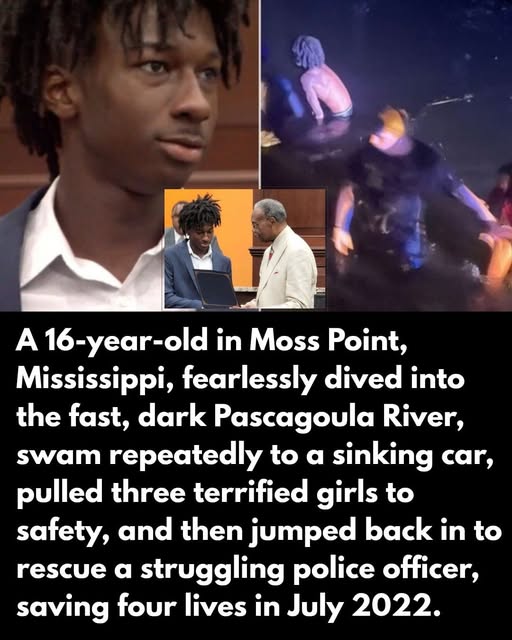
What began as an ordinary summer afternoon along the Pascagoula River shifted without warning. The water looked calm. The light was bright. Then the shouts cut through the air.
A car had slipped into the river.
Three teenage girls were clinging to its roof as it sank lower, the current pulling steadily, without emotion or pause. There were no boats nearby. No lifeguards in sight. Just people shouting and running along the bank, unsure what to do.
Among them was Corion Evans, sixteen years old.
He didn’t wait for instructions.
He didn’t weigh risk against comfort.
He removed his shoes, pulled off his shirt, and went into the water.
The river was stronger than it looked. Each stroke fought against a force that doesn’t negotiate. Corion reached the first girl and guided her back toward the shore. Then he turned again — for the second, and then the third — moving with urgency but control, refusing to rush in a way that would cost balance.
Each time, he made it back.
When the girls were safe, it would have been enough. But the river hadn’t finished.
A police officer who had entered the water to help was now struggling against the same current. Without pause, Corion turned again and swam out once more, pulling the officer toward safety.
Four people were alive because a teenager chose to act.
There was no celebration in the moment — only exhaustion, shaking hands, and the quiet realization of what had nearly been lost.
Later, the community would honor him. Headlines would use the word “hero.” Corion himself spoke simply. He said he did what anyone should do.
But not everyone does.
Courage often isn’t loud.
It doesn’t arrive with sirens or preparation.
Sometimes it’s a young person stepping forward while others freeze — not because they feel fearless, but because they recognize someone else’s life matters more than their hesitation.
That afternoon on the river didn’t create a legend.
It revealed character.
And four families went home intact because one teenager chose responsibility over fear.