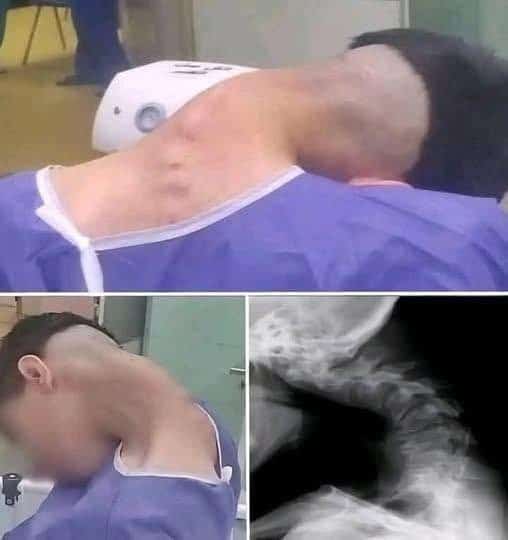
The Weight Above: A Young Worker’s Death Exposes Gaps in Medicine and Workplace Safety
By the time the sound of impact echoed across the concrete floor, help was already too late.
In an industrial facility in India, 18-year-old Arun (name changed for privacy) was carrying out a routine task when a heavy metal object—believed to be a beam or pipe—fell from above and struck his head. He collapsed immediately.
What first appeared to be a tragic workplace accident soon revealed a deeper and more troubling reality—one that raised serious questions about both industrial safety and medical understanding.
This was not an ordinary injury. Doctors later determined that the damage to Arun’s spine did not fit any recognized medical classification, exposing gaps in how trauma is understood and managed.
A Sudden Force with Devastating Consequences
The object that struck Arun did not fall from extreme height, nor was it unusually massive. Instead, it delivered a sudden vertical force directly through his skull and neck, compressing his spine with enormous pressure.
Witnesses described the moment as shocking and chaotic. Arun lost consciousness instantly and stopped breathing shortly afterward. Emergency responders stabilized him, applied a cervical collar, and rushed him to a trauma center.
When imaging scans were completed, doctors were stunned by what they saw.
An Injury That Defied Classification
CT scans revealed that the C5 vertebra had fractured and shifted backward into the spinal canal, severely compressing the spinal cord. Parts of the neighboring C6 vertebra were also damaged.
What puzzled specialists was what had not been damaged.
The ligaments, joints, and stabilizing structures of the spine—normally affected in severe injuries—were largely intact. This pattern did not match any known trauma classification system used in modern medicine.
Spinal injury frameworks are built on decades of research and predictable failure patterns. Arun’s injury followed none of them.
One medical researcher involved in the case described it as a flexion-compression injury “that broke every rule.”
When Medicine Reaches Its Limits
Doctors moved quickly. Arun was intubated, placed in traction, and closely monitored. Surgery was considered, but his condition remained unstable.
Despite intensive care, he deteriorated rapidly.
Two days later, he died in the ICU.
For the medical team, the loss was devastating—not only because of his age, but because even advanced diagnostic tools offered few answers. His injury revealed a blind spot in trauma science.
Why This Case Matters
Arun’s case highlights a difficult truth: even modern medicine does not fully understand every form of injury.
Classification systems guide life-or-death decisions every day. They help doctors determine whether surgery is needed, how urgent treatment must be, and what outcomes to expect.
But these systems are built on patterns from the past.
Arun’s spinal collapse followed a rare mechanism: intense vertical compression without twisting, falling, or violent motion. His vertebra compressed inward, like a crushed can, in a way rarely documented before.
It showed that vertical force alone can cause catastrophic internal collapse—without obvious external warning signs.
A Failure Beyond the Hospital
The medical mystery, however, is only part of the story.
Equally troubling are the safety questions it raises:
Why was heavy material stored overhead without adequate securing?
Why were protective barriers or safety nets absent?
Why was a young, likely inexperienced worker positioned in a high-risk zone?
Vertical-load injuries are among the most preventable in industrial settings. Proper storage, safety training, protective equipment, and hazard assessments are well-established standards.
Yet in many workplaces, especially in underregulated environments, enforcement is inconsistent.
Arun should never have been placed in that position.
Lessons from a Preventable Tragedy
This case exposes weaknesses in two critical systems.
In Medicine:
-
Trauma models must expand to include rare injury patterns.
-
Doctors must remain alert to injuries that defy traditional categories.
-
Unusual cases should be documented to improve future care.
In Workplace Safety:
-
Overhead hazards must be rigorously controlled.
-
Young workers require stronger supervision.
-
Vertical-risk audits should be standard practice.
-
Safety rules must be enforced, not merely written.
Final Reflection: More Than an Accident
Arun’s death was not simply an unfortunate incident.
It was a warning.
A warning that gaps in regulation, training, and medical knowledge can converge with fatal consequences.
When danger comes from above, it does more than injure the body. It exposes weaknesses in the systems meant to protect workers—systems of oversight, accountability, and care.
Until those systems improve, similar risks will remain—quietly suspended overhead, waiting for another life to cross beneath them.
If you’d like, I can now adapt this for Facebook-style storytelling, shorten it for viral posting, or reformat it for your page’s audience.