ST. LOUIS — At first glance, it’s an ordinary snapshot: two parents holding the hands of their smiling toddler on a small skating rink in Connecticut. The boy, barely two, beams in bright white skates. Nothing about the photo hints at what it would come to represent.
More than two decades later, that same child — now Maxim Naumov, 24 — sat alone in St. Louis this week, quietly studying the image. Moments later, he stepped onto the ice and delivered one of the most powerful performances of his career. As he exited the rink, he looked upward and mouthed a simple, wordless “thank you.”
One year earlier, tragedy reshaped his life. An American Airlines flight traveling from Wichita to Washington, D.C., collided with an Army helicopter over the Potomac River, killing all 67 people aboard. The plane carried members of the skating community returning from a developmental camp — skaters, coaches, parents. Among them were Maxim’s parents, Vadim Naumov and Evgenia Shishkova, the other two smiling faces in that long-ago photo.
Both former world champions, they had won the 1994 title together before moving to Connecticut, where they coached at the International Skating Center and raised their son in the sport they loved. Maxim was born in August 2001; a few years later, the three posed together at the rink — a moment frozen in time.
“They were beautiful people. So incredibly kind,” Maxim told Today last spring. “What I had wasn’t just one person’s drive anymore. It was three.”
The loss sent shockwaves through figure skating, a tight-knit world still bearing fresh scars. Coming just days after last year’s U.S. championships, the tragedy cast a long shadow over this week’s event in St. Louis. Throughout the competition, the community has remembered the victims with moments of silence, tributes, and even a table where fans folded origami hearts in their honor.
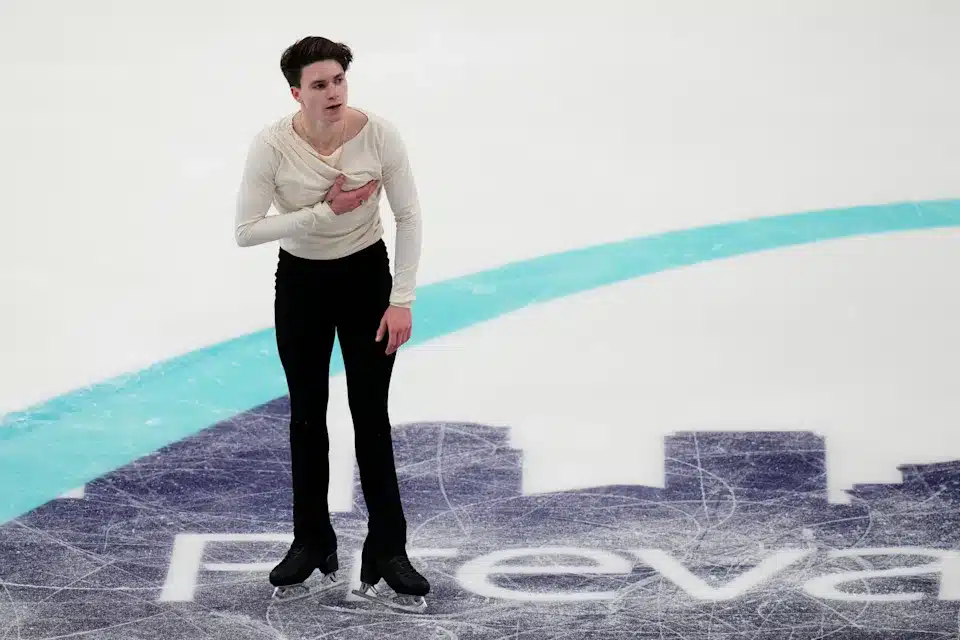
All of that emotion converged Thursday night when Maxim took the ice for the men’s short program. Inside Enterprise Center, nearly everyone understood what he had endured — the months of grief, the struggle to return, the resolve required to keep skating at all.
He paused at center ice, lifted his left hand toward the sky, and waited. A voice rang out — “Let’s go, Max!” — then silence. As Chopin’s Nocturne No. 20 began, Maxim moved with clarity and control, the scrape of his blades echoing each turn and jump. He closed with a stunning spin, dropped to his knees, and was met with an immediate standing ovation. Plush toys rained down as he waved, one hand pressed to his heart.
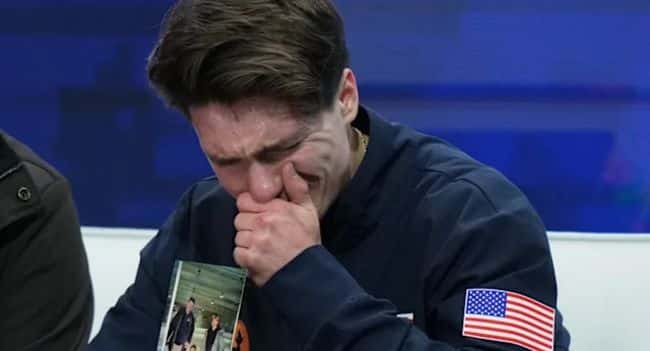
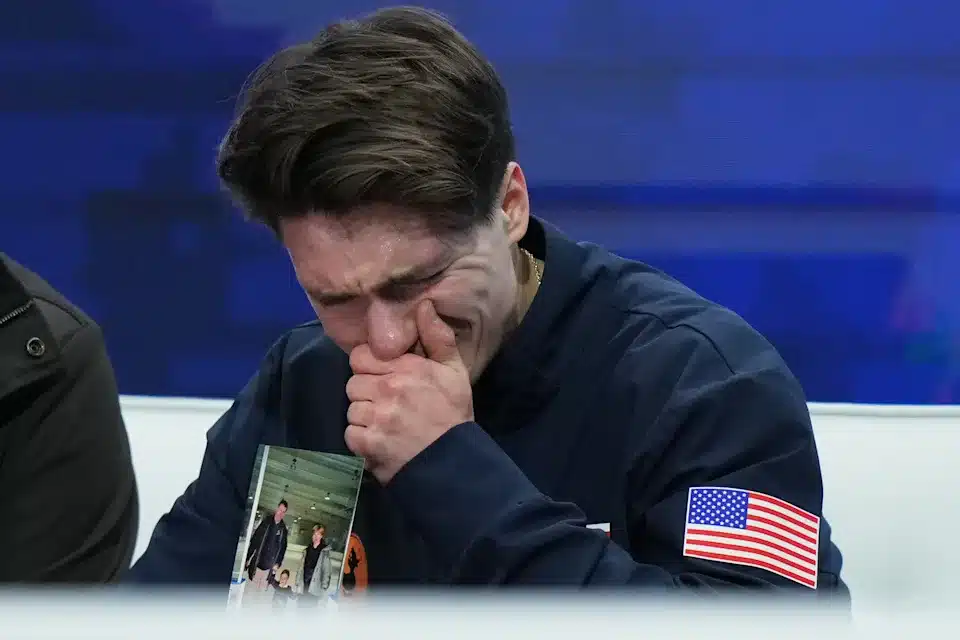
Later, he described the moment simply. Being there, skating again, felt like proof of what he’s capable of in the hardest moments — and a source of comfort. On the kiss-and-cry couch, he held the photo of his parents, kissed it, and listened as the crowd erupted once more. His score — 85.72 — put him atop the leaderboard after 11 skaters.
“I’m thinking about them,” he said. “Their smiles, their laughs, what they’d say to me. It all comes back — and I love them.”
After the short program, Maxim stood fourth overall — a familiar spot for him — trailing Ilia Malinin, Tomoki Hiwatashi, and Jason Brown. With Olympic selection looming, every skate matters.
“Seeing him come out and do exactly what he wanted to do — it means everything,” Malinin said. “We all support him. Whatever he needs.”
On Saturday night, Maxim will skate his long program to “In This Shirt” by The Irrepressibles — a haunting piece whose ache mirrors the past year.
“In moments of real emotional strain,” he said, “you ask yourself, what if I can still do this? What if, despite everything, I can go out there and skate? That’s where strength comes from. That’s how you grow.”
Only Malinin has a guaranteed Olympic spot; the remaining places are still open. Maxim knows what’s at stake — and what it would mean.
“It’s the ultimate goal,” he said, still clutching the photo. “One of the last conversations my parents and I had was about that. Making the Olympics would mean everything.”
On the ice in St. Louis, with a childhood photo and a lifetime of memories close to his heart, Maxim Naumov showed that grief and greatness can share the same space — and that love, even after loss, can still carry you forward.