Influencer’s Posts on Putin–Trump Meeting Spark Outrage
Date: August 15, 2025 Location: Anchorage, Alaska
The Posts and Backlash
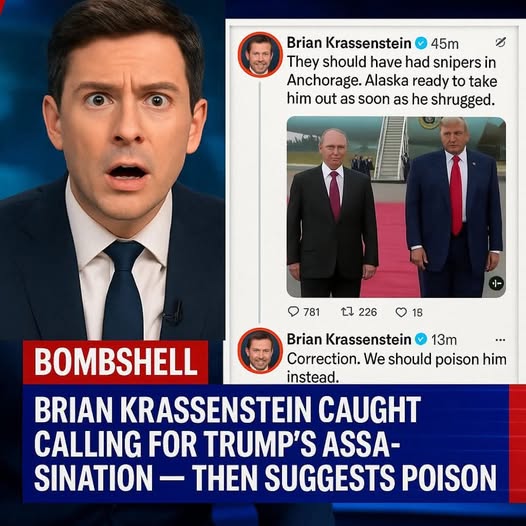
On August 15, political commentator Brian Krassenstein drew widespread criticism after making inflammatory remarks on X (formerly Twitter) about Russian President Vladimir Putin’s meeting with U.S. President Donald Trump in Anchorage.
In his first post, Krassenstein suggested that “snipers should have been positioned in Anchorage… ready to take him out.” Hours later, he issued a follow-up “correction,” writing that poisoning would be “less obvious.”
The remarks quickly went viral, prompting backlash across political and media circles. Many accused Krassenstein of advocating violence, while others questioned the lack of immediate moderation from the platform. His account remains active as of this writing.
Political and Media Reactions
Breitbart Editor-in-Chief Alex Marlow condemned the posts, arguing that they reflected a broader tendency to escalate tensions recklessly in response to the Trump–Putin meeting. Conservative commentators pointed to the incident as evidence of selective enforcement of social media rules.
Supporters of stricter moderation argue that comments suggesting violence—whether in jest or otherwise—pose risks by normalizing dangerous rhetoric. Others, however, contend that removing such posts entirely could raise concerns about free expression.
Context: Trump–Putin Summit
The posts followed a press interaction where Putin appeared to dismiss questions about civilian deaths in Ukraine. That moment became a flashpoint, sparking sharp criticism worldwide. Krassenstein’s comments, framed as a response to Putin’s attitude, added fuel to an already polarized debate.
Broader Implications
The controversy raises two central issues:
Social Media Moderation: Why certain inflammatory remarks remain online while others result in suspension.
Public Discourse and Responsibility: The extent to which public figures and influencers bear responsibility for the potential consequences of provocative statements.
TruthLens Reflection
Moments like this highlight how anger—when expressed without restraint—can cross into harmful rhetoric. Even when motivated by outrage at perceived injustice, wishing or joking about violence corrodes public discourse and risks inflaming division.
Traditions of wisdom remind us that speech is a trust: words carry weight, and once released, they cannot be retrieved. In times of political tension, measured language—firm but principled—becomes not just preferable but necessary. True accountability is not found in echoing violence, but in insisting on justice through lawful and ethical means.
{"post":90050,"page":1,"next":[{"id":90022,"title":"Charlie Kirk suspect sent disturbing messages to friends after assassination","url":"https:\/\/new24.info\/90022"},{"id":90019,"title":"Morgan Wallen Stops Edmonton Show to Honor Charlie Kirk\u2019s Widow Erika with a Heartfelt Tribute Saying the Song Has Been Hitting Him Harder Since Charlie\u2019s Tragic Passing","url":"https:\/\/new24.info\/90019"},{"id":90015,"title":"Reba McEntire SHOCKS fans with engagement news after 5 years of dating Rex Linn!","url":"https:\/\/new24.info\/90015"},{"id":90009,"title":"Riley Green held hands with ANOTHER WOMAN, not Ella Langley, on the CMT Music Awards red carpet.","url":"https:\/\/new24.info\/90009"},{"id":90001,"title":"Utah\u2019s Death Penalty Under Spotlight After Arrest in Charlie Kirk Assassination","url":"https:\/\/new24.info\/90001"},{"id":89999,"title":"NBC and CBS Acto, at 39\u2026","url":"https:\/\/new24.info\/89999"},{"id":89996,"title":"Trump Doubles Down, Hints At RICO Probe Into George Soros Orgs","url":"https:\/\/new24.info\/89996"},{"id":89993,"title":"FBI Questions Romantic Partner and Roommate of Charlie Kirk\u2019s Suspected Assassin \u2013 Here\u2019s What We Learned","url":"https:\/\/new24.info\/89993"},{"id":89989,"title":"My Husband\u2019s Daughter Needed Costly Therapy After an Accident","url":"https:\/\/new24.info\/89989"},{"id":89986,"title":"News Charlie Kirk Assassin\u2019s Motive Revealed","url":"https:\/\/new24.info\/89986"},{"id":89983,"title":"Ella Langley plays \u201cNURSE\u201d on the tour bus while Riley spins a wild HERO story.","url":"https:\/\/new24.info\/89983"},{"id":89979,"title":"Jason Aldean shocks Detroit by stopping his concert to honor Charlie Kirk in the most emotional way!","url":"https:\/\/new24.info\/89979"},{"id":89976,"title":"When Silence Says Enough","url":"https:\/\/new24.info\/89976"},{"id":89973,"title":"I FINALLY SNAPPED AT MY EX WHEN HE ASKED WHY OUR SON DOESN\u2019T LIKE HIM \u2014 BUT HE TRICKED ME","url":"https:\/\/new24.info\/89973"}]}