Facebook Twitter Instagram
    Trending
    • Jason Aldean Reveals Brittany Aldean Was Nervous And Sweaty Before Their First-Ever Duet Turned Magical
    • “Keith Urban’s Regret Could Reignite a Hollywood Love Story — But Nicole Kidman’s Heart Hangs in the Balance” 💔 Keith Urban is reportedly haunted by the choices of the past, and whispers of regret have reached Nicole Kidman’s closest friends. They fear she might let him back into her life, stirring a storm of emotions neither of them expected. Years of love, heartbreak, and shared memories weigh heavily, making every decision feel monumental. Fans watch, hearts in their throats, as one of Hollywood’s most iconic romances teeters between reconciliation and caution. In a world where fame magnifies every feeling, the question remains: can old love truly find its way home, or is this a chapter meant only for memories?
    • “WAIT A MINUTE… THIS SCENE LOOKS SO FAMILIAR!” — a single, brief exclamation was enough to ignite a storm of controversy. With just a sparkling white outfit, a cowboy hat, and a festive entrance, Lainey Wilson was unexpectedly accused of “copy-pasting,” causing a social media frenzy. Viewers scrutinized every detail, from her styling and stage presence to the déjà vu vibe, leading many to immediately name Beyoncé. Harsh comments poured in, claiming it was a “meticulously polished copy” rather than a coincidence. Conversely, the audience countered that the winter white, cowboys, and Christmas spirit belonged to no one in particular. And so, the music stage quickly transformed into a visual battleground, where the line between inspiration and imitation blurred more than ever.
    • Following the official conclusion of their divorce, Keith Urban and Nicole Kidman’s nearly $50 million real estate portfolio immediately became the focus of attention, no less than their once-admired romance. The public began to question: how were their multi-million dollar properties, spanning from the US to Australia, ultimately divided? According to close sources, some assets were clearly divided based on their purchase dates (before and after the marriage), while the most valuable properties were subject to confidential legal clauses that have never been disclosed. Experts believe that the division of this real estate portfolio alone constitutes one of Hollywood’s most complex post-divorce settlements. Even more intriguing is the absolute secrecy from both sides, raising suspicions that what has been revealed is only the tip of the iceberg. And when the spotlight faded from their marriage, the question remains: who truly holds the real estate empire in the end?
    • “Tonight, we can’t laugh.” — that single, brief sentence caused Saturday Night Live to do something unprecedented in its nearly half-century history. No catchy theme music, no familiar “goodnight” greeting; the entire studio held its breath as the show abruptly stopped in the midst of the laughter that is its very soul. The silence lasted only a few seconds, but it was enough to leave millions of viewers speechless, because everyone understood this wasn’t a joke. The tribute card appeared like a cut into television memory, forcing viewers to confront the truth: there are legends so great that when they pass away, an entire comedy empire must bow its head. And that very moment transformed an ordinary SNL episode into the most shocking moment of the year — when laughter, for the first time, succumbed to loss.
    • “Go ahead and sing. I’ve heard it.” — a simple, quiet nod from Bruce Springsteen was enough to send the entire auditorium into a frenzy. When Brandon Flowers sang “When You Were Young” with Dawes, the emotions were high, but the real explosion came when they transitioned to “The Promised Land.” From the first notes, the atmosphere seemed to freeze — and when the camera captured Springsteen standing backstage, nodding slightly and smiling, everything ignited. It wasn’t a polite nod, but an acknowledgment from the very man who had created the legend. The audience rose to their feet, applause erupted, and many were moved to tears, understanding they had just witnessed a rare moment: when music transcended the stage, passed from a legend to the next generation, in silence — yet more powerful than any lyrics.
    • “‘I Can’t Speak…’” — Eddie Vedder walked onto the Kennedy Center with a hoarse, trembling voice, and in just a few minutes, silenced the entire audience. My City of Ruins was no longer just a song, but a prayer addressed directly to Bruce Springsteen seated in the VIP section. The stage lights dimmed, and the cameras captured Springsteen’s stunned silence, his eyes reddening as he listened to his creation being reborn in an unexpected way. That night, the performance spread like wildfire, transforming remembrance into action as the song was used to raise funds for Haiti. A tribute that became an emotional milestone of the decade. And the audience realized: This wasn’t a cover — it was history being rewritten.
    • A NIGHT OF COMEDY THAT BROKE OUT OF CONTROL ON TELEVISION… Tim Conway walked out as the “oldest doctor on the planet”—and from the very first moment, Harvey Korman knew he was doomed. One ridiculously slow step, one seemingly endless bow, and the entire studio erupted in laughter. Harvey slumped into his chair, trembling, unable to continue acting while Conway continued his “examination” as if defying time. The cameras shook, the actors abandoned their roles, the crew collapsed in shock, and the audience wept with laughter. To this day, fans still call this the most hilarious moment in television comedy history—a complete collapse of all scripts and professional boundaries.
    Facebook Twitter Instagram
    Daily Stories
    • Home
    • News
    • Conservative
    • Magazine
    • Health
    • Animals
    • English
    Daily Stories
    Home » The Unexpected Guest Who Changed Everything
    News

    The Unexpected Guest Who Changed Everything

    Kelly WhitewoodBy Kelly WhitewoodSeptember 8, 20258 Mins Read
    Facebook Twitter Pinterest LinkedIn Tumblr Email
    Share
    Facebook Twitter LinkedIn Pinterest Email

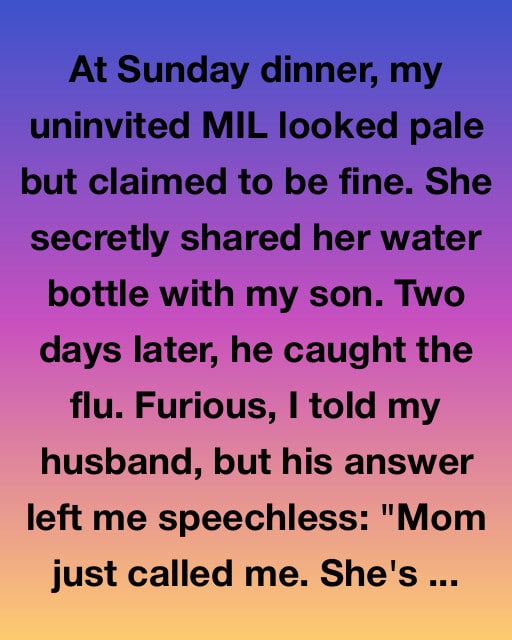
    Two Sundays ago, Silvia showed up at our place looking washed-out but stubbornly cheerful—the way people do when they’re trying to outrun a cold by smiling at it. She wasn’t invited; she never is, exactly. She just appears with a pie and opinions. We made room, because that’s what we always do.

    Dinner was ordinary until it wasn’t. In the middle of the chatter, I glanced over just in time to see her pass her water bottle to my son, Noah. He took two happy gulps before I could move. I felt heat rush to my face.

    “Silvia, he has his own cup,” I said as evenly as I could.

    She waved it off. “Oh please, it’s just water. I’m fine.”

    By Tuesday, Noah was not fine. Burning cheeks, glassy eyes, restless sleep. My fear braided itself into anger—tight and hot—and I told my husband, Nick, exactly what I thought of “just water.”

    He listened, jaw tense, and then his phone rang. He stared at the screen longer than usual before answering. “Mom?” A beat. His face drained. “We’re coming.”

    He hung up slowly. “She’s in the hospital.”

    My breath snagged. “Why?”

    “She collapsed. It’s the flu,” he said, voice rough. “But… there’s more. She has lupus. She never told anyone. Her immune system’s a mess.”

    The anger that had felt so righteous a minute ago broke apart in my hands. Lupus. A year of unsolicited advice, sudden visits, brittle smiles—and under it all, a story we didn’t know.

    “I’ll stay with Noah,” I said softly. “Go.”

    That night, I held our feverish son and replayed every barb, every boundary Silvia crossed, every time I bit my tongue and wished I hadn’t. Then, under those, the questions: Why didn’t she tell us? Why did she risk coming if she felt this bad? Why share water with my child—unless she was trying to pretend her body wasn’t betraying her?

    Two days later, Nick came home late, red-eyed and wrecked. “She wants to talk to you,” he said. “Alone.”

    “Me?”

    He nodded. “She said she has something to confess. And to ask.”

    I didn’t have forgiveness in me, but I had curiosity—and a thin thread of something like compassion I couldn’t quite name. I agreed.

    Silvia looked smaller under the hospital sheets, as if the bed had taken a bite out of her. Her skin had gone almost translucent, her hands trembling with each breath. The monitor kept time.

    “I owe you the truth,” she said, voice sandpapered down to a rasp. “And probably an apology.”

    I sat, choosing neutral. “I’m listening.”

    “I’ve been in a flare for weeks,” she said. “I should have canceled dinner. But I didn’t come for the meal. I came for you. I wanted to make peace.” Her mouth quivered. “I brought a letter. It’s… in my bag.”

    Me. Peace. I thought of the day she told me my lasagna tasted like “regret and oregano” and had to fight the urge to laugh.

    “When I saw Noah sip my water,” she continued, “I panicked. I didn’t want to make a scene. I told myself it was just a sniffle. I didn’t mean to put him at risk. I wanted one night that felt normal.”

    “Kids bounce back,” I said, more gently than I expected.

    She gave a crooked smile. “I don’t.”

    We sat with that. Then she pulled out a thick, folded letter and handed it over with shaking fingers. My name was written on the front in careful loops.

    “Why didn’t you tell us about the lupus?” I asked.

    “Pride,” she said simply. “And shame. I’m the fixer, not the one who needs fixing. At least, that’s the lie I kept telling myself.”

    That night, after Noah finally slept, I read her letter at our kitchen table. Seven pages. She admitted everything I had suspected—and more I hadn’t. She’d judged me long before she’d met me. She’d been jealous of the place I took in her son’s life, and terrified of being replaced. She’d learned cruelty at the knee of her own mother-in-law and confused “honesty” with the habit of hurting people first. She’d been diagnosed with lupus a year before our wedding and told no one because she didn’t want to be a burden, or a story that made people look at her with pity.

    On the last page, in handwriting that tilted into vulnerability, she wrote: If anything happens to me, please don’t let Noah think I didn’t love him. And if you can… forgive me.

    I cried in the quiet kitchen while the dishwasher hummed as if it were trying to comfort me.

    The next morning, I made chicken soup and packed crayons. Noah and I walked into her hospital room, and she looked more shocked than pleased at first, like grace was a language she’d forgotten how to translate.

    “I thought you’d be too angry,” she whispered.

    “I was,” I admitted. “Now I’m mostly sad.”

    She opened her arms. Noah went to her like he’d known the ending of this story all along.

    Something shifted after that. We visited daily. Noah drew dragons with terrible wings. I brought meals in Tupperware labeled with reheating instructions. Silvia talked about real things: the years she’d spent performing strength, the loneliness tucked under her perfect hair, the gnawing fear that if she needed help, she’d be less herself.

    One afternoon, while sunlight climbed the blanket at the foot of her bed, she told me about the daughter she lost in childbirth before Nick was born. I didn’t know. Grief rearranged her face as she said it.

    “I’ve been terrified of losing the people I love ever since,” she whispered. “So I held on too tight. I confused control with care.”

    I finally understood the constant drop-ins, the critiques disguised as kindness, the water bottle at dinner like a dare to her own body. Not excuse—explanation.

    By the time she was discharged, we weren’t friends. We were honest. It felt like a sturdier bridge.

    A week later, she invited us for dinner—her cooking, her table, her pace. The table was set with cloth napkins and the good plates. Halfway through the meal, she put down her fork with ceremony.

    “I’m moving into assisted living,” she said.

    Nick stared. “Mom—what?”

    “I need help,” she said simply. “I’m done pretending I don’t. I want the time I have left to be lived, not survived.”

    Then she turned to me. “You showed me what accepting care looks like without shame. Watching you with Noah, and the way you cared for me even when you were angry… it changed me.”

    I didn’t have words, so I reached for her hand. Sometimes touch is the only sentence that lands.

    In the months that followed, she adjusted. The place was small and warm, ten minutes from our house. She joined a book club. She painted clumsy tulips. She learned the names of everyone who pushed a walker past her door. And her best standing date became Noah.

    Every Saturday, they’d play Go Fish and she’d cheat outrageously, tucking a card up her sleeve and winking at him. They shared secrets in whispers. She became his favorite storyteller.

    “Did Grandma always love me this much?” he asked one night, chocolate on his lip.

    “Yes,” I said. “She just didn’t always know how to show it.”

    Three years later, on a July night soft as a lullaby, she slipped away in her sleep. At her memorial, I read a paragraph from her letter—the part where she apologized for the harm control can do when it tries to wear compassion’s clothes. People cried, and then they laughed at a story about her insisting “oregano is a feeling, not a spice,” and it felt like the truest celebration we could give her: the whole woman, not just the hardest parts.

    Afterward, one of her neighbors took my hand. “She called you the daughter she never got to raise,” she said.

    It knocked the breath out of me. Because she had hurt me. And yet—she had, finally, healed something in me too: the place that believes people never change, the place that thinks a story can only end how it begins.

    I still think about that Sunday dinner—my anger at the water bottle, my fear for Noah, the fight that bloomed in my throat and then withered when Nick said “hospital.” But the memory doesn’t end there anymore. It ends with soup in a thermos, a letter folded and refolded, card games on a Saturday afternoon, and a woman brave enough to trade pride for help.

    Sometimes the door to forgiveness is made out of paperwork you never meant to sign: discharge forms, assisted-living contracts, seven handwritten pages addressed to you. Sometimes the foolish thing—a shared sip of water—becomes the hinge the whole family turns on.

    If there’s a lesson, it’s small and simple: you can be right and still choose mercy. You can be hurt and still make soup. And if you’re lucky, someone on the other end will meet you halfway with the truth, a trembling apology, and a seat at a table that finally feels safe.

    Share. Facebook Twitter Pinterest LinkedIn Tumblr Email
    Previous ArticleMy MIL Wanted $500 After Her ‘Antique’ Chair Collapsed Under Me – I Thought It Was My Fault Until My FIL Stood Up
    Next Article My Husband’s Ex Sent Over A Giant Pool—But What I Found Inside It Changed Everything

    Related Posts

    Jason Aldean Reveals Brittany Aldean Was Nervous And Sweaty Before Their First-Ever Duet Turned Magical

    January 11, 2026

    “Keith Urban’s Regret Could Reignite a Hollywood Love Story — But Nicole Kidman’s Heart Hangs in the Balance” 💔 Keith Urban is reportedly haunted by the choices of the past, and whispers of regret have reached Nicole Kidman’s closest friends. They fear she might let him back into her life, stirring a storm of emotions neither of them expected. Years of love, heartbreak, and shared memories weigh heavily, making every decision feel monumental. Fans watch, hearts in their throats, as one of Hollywood’s most iconic romances teeters between reconciliation and caution. In a world where fame magnifies every feeling, the question remains: can old love truly find its way home, or is this a chapter meant only for memories?

    January 11, 2026

    “WAIT A MINUTE… THIS SCENE LOOKS SO FAMILIAR!” — a single, brief exclamation was enough to ignite a storm of controversy. With just a sparkling white outfit, a cowboy hat, and a festive entrance, Lainey Wilson was unexpectedly accused of “copy-pasting,” causing a social media frenzy. Viewers scrutinized every detail, from her styling and stage presence to the déjà vu vibe, leading many to immediately name Beyoncé. Harsh comments poured in, claiming it was a “meticulously polished copy” rather than a coincidence. Conversely, the audience countered that the winter white, cowboys, and Christmas spirit belonged to no one in particular. And so, the music stage quickly transformed into a visual battleground, where the line between inspiration and imitation blurred more than ever.

    January 11, 2026
    Search
    Categories
    • News (4,759)
    Categories
    • News (4,759)
    • Contact Us
    • Privacy Policy
    • Terms of Service
    Copyright © 2026, News24. All Rights Reserved.

    Type above and press Enter to search. Press Esc to cancel.