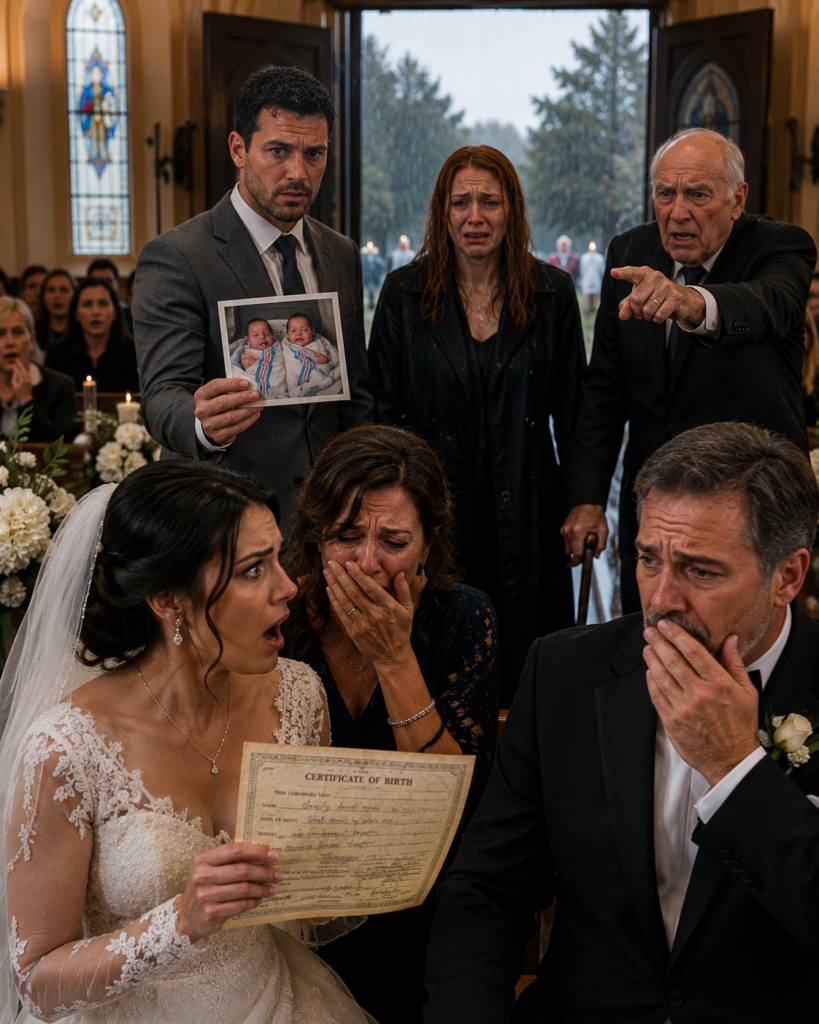
“He’s the man I paid to disappear.”
Mark’s words hung over the chapel like smoke.
No one moved.
The elderly man stood near the entrance, one hand trembling where his cane had fallen.
The woman beside him—Grace—did not take her eyes off Lily.
My daughter stared back at her identical face.
Nathan still held Lily around the waist, as though he feared her legs might give way.
I feared the same thing.
My husband looked toward me.
“Evelyn, I can explain.”
I had heard those words in movies and courtrooms.
I never imagined hearing them from the man with whom I had shared thirty-one years.
“Then explain,” I said.
My voice sounded strangely calm.
“What did you pay him to do?”
Mark glanced around the crowded chapel.
“This isn’t the place.”
Lily tore herself away from Nathan.
“You let me stand here believing a stranger had ruined my wedding, and now you want privacy?”
“Sweetheart—”
“Don’t call me that.”
Her words struck him harder than a slap.
The stranger who had interrupted the ceremony stepped beside the elderly man.
“My name is Caleb Mercer,” he said. “This is my father, Samuel.”
The old man bent slowly to retrieve his cane.
Caleb helped him.
“And Grace?” Lily asked.
Caleb looked toward the auburn-haired woman.
“My wife.”
That revelation startled me almost as much as everything else.
“You’re not their brother?” I asked.
“No.”
He looked at Samuel.
“I grew up next door to them.”
Grace finally moved.
She walked down the aisle toward Lily.
Each step seemed careful, almost frightened.
When she reached the front, she stopped several feet away.
“I’ve imagined this moment since I was sixteen,” Grace whispered.
Lily’s eyes filled with tears.
“You knew about me?”
“Not your name. Not where you lived.”
Grace touched the silver bracelet around Caleb’s wrist.
“I knew I had a twin because my father kept the hospital records. But everyone told us you died.”
“Everyone?”
Grace looked at Mark.
“Your husband made sure of it.”
I turned on him.
“What did you do?”
Mark pressed his palms together.
“I did not steal her.”
Caleb laughed bitterly.
“You changed her records, arranged an illegal placement and paid a grieving father to sign away his rights while he was medicated.”
“I saved her.”
“You bought her.”
The word struck the room hard.
Mark shook his head.
“You don’t understand what happened.”
“Then tell us,” I said.
He stared at me.
I saw calculation behind his eyes.
He was trying to choose which truth would damage him least.
That was when I realized the explanations I had received throughout our marriage might not have been explanations at all.
They had been carefully selected pieces of information.
“Everyone out,” I said.
The minister stepped forward.
“Evelyn—”
“Please.”
I looked at the guests.
“My daughter’s wedding will not continue today.”
A murmur passed through the chapel.
Lily flinched, but Nathan squeezed her hand.
“We’ll have another day,” he told her.
There was no anger in his voice.
Only devotion.
The guests slowly began to leave.
Some hugged Lily.
Others offered whispered apologies.
Several stared openly at Mark as they passed.
Mark’s sister, Patricia, remained seated in the second row.
She was crying before anyone had fully explained why.
I noticed.
“Patricia,” I said, “did you know?”
Her face crumpled.
Mark spun toward her.
“Don’t.”
That single word answered my question.
Patricia covered her face.
“I knew there had been another baby,” she whispered. “I didn’t know she was alive.”
Lily turned to her aunt.
“You knew I was taken from someone?”
Patricia began sobbing.
“I was nineteen. Mark said the adoption was legal. He said your biological mother had died and your father was unfit.”
Samuel’s cane struck the floor.
“My wife did die.”
Everyone looked at him.
Samuel’s voice shook, but each word was clear.
“Margaret died delivering our daughters. She hemorrhaged before I could even say goodbye.”
Grace reached for his hand.
Samuel held it tightly.
“I had two premature girls and no wife. I was twenty-six years old. I worked nights repairing farm machinery. We had no insurance. The hospital social worker said there were charities that could help.”
His eyes moved to Mark.
“Then this man appeared.”
Mark lowered his head.
I felt as though I were listening to the opening statement of a trial.
Samuel continued.
“He introduced himself as Daniel Lawson.”
Daniel.
Mark’s dead brother.
“He said he represented a foundation for struggling parents,” Samuel said. “He offered to cover the hospital bills and arrange temporary foster care while I got back on my feet.”
Caleb opened a folder and handed me a copy of a form.
At the bottom was Samuel’s signature.
The paper authorized temporary medical guardianship of Infant A for thirty days.
“This is not an adoption form,” Caleb said. “It never was.”
Mark rubbed his forehead.
“The hospital was going to separate them anyway.”
Samuel’s expression hardened.
“For one month. Not forever.”
I stared at the date.
October 14, 1999.
The day Mark claimed he had flown to Chicago.
He had used his dead brother’s identity to obtain guardianship of Lily.
“But why Lily?” I asked.
Mark looked at me.
“Because she was stronger.”
The words chilled me.
Grace’s eyes filled with pain.
She had been the smaller twin.
The one who required oxygen.
The one with a heart murmur.
Mark had selected the healthier baby.
Like choosing merchandise.
“You told me her mother died and no family wanted her,” I said.
“Her mother did die.”
“Her father wanted her.”
“He couldn’t provide for either of them.”
Samuel stepped closer.
“I was poor, not dead.”
Mark raised his voice.
“You signed the papers.”
“I signed temporary guardianship while I was taking morphine after collapsing in the hospital hallway.”
Caleb handed another document to me.
“This is the permanent surrender form,” he said. “Notice the signature.”
I compared it with Samuel’s signature on the first document.
They were similar.
But not identical.
The permanent form had been forged.
My stomach turned.
Mark looked at me desperately.
“We had lost three pregnancies, Evelyn. You had just undergone surgery. You wouldn’t eat. You barely spoke. I thought you were going to die.”
“So you stole someone’s child?”
“I thought I could make everything right.”
“You made it right for yourself.”
“For us.”
“There is no ‘us’ in what you did.”
My voice cracked.
For the first time, Mark seemed frightened.
Not of prison.
Of losing me.
Lily had gone completely still.
She looked at Samuel.
“Did you search for me?”
The old man’s face collapsed.
“Every day.”
He opened his coat and withdrew a weathered notebook.
The cover was held together with tape.
Inside were names, telephone numbers, addresses and dates.
Twenty-seven years of searching.
“I contacted the hospital,” Samuel said. “They claimed you died from respiratory failure on the third night.”
Grace whispered, “They gave Dad a sealed coffin.”
My skin prickled.
Samuel explained that the hospital reported that Infant A had died while he was at home collecting clothes for Grace.
He was told the body had deteriorated after an equipment malfunction in the morgue.
The hospital strongly advised a closed casket.
Grieving, exhausted and overwhelmed, Samuel accepted the explanation.
He buried a tiny coffin beside Margaret.
But there had been inconsistencies.
The death certificate listed the wrong birth weight.
The bracelet returned with the personal effects read Baby B, not Baby A.
Samuel complained.
The hospital called it a clerical error.
Then a check arrived from a private charity covering both babies’ medical bills and Margaret’s funeral expenses.
Attached was a letter stating that accepting the funds settled any administrative dispute with the hospital.
“I didn’t understand what I was signing,” Samuel said. “I thought they were helping me bury my wife.”
Caleb put a hand on his shoulder.
“Years later, the hospital was investigated for falsifying records in unrelated adoption cases.”
Samuel requested the coffin be exhumed.
The county denied his first petition.
Then his second.
It took him eleven years to receive permission.
“There was a baby inside,” Samuel said. “But she wasn’t ours.”
DNA testing proved the infant had no biological connection to Samuel or Margaret.
Another family’s child had been buried under Grace’s name.
“And my sister?” Grace asked, looking at Mark. “Where had she gone?”
Mark said nothing.
Grace answered for him.
“To Evelyn.”
The name felt foreign in her mouth.
Not because she meant disrespect.
Because I was the woman who had unknowingly raised her sister.
Lily finally spoke.
“What happened to the other baby’s family?”
Caleb’s expression darkened.
“That is the next part.”
There was more.
Of course there was more.
Caleb explained that the child buried in the Mercer plot was believed to be Hannah Cole, a premature infant reported missing from St. Catherine’s on the same night.
Hannah’s parents had been told she was transferred to a specialist hospital.
By the time they learned no transfer had occurred, the hospital claimed Hannah had been taken by an unidentified woman.
The investigation went nowhere.
The Cole family spent decades believing their daughter might still be alive.
Samuel’s exhumation proved she had died in the hospital and had been buried under another child’s identity.
The records had not been carelessly confused.
They had been deliberately manipulated.
“Why?” I asked.
Caleb looked at Mark.
“That is what we wanted him to tell us.”
Mark sat heavily in the first pew.
He suddenly looked older.
“I didn’t arrange the coffin.”
“No,” Caleb said. “Your cousin did.”
Mark looked up sharply.
My stomach tightened.
“The cousin who arranged Lily’s adoption?” I asked.
Mark nodded.
His cousin’s name was Dr. Howard Vale.
He had been a hospital administrator at St. Catherine’s.
He was also the man who called Mark when an “orphaned” newborn became available.
Howard died eight years earlier after a sudden heart attack.
Conveniently, I thought.
Dead men did not testify.
Mark wiped sweat from his forehead.
“Howard told me Samuel had agreed to surrender one twin. He said the paperwork needed to be accelerated because the hospital feared Samuel would change his mind.”
“Did you believe him?” Lily asked.
“At first.”
“And later?”
Mark closed his eyes.
“Later, I understood there were problems.”
“What problems?”
“The forged signature. The death certificate. Howard using Daniel’s identity on some forms.”
“You used Daniel’s identity,” Samuel said.
Mark looked away.
I remembered the first time he told me about his brother.
Daniel had died in a motorcycle accident at twenty-four.
Mark rarely discussed him.
Now I wondered whether grief had made Daniel useful.
A name that could be borrowed.
A dead man who could absorb blame.
“Why did you pay Samuel?” I asked.
Mark flinched.
Samuel answered.
“Four years after Lily disappeared, Mark found me.”
The chapel seemed to shrink.
“He came to my home at night,” Samuel said. “He showed me a photograph of Lily playing in a garden. It was the first proof I had that she was alive.”
Lily began crying silently.
“He offered me fifty thousand dollars,” Samuel continued. “He said Grace had medical problems and I would need money to care for her. In return, I had to stop contacting the hospital and sign a statement saying I had knowingly surrendered Lily.”
“Did you take it?” Lily asked.
Samuel’s shame was visible.
“Yes.”
Grace squeezed his hand.
“Dad—”
“I took it,” he repeated. “Grace needed heart surgery. I had no insurance and no other way to pay.”
He looked at Lily.
“I told myself I was choosing the child I could still save.”
Lily wiped her face.
“You let me go.”
“I had already lost you.”
“You knew where I was.”
“No. Mark never gave me a name or address.”
Mark spoke quickly.
“I protected Lily. Howard said if Samuel pursued the case, the state might remove her from both families while it investigated.”
“That was a lie,” Caleb said.
“I didn’t know that.”
“You knew enough to pay him.”
Mark looked at me.
“I was afraid.”
“So was Samuel,” I replied. “The difference is that you had money, lawyers and choices.”
The room fell silent again.
Patricia stood.
“There’s something else.”
Mark’s head snapped toward her.
“Patricia, stop.”
She ignored him.
“Daniel didn’t die in a motorcycle accident.”
I felt the last stable piece of my marriage crack.
“How did he die?”
Patricia stared at her brother.
“He killed himself six months after Lily came home.”
Mark shouted her name.
But she kept talking.
“Daniel discovered Mark had used his identification. He threatened to go to the police. Mark begged him to wait until the adoption was finalized.”
Lily covered her mouth.
“Daniel left a letter,” Patricia said. “He wrote that he could not live knowing his name had been used to take a child.”
Mark stood.
“You were a child. You don’t know what happened.”
“I found the letter after Mom died.”
Patricia reached inside her purse.
She had carried it to the wedding.
Perhaps guilt had told her she might finally need it.
She handed the letter to Lily.
The paper was brittle.
Lily read silently.
Then she passed it to me.
Daniel’s words were uneven and desperate.
He wrote that Mark and Howard had “crossed a line no family should cross.”
He said a grieving father was being deceived.
He said a child would grow up inside a lie.
The final sentence read:
I hope one day the little girl learns that someone tried to stop them. Continue Reading ⬇️