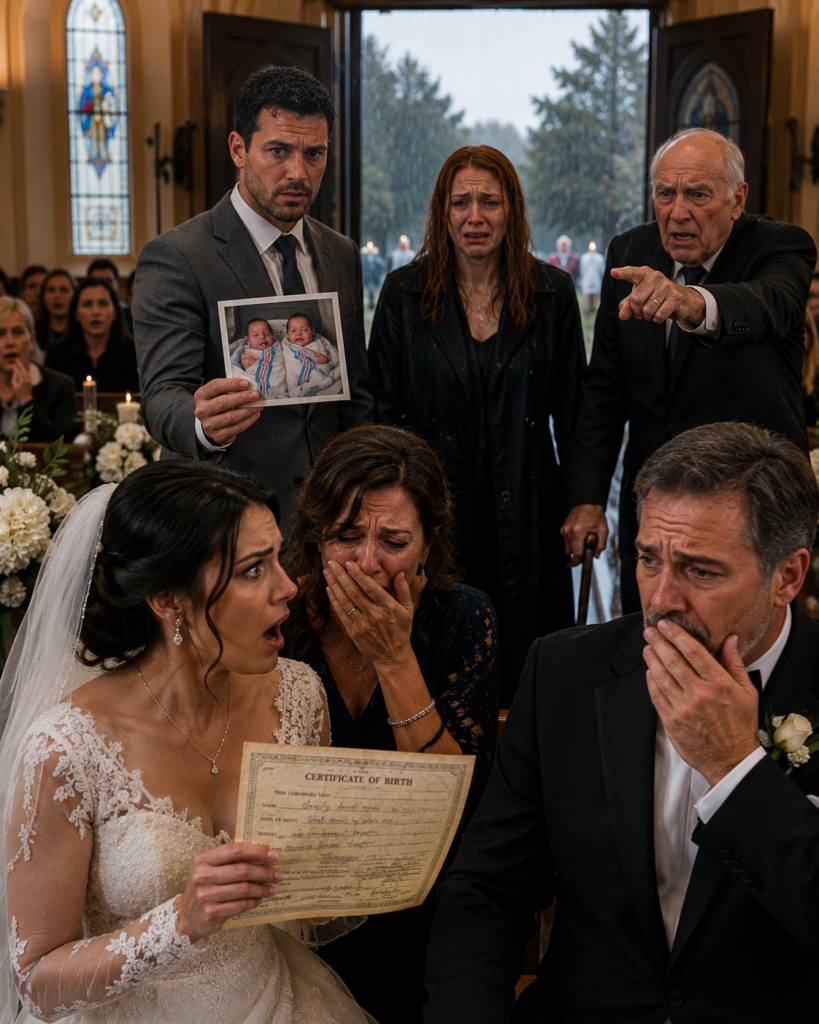
I folded the letter.
Mark was crying now.
“I loved Daniel.”
“Did you?” Patricia asked. “You spent twenty-seven years telling everyone he died in an accident because the truth made you look guilty.”
“He was unstable.”
“He was ashamed of what you made him part of.”
Mark looked around the chapel.
Every face had turned against him.
He walked toward the side exit.
Two police officers entered before he reached it.
Nathan had quietly called them when the confrontation began.
One officer asked Mark to remain inside while they assessed the situation.
Caleb provided copies of the forged documents and recordings of conversations with former hospital staff.
This had not been an impulsive wedding interruption.
It was the final step of a carefully built case.
“You used my wedding as a trap,” Lily said.
Caleb’s expression softened.
“We tried contacting you privately.”
“I never received anything.”
All eyes turned to Mark.
He had intercepted the letters.
Three certified envelopes.
Two messages sent through Lily’s workplace.
A package addressed to our home.
Mark admitted he destroyed them.
“When we learned you were getting married,” Grace said, “we were afraid you would change your name and disappear again.”
“I wasn’t disappearing.”
“We didn’t know that.”
Grace’s voice broke.
“We had already lost twenty-seven years.”
Lily looked down at her wedding dress.
“This was supposed to be the happiest day of my life.”
Nathan stepped beside her.
“It still can be someday.”
She looked at him.
“You don’t have to stay.”
He seemed almost offended.
“I proposed to you, not your birth certificate.”
For the first time since the chapel doors opened, Lily gave a small, broken laugh.
Nathan cupped her face.
“We will get married when you are ready. Today, tomorrow or ten years from now.”
Lily leaned into him.
That quiet act of loyalty hurt me because it reminded me of what marriage was supposed to be.
Trust.
Not ownership disguised as protection.
The police escorted Mark to the station for questioning.
He was not handcuffed.
Not yet.
Before leaving, he turned to Lily.
“I am your father.”
She looked at him for a long time.
“You raised me,” she said. “Today I learned that isn’t the same as having the right to take me.”
His face collapsed.
Then he looked at me.
I removed my wedding ring.
I did not throw it.
I did not make a speech.
I placed it in his palm.
That was enough.
The weeks that followed were brutal.
News of the interrupted wedding spread through our town.
The state reopened the St. Catherine’s investigation.
Former nurses were questioned.
Archived records were recovered from a storage facility owned by Howard Vale’s estate.
Investigators discovered evidence of at least nine illegal infant placements between 1997 and 2002.
Some biological parents had been told their babies died.
Some adoptive parents had been misled into believing the placements were legal.
Money had moved through shell charities and private foundations.
Mark claimed he knew nothing about the larger scheme.
That may have been true.
But he knew Lily’s surrender form was forged.
He knew Samuel wanted his daughter.
He knew Daniel objected.
And he paid Samuel to remain silent.
The prosecutor charged Mark with conspiracy, fraud, obstruction and falsifying records.
The oldest kidnapping-related charges were complicated by limitation laws and Mark’s claim that Howard had orchestrated the scheme.
Still, the documents and intercepted letters created a strong obstruction case.
Mark eventually accepted a plea agreement.
He received a prison sentence, though far shorter than Samuel believed he deserved.
Part of the agreement required him to surrender assets connected to the fraudulent adoption and fund searches for families affected by Howard’s scheme.
I filed for divorce.
Mark wrote to me every week.
I opened only one letter.
It began:
I know you think our entire marriage was a lie, but my love for you and Lily was real.
I believed that part.
That was what made everything harder.
People like Mark are easier to hate when nothing about them is good.
But he had loved us.
He had also built that love on a crime.
Real affection does not erase deliberate harm.
I did not answer.
My relationship with Lily changed too.
She never accused me of knowingly taking her.
But there were moments when she looked at me and saw the life she might have had.
I could not blame her.
She began meeting Grace slowly.
At first, they exchanged messages.
Then they met at a quiet café.
I waited in my car nearby because Lily asked me to.
She stayed inside for four hours.
When she emerged, her eyes were swollen from crying.
Grace followed her.
They stood on the sidewalk, uncertain.
Then Grace reached out.
Lily took her hand.
They had the same nervous habit of rubbing their thumbs over their knuckles.
Seeing it broke something in me.
Not from jealousy.
From grief for every shared childhood moment they had been denied.
Grace had grown up on a farm with Samuel.
She underwent two heart surgeries before turning ten.
She loved horses, old crime novels and strawberry ice cream.
Lily hated horses, preferred historical fiction and always chose chocolate.
They were not two halves of one personality.
They were separate women with an astonishing physical resemblance and twenty-seven years of different memories.
Still, connections emerged.
Both slept with one foot outside the blanket.
Both hummed while concentrating.
Both hated the smell of lavender.
Both had dreamed repeatedly as children about searching for someone in a crowded train station.
Grace showed Lily a box of birthday cards Samuel had written to his missing daughter each year.
He never knew where to send them.
Lily read all twenty-seven.
She brought the box home and placed it beside her bed.
Samuel and Lily had a more difficult beginning.
She wanted to love him immediately.
But she was angry.
He had accepted Mark’s money.
He had stopped searching publicly for several years.
Samuel never defended himself.
“I failed you,” he told her during their first private conversation.
“You were manipulated,” Lily replied.
“I was still your father.”
“You were trying to save Grace.”
“I should have found a way to save both of you.”
Lily later told me that his refusal to excuse himself helped her trust him.
He did not demand forgiveness.
He waited.
Just as he had waited for twenty-seven years.
The Cole family also received answers.
DNA testing confirmed the infant buried in the Mercer plot was Hannah Cole.
Her remains were moved to a grave beside her mother, who had died believing her daughter had been kidnapped.
Hannah’s father attended the reburial.
Samuel stood beside him.
Two fathers deceived by the same institution.
Neither could restore what had been stolen.
But both could finally put the correct names on their daughters’ graves.
Six months after the interrupted wedding, Lily and Nathan chose another date.
This time, the ceremony took place in Samuel’s orchard.
There were no expensive decorations.
White ribbons hung from apple trees.
Grace stood beside Lily as maid of honor.
I helped Lily into her dress inside the farmhouse.
She looked at herself in the mirror.
“Are you okay?” I asked.
“I don’t know what okay means anymore.”
I nodded.
“That makes two of us.”
She turned.
“Mom, I need you to hear something.”
My chest tightened.
“You didn’t steal me.”
“I benefited from it.”
“You loved me.”
“So did Samuel.”
“Yes.”
She took my hands.
“One truth doesn’t cancel the other.”
I began crying.
For months, I had feared she would eventually decide I was merely part of the machinery that separated her from her family.
“I don’t know what my place is now,” I admitted.
“You’re my mother.”
The word nearly brought me to my knees.
She smiled through tears.
“Samuel is my father. Grace is my sister. You are my mother. My family became larger. It didn’t erase you.”
When it was time to walk down the aisle, Lily made a choice no one expected.
Samuel stood on one side.
I stood on the other.
Together, we walked her toward Nathan.
Halfway down the aisle, Samuel’s steps slowed.
His health had worsened during the investigation.
Lily stopped immediately.
“We can rest,” she whispered.
Samuel shook his head.
“I’ve waited twenty-seven years to walk beside you. I’m finishing.”
He did.
At the altar, Nathan embraced him.
Then he embraced me.
The ceremony was simple.
When the minister asked who supported the marriage, Samuel answered first.
“Her whole family.”
Grace laughed through tears.
So did I.
After the vows, Lily and Nathan did not release each other’s hands.
There was no dramatic interruption.
No hidden document.
No stranger carrying a buried truth.
Only sunlight through the trees and the sound of people who had survived something terrible learning how to celebrate again.
Samuel died the following spring.
Lily was with him.
So was Grace.
Before he passed, he gave Lily the weathered notebook containing every search he had made for her.
Inside the back cover, he had written one final message:
I searched for a missing child and found two remarkable women.
Lily framed those words.
They now hang beside a photograph from her wedding.
In the picture, Samuel stands between his daughters.
Grace is laughing.
Lily is looking at him.
I am beside them.
The family does not look traditional.
It does not look untouched.
It looks repaired.
There is a difference.
Mark remains part of Lily’s story, though she has not visited him in prison.
She occasionally reads his letters.
She has not decided whether she will ever answer.
I no longer tell her what forgiveness should look like.
Forgiveness is not a door another person gets to push open.
It belongs to the wounded.
They decide whether it moves.
For twenty-seven years, I believed motherhood began the afternoon Mark placed a newborn in my arms.
I know better now.
Motherhood is not a document.
It is not blood alone.
It is not possession.
It is the daily decision to love someone without rewriting their truth to make yourself comfortable.
Mark said he stole Lily because he loved me.
But love without consent became control.
Protection without honesty became imprisonment.
And a secret meant to preserve our family nearly destroyed everyone inside it.
The truth took away my marriage.
It took away Lily’s certainty.
It reopened Samuel’s oldest wound.
But it also returned two sisters to each other.
It gave Hannah Cole her name.
It exposed a system that had harmed families for years.
And it taught us that a family can survive the truth, even when it cannot survive the lie.
Lily sometimes asks whether I wish the stranger had waited until after the wedding.
My answer is always no.
The timing was cruel.
The truth was not.
Because the woman who entered that chapel in a wedding dress believed her past had already been written.
The woman who left carried a second birth certificate, an identical sister and a history stolen before she could speak.
Six months later, she returned to an altar on her own terms.
This time, no one gave her away.
We simply walked beside her.