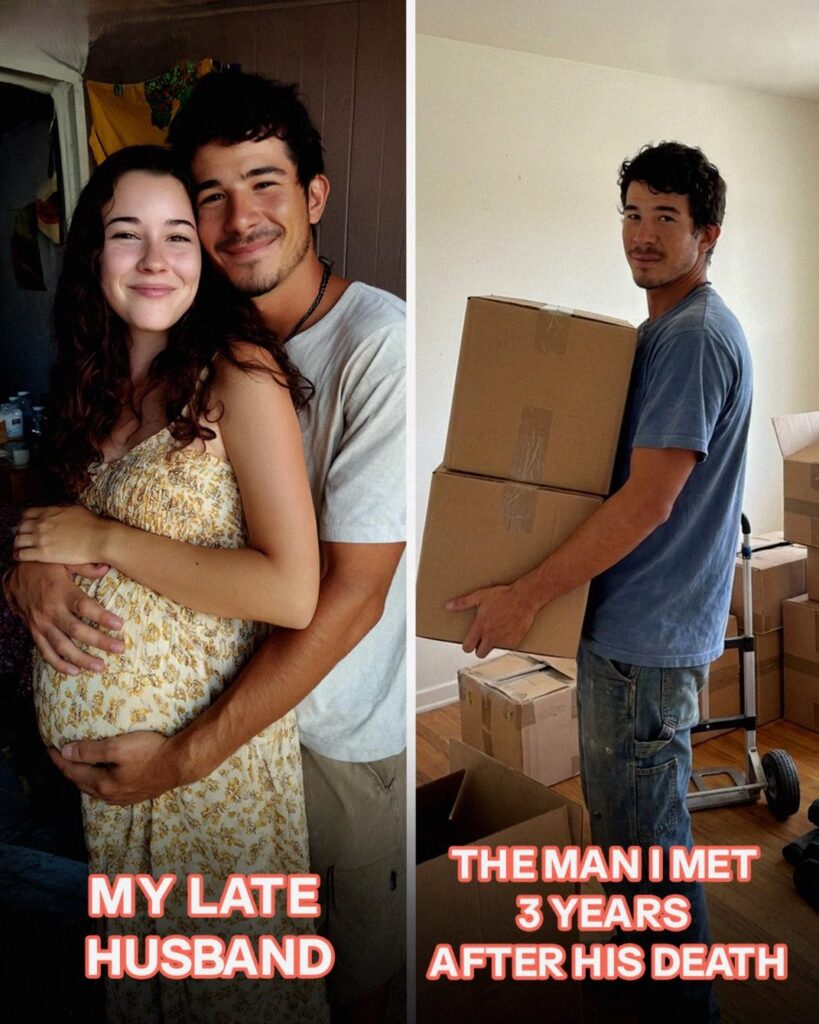
I was eight months pregnant when I stood in a black dress stretched tightly over my swollen stomach and watched them lower my husband into the ground.
No one let me see his face.
They said the crash had been too severe.
They said I should remember him the way he used to be.
As if memory could ever compete with a coffin.
By the next morning, the baby inside me stopped fighting too.
In less than forty-eight hours, I lost my husband and my daughter.
One to a highway.
One to grief.
The doctors called it trauma-induced labor. Shock. Emotional collapse. They spoke gently, carefully, like softer words could somehow reduce the damage.
But grief doesn’t care how politely it’s explained.
Three years later, I lived in a small third-floor apartment in another city with blank walls and no photographs.
I worked reception at a dental office.
I survived by keeping my life quiet.
Small.
Controlled.
No memories hanging on walls.
No conversations about the past.
Just manageable days.
That was enough.
Or at least I kept telling myself it was.
Then one Sunday afternoon, I heard furniture scraping up the apartment stairwell.
Voices echoed through the hallway.
A man said, “Careful with the corner,” followed by a woman laughing softly.
I walked to the window without thinking.
A young family was moving into the apartment across from mine.
A dark-haired woman directing movers.
A little girl clutching a pink stuffed rabbit.
And a man carrying a couch with practiced ease.
For one painful second, my chest tightened.
That could’ve been us.
Then he looked up.
And the world tilted beneath me.
Same eyes.
Same mouth.
Same posture.
This wasn’t resemblance.
It was recognition.
I stumbled backward so fast I knocked a glass off the counter.
“No,” I whispered to myself. “That’s impossible.”
But minutes later, I opened my apartment door and found the impossible standing directly in front of me.
He was holding a little girl on his hip.
And when I looked down at his right hand, I stopped breathing.
Two fingers missing.
The same two fingers Ron lost when he was ten years old trying to light fireworks behind his uncle’s garage.
“Ron?” I whispered.
Fear flashed across his face instantly.
A woman stepped around the corner carrying a box.
“Is there a problem?” she asked.
I looked at her.
Then back at him.
My voice shook violently.
“I married Ron five years ago,” I said. “I buried him three years ago.”
Silence swallowed the hallway whole.
Later that evening, Ron sat across from me in my tiny kitchen while his new wife stood frozen beside the refrigerator looking like the floor might disappear beneath her feet.
And then he told me the truth.
He hadn’t died.
He disappeared.
Business debt.
Loans.
Credit cards.
Panic.
He said he thought I’d be “better off without him.”
As if becoming a widow at twenty-nine was some twisted act of mercy.
He explained that his aunt handled the paperwork. The closed casket funeral. The death certificate.
“It wasn’t supposed to become this big,” Continue Reading ⬇️