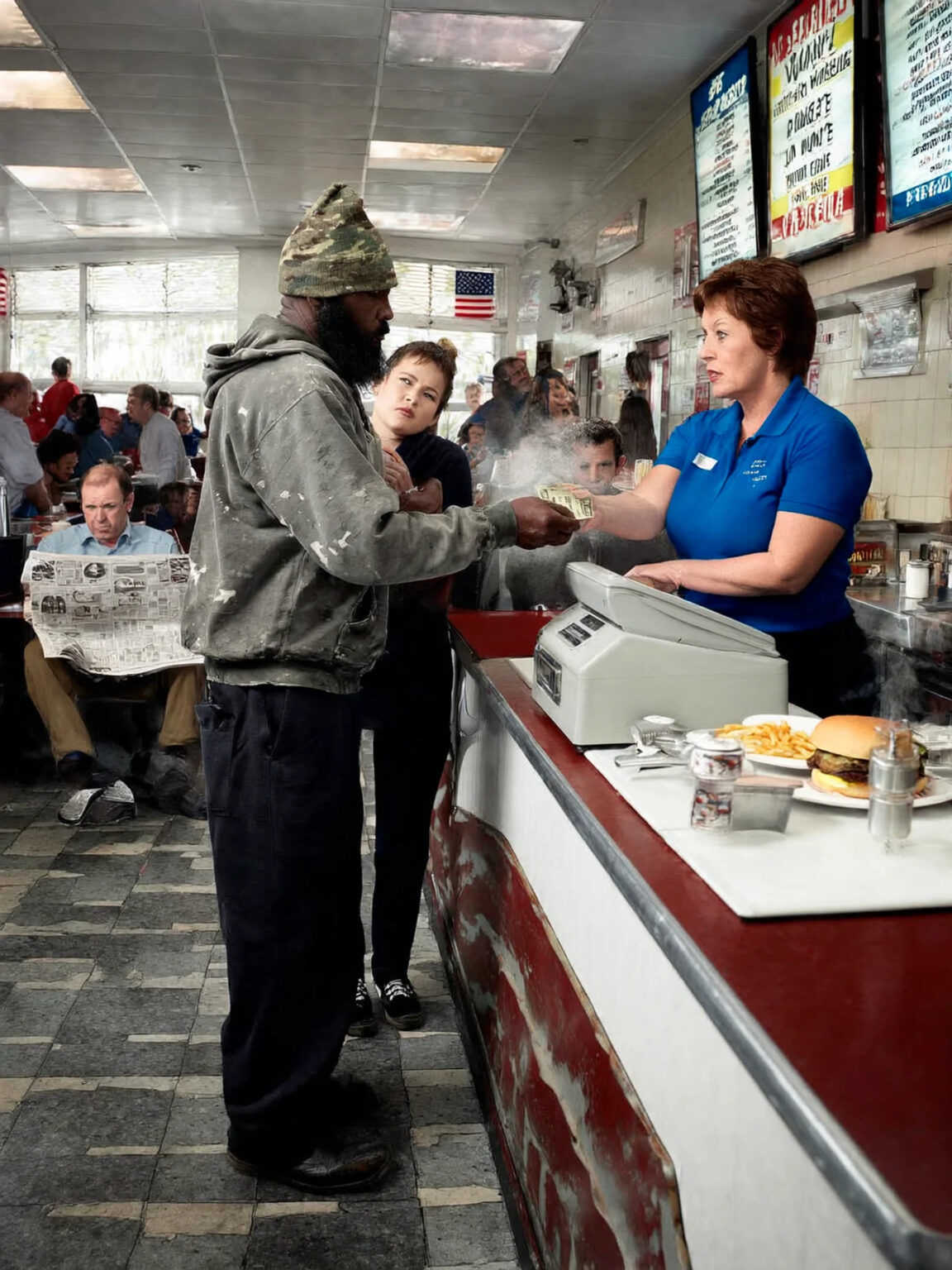
Michael Carter had built a successful restaurant chain, but something felt off when he thought about the diner where it all began in Springfield. While the brand expanded, that original location was losing money—and more importantly, losing its warmth.
Instead of reviewing reports from a distance, Michael decided to see it for himself. Dressed as a construction worker in worn boots and a faded flannel, he sat quietly at the counter and observed. It didn’t take long to notice the difference between how things looked and how they actually felt.
Amid the noise and routine, one person stood out.
Henry Lawson, an older dishwasher with silver hair, moved with quiet purpose. While others rushed through tasks, Henry treated even the smallest job with care. He didn’t draw attention to himself, but he gave the place a sense of dignity that felt increasingly rare.
Over several days, Michael watched more closely. Two younger employees, Megan and Troy, treated their work like a performance. Worse, they openly mocked Henry—his age, his situation, even the fact that he lived modestly.
One morning, a young mother’s card was declined at the register. Before the moment could turn uncomfortable, Henry stepped forward and paid for her meal himself. It was a small act, done quietly.
Megan and Troy laughed.
They joked about his kindness, spreading rumors that he was struggling with medical debt and living out of his car. In that moment, Michael understood the deeper problem. The diner hadn’t just lost money—it had lost its values.
As he continued watching, the truth surfaced. Megan and Troy weren’t just disrespectful—they were stealing. They voided legitimate sales and took cash, then tried to shift suspicion onto Henry by telling management he was the one taking money.
Michael waited for the right moment.
During a busy morning shift, when another shortage was blamed on Henry, he stood up. Removing his hat, he revealed who he was. The room fell silent.
He presented security footage—clear evidence showing exactly who had been stealing.
There was no argument left to make.
Megan and Troy were dismissed immediately. But Michael didn’t stop there.
He turned to Henry.
In front of everyone, he shared what he had learned—not just about the theft, but about Henry’s quiet generosity. He announced that Henry’s medical debts had been paid off. Then, he handed him something more permanent: the deed to a small house.
For the first time, Henry didn’t have to worry about where he would sleep.
Michael also asked him to step into a new role—floor manager. Not because of experience on paper, but because he had already been leading in the ways that mattered most.
From that point on, the diner began to change.
The atmosphere returned. Customers felt it. Staff respected it. And the business slowly found its footing again—not just financially, but culturally.
Michael realized something he hadn’t fully understood before.
Growth isn’t just about expansion.
It’s about protecting the people who carry your values when you’re not there to see them.