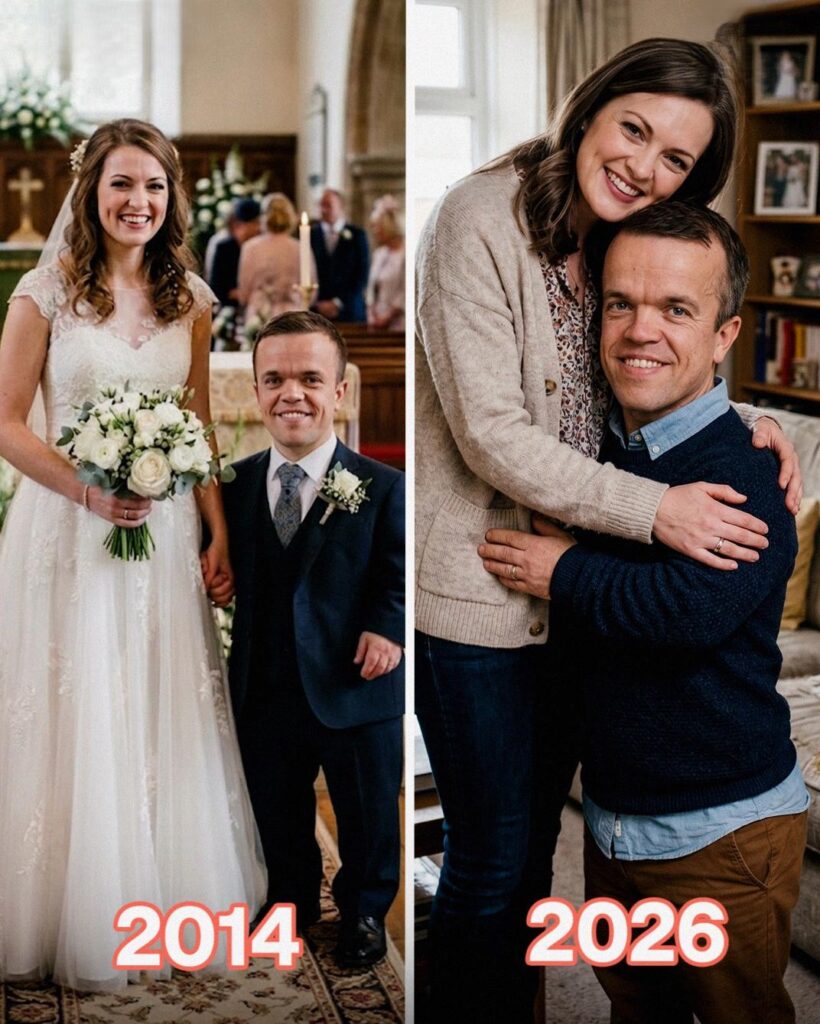
I’ll never forget the look on my mother’s face at my wedding.
She wasn’t proud. She wasn’t emotional. She looked embarrassed — the kind of embarrassed that says, please let the floor open and swallow me whole.
All because my husband, Jordan, was born with achondroplasia. In plain words, he has dwarfism.
My parents never accepted him. Not really.
They smiled when people were watching, but behind closed doors, I heard them call him a “genetic stain” on the family name. I should have cut them off then. Maybe part of me still hoped they would grow kinder with time.
They didn’t.
At our wedding reception, my father stepped up to the microphone already laughing.
“To the couple!” he said. “May their children be able to reach the dinner table!”
A few people chuckled nervously.
My face burned. I wanted to disappear.
But Jordan took my hand under the table and whispered, “Don’t let it get to you.”
“How can I not?” I whispered back. “That’s my father.”
Jordan only squeezed my hand. “Life is easier when you let ugly remarks pass.”
I hated that he could say that so calmly, because I knew what it really meant.
He was used to it.
He had heard worse.
That broke my heart more than the joke itself.
My parents didn’t care that Jordan was a brilliant architect. They didn’t care that he treated me with more gentleness and respect than anyone ever had. To them, he was always something to tolerate, crop out, laugh about, or explain away.
And the cruelty didn’t stop with his height.
One night, over dinner, Jordan mentioned that he had grown up in an orphanage after his biological parents abandoned him. I expected sympathy. Maybe even admiration for how much he had built from nothing.
Instead, my parents exchanged a look and giggled.
“I’m sorry,” my mother said, though she didn’t sound sorry at all.
Then my father added, “But I think we all know why your parents left you there.”
I stared at him. “Are you serious?”
“It’s just a joke, Jen,” Dad said. “Jordan doesn’t mind, do you? A little guy like you must—”
“Stop,” I snapped. “Just stop.”
Mom muttered that I was too sensitive.
That was when I finally understood they would never see him the way I did. To them, he would always be the punchline.
So I pulled away.
I called less. Visited less. Stopped inviting them to things where I knew Jordan would be forced to sit politely through another insult disguised as humor.
Jordan never fought back. Not once.
He simply kept going.
He built his career quietly, steadily, becoming one of the most respected architects in the city. He hired people most firms overlooked. He created spaces where accessibility wasn’t an afterthought, but the foundation.
Then my parents’ business collapsed.
The details came in pieces: debt, bad decisions, rising costs, failed loans. Within months, they lost almost everything they had spent decades bragging about.
Then one Tuesday, they showed up at our front door.
They looked smaller than I had ever seen them. Tired. Desperate.
And suddenly, very polite.
“Jordan,” my mother said, smoothing her skirt, “we heard your firm secured a major contract.”
My father cleared his throat. “We need $20,000 to keep the bank from taking the condo.”
I stared at them.
After everything they had said, after every joke, every humiliation, they had come to him.
I was ready to tell them to leave.
But Jordan spoke first.
“Come in,” he said. “We’ll talk over tea.”
They sat in our living room for nearly two hours, explaining their troubles. My mother’s hands shook around her cup. My father kept his jaw tight, pretending he still had dignity left to command.
Not once did either of them say, “We’re sorry.”
Finally, Jordan stood and went to his office. When he returned, he held a check for $20,000.
My mother’s eyes lit up immediately.
“You have no idea what this means to us,” she said, reaching for it.
Jordan pulled it back gently.
“You can have this,” he said. “Right now. But only on one condition.”
My father stiffened. “What condition?”
Jordan’s voice stayed calm. “I want an apology. A real one. For the way you’ve treated me over the years.”
Dad let out a quick breath, almost a laugh. “That’s it? Of course. I’m sorry, Jordan.”
Mom nodded quickly. “If anything we ever said hurt you—”
“If?” I said.
She blinked.
“If anything?” I repeated.
Mom looked annoyed, but tried to recover. “We didn’t mean it that way. They were jokes. We’re sorry.”
There it was.
Twelve years of cruelty reduced to a rushed sentence.
I looked at Jordan as he held out the check, and something in me refused to let it happen.
I reached forward and took the check from his hand.
“No,” I said.
Everyone stared at me.
Mom’s mouth opened. “What do you mean, no?”
“You don’t get to insult him for twelve years and fix it in twelve seconds with an apology you don’t mean.”
Dad’s face tightened. “We did what he asked.”
“No. You performed what he asked so you could get what you came for.”
Mom’s voice sharpened. “We’re trying.”
Dad turned to Jordan. “You’re not seriously going to let her do this. We came to you.”
Jordan didn’t hesitate.
“We make decisions together,” he said. “If Jen isn’t satisfied, I trust her judgment.”
The room shifted.
For the first time in years, my parents weren’t controlling the conversation.
I turned the check over in my hands.
“If you want our help,” I said, “you need to earn it.”
Dad laughed dryly. “Earn it? We’re your parents.”
“And you spent years mocking the man I love because he’s different from you.”
Mom frowned. “What do you want?”
“One week,” I said. “At Jordan’s firm.”
They stared at me.
“You won’t work,” I continued. “You won’t be paid. You’ll show up every day, sit, watch, listen, and learn what Jordan built.”
Dad’s eyes narrowed. “What is that supposed to mean?”
Jordan folded his hands. “Most of my staff are people with dwarfism, people with disabilities, or people who were overlooked elsewhere because someone decided they didn’t fit the room.”
Dad scoffed. “You’ve got to be kidding.”
“No,” I said. “You’ll spend one week being the outsiders. You’ll see what it feels like to be the only people in the room who don’t belong. And you’ll do it without one cruel joke.”
Mom looked offended. “This is ridiculous. We came here for help, and you’re trying to punish us.”
“No,” I said. “This is the first honest thing that has happened in this room today. If you see it as punishment, that says more about you than me.”
That was when Dad’s mask finally slipped.
“We don’t need to spend a week at some circus just to get help from you.”
The word hung in the air.
Circus.
Not softened. Not disguised. Not followed by a nervous laugh.
Just the truth.
I stood.
“Leave.”
Mom’s face changed. “Please, your father didn’t mean it like that.”
“Yes, he did.”
Dad pointed at me. “You’re being cruel.”
“No,” I said. “Cruel was what you did for twelve years and called humor.”
Mom turned to Jordan. “Please. There has to be another way.”
Jordan shook his head. “I stand by my wife.”
Then Dad delivered the final blow.
“I shouldn’t have expected a half-size man to wear the pants. Hard to stand up to your wife when she’s double your height, huh?”
“Out,” I said.
This time, my voice was quiet.
That made it worse.
Mom took Dad’s elbow. She finally looked frightened, but not remorseful. Just aware that she had run out of options.
They left without the check.
When the door closed, the house went silent.
The check still lay on the table.
Neither of us touched it.
I looked at Jordan. “That wasn’t what you expected.”
“No,” he said. “But it was the right call.”
My throat tightened.
He reached for my hand. “You did what I should have let myself do years ago.”
“What?”
“Stop pretending cruelty becomes harmless when people call it a joke.”
I leaned into him, and for the first time, I didn’t feel torn between the family I came from and the family I chose.
My parents had come asking for mercy.
What they revealed was that they still didn’t understand respect.
And without respect, forgiveness is just another thing cruel people expect to receive for free.