Where a Boundary Was Quietly Crossed
It started with a call.
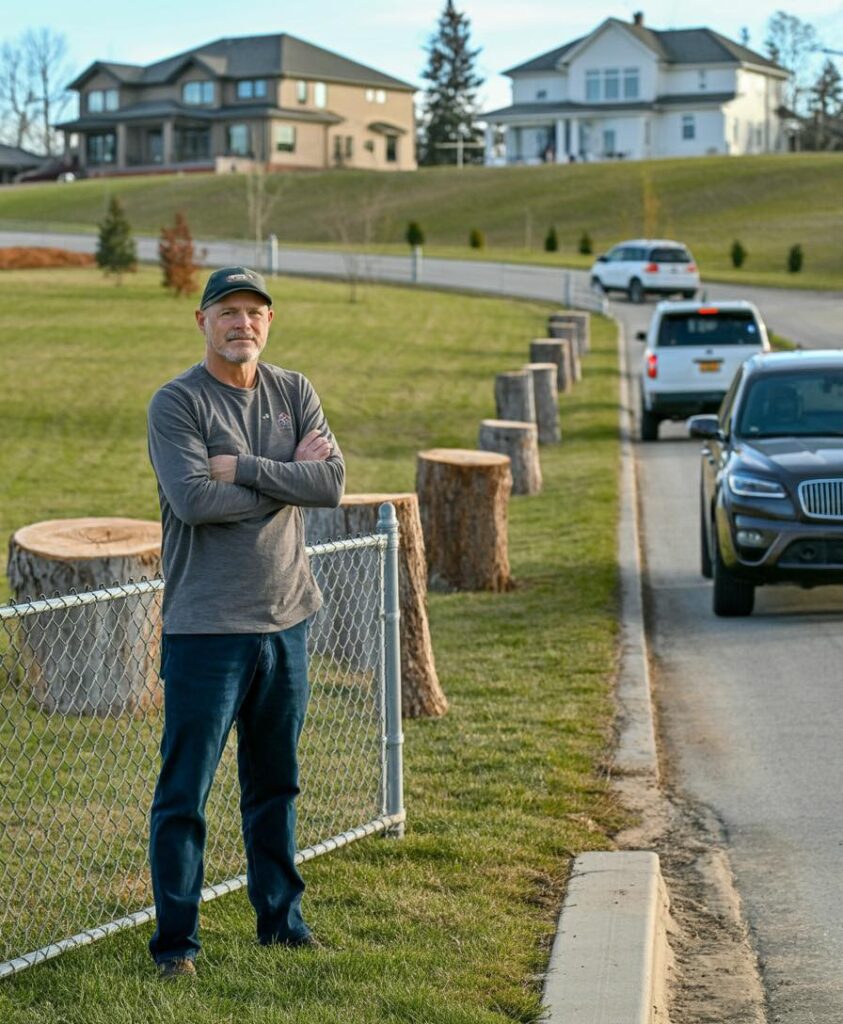
My sister Mara was shaken, the kind of urgency you don’t ignore. By the time I reached our family property on Pine Hollow Road, the damage was already done. Six sycamore trees—tall, established, and older than some of the homes nearby—were gone.
Not damaged. Removed.
What remained were stumps and the kind of silence that follows something taken too quickly.
What Was Taken
Those trees were not decoration.
Some had been planted by my father when I was a child. Others had stood long before that. They marked more than a boundary—they carried memory, shade, and a sense of continuity that doesn’t need explanation.
They were part of the land.
And someone had decided they were expendable.
A Decision Made Without Right
The clearing crew had been hired by the homeowners association from Cedar Ridge Estates. Their president, Gordon Hale, didn’t deny it. He explained it as a matter of improving the view for the neighborhood.
He spoke as if the outcome justified the method.
But the method matters.
We had a recorded easement—clear, specific, and limited. It allowed passage across Pine Hollow Road. Nothing more. No alterations. No claims beyond access.
Convenience does not extend ownership.
Choosing a Measured Response
I didn’t argue beyond what needed to be said.
I took the documents to my attorney, Denise Alvarez, who confirmed what was already clear: this was trespass, and it went beyond that into damage that carries legal weight.
The next step was not dramatic.
It was precise.
I marked the boundary again and placed a chain across the road—within my rights, and in line with the agreement. Access was restricted. Not blocked recklessly, but controlled, with emergency passage maintained.
The response was immediate.
Frustration, anger, disbelief.
But none of that changes what is written, or what is owned.
When Facts Settle the Matter
An independent county survey followed.
It confirmed what I had known from the beginning: every stump sat firmly within our property lines.
There was no ambiguity left.
At that point, the conversation shifted. Not because attitudes softened, but because the facts no longer allowed room for interpretation.
Repair Without Erasing
The settlement did not restore what had been there.
It did require acknowledgment.
By November, a crew arrived to plant twelve mature sycamores along the same line. More than before. Not as a gesture of generosity, but as a corrective measure.
The land will take time to look as it once did.
That part cannot be rushed.
Once the work was complete, I removed the chain. The road reopened. Access returned.
Final Reflection
The neighbors regained their view, for a while.
Over time, the trees will grow. The view will narrow again.
Not as retaliation.
Simply as a consequence of restoring what was crossed.
There is a difference between sharing space and taking from it. That line can be overlooked when it feels convenient.
It becomes clear again when it is enforced—calmly, and without excess.
Some things don’t need to be fought loudly.
They need to be held in place.