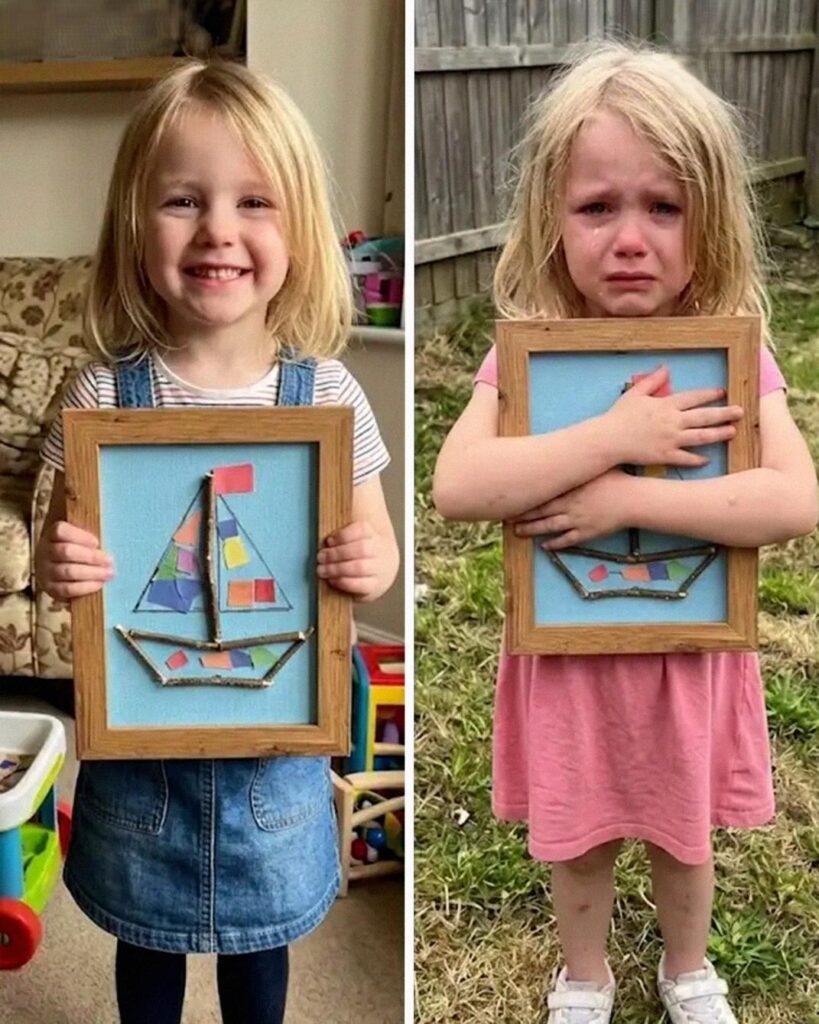
I left my five-year-old at a family birthday party thinking the biggest risk was frosting in her hair and sugar in her system.
An hour later, my phone rang—and everything shifted.
Mira has always been the kind of child who builds things like they matter. Not quick crafts or messy scribbles, but careful, quiet projects that take days because, in her mind, they deserve it. When she decided to make her cousin Tommy a gift, she didn’t hesitate. She gathered twigs from the park, scraps of colored paper, a piece of cardboard from a cereal box, and what she called “the good glue”—the one that doesn’t quit.
For three days, she worked on that little boat.
It leaned slightly. The sail didn’t cooperate. The blue paper waves were uneven. But every inch of it carried her attention, her patience, her intention. It wasn’t perfect.
It was hers.
At the party, she carried it like something fragile and important, refusing to let me hold it. I stayed just long enough to settle her in before leaving for a meeting, reassured by the fact that her grandmother was there and watching her.
That’s the only reason I walked away.
When my phone rang, I knew immediately something wasn’t right. My mother-in-law didn’t waste time.
“Mandy opened Mira’s gift,” she said. “And she told everyone it was the worst and cheapest one there.”
For a second, the words didn’t even register.
Then they did—and everything inside me went cold.
“She said it loudly. In front of the kids. Mira heard everything.”
I was already moving before the call ended.
The drive back blurred into nothing but one thought: she spent three days making that.
Three days of quiet effort, of careful hands, of believing it mattered.
And a grown woman had decided to humiliate her for it.
When I walked into the backyard, the atmosphere hit me first. That unnatural silence that follows something ugly. Conversations had stopped. People stood in small, awkward clusters. No one quite knew where to look.
I found Mira on a bench near the fence, her cheeks wet, her hands folded tightly in her lap like she was trying to hold herself together.
But it wasn’t her that froze the entire yard.
It was Tommy.
He stood in the center, holding the frame with the little crooked boat. Small hands gripping it like it mattered more than anything else on that gift table.
I dropped to my knees in front of Mira. “I’m here.”
Her voice shook. “I made it for Tommy.”
“I know.”
“I worked really hard.”
“I know you did.”
That’s when I heard his voice.
“It’s my favorite one.”
Every adult turned.
Mandy laughed lightly, the kind of laugh people use when they want to move past something they can’t undo. “Tommy, sweetheart, open the rest.”
“No.”
He didn’t raise his voice. He didn’t argue. He just held that frame closer.
“This one is my favorite because Mira made it.”
Something shifted in that moment. Not loudly. Not dramatically. Just enough that people started seeing what had actually happened.
He went on, explaining the details the way only a child who truly cares can. The blue paper because it was his favorite color. The shiny piece because it was “the sun on the water.” The effort behind it, the time it took, the way she had told him about every part.
Then he walked over to Mira and sat beside her like nothing else mattered.
“Show me again,” he said.
And she did.
Through shaky breaths, pointing with small fingers, explaining each piece as if she were presenting something important. Because to her, it was.
He listened like it deserved that attention.
“Cool,” he said when she finished.
“That’s why it’s good.”
No one interrupted.
No one corrected him.
Because there was nothing to correct.
One by one, the adults began to speak—but not to defend Mandy.
“That’s actually really thoughtful.”
“That’s the sweetest gift here.”
My mother-in-law stepped forward, her voice steady. “It’s the only one made with real care.”
And just like that, the balance shifted completely.
Mandy tried to hold her ground, talking about “standards,” about appearances, about what was “acceptable.” But the words sounded thin now. Out of place.
Because everyone had seen it.
A five-year-old had made something with love.
And a six-year-old had recognized its worth.
Tommy stood again, still holding the frame.
“I want this in my room,” he said.
Not the playroom. Not a shelf somewhere out of sight.
His room.
Then he added the part that ended it.
“And Mira stays. It’s my birthday.”
There wasn’t anything left to argue after that.
He took her hand and led her toward the house, carrying that little uneven boat like it was something valuable.
And in a way, it was.
I stayed for the rest of the party—not for Mandy, not for appearances, but for Mira. She laughed again. She had cake. Tommy showed every kid who came near him the boat, explaining it like it was a masterpiece.
By the time we left, the hurt had softened.
On the drive home, she kicked her shoes lightly against the seat and said, “Tommy really liked it.”
“He did.”
She was quiet for a moment. Then she asked, “Was Aunt Mandy mad because we don’t have as much money?”
That question stayed with me longer than anything else.
I met her eyes in the mirror. “No. She was wrong because she forgot that kindness matters more than looking impressive.”
Mira nodded slowly, like she was filing that away somewhere important.
And I realized something then.
That day wasn’t defined by what Mandy said.
It was defined by what Tommy chose.
The boat stayed on his nightstand for months. Every time we visited, he pointed to it like it was something worth showing.
And maybe that’s the part that matters most.
Not the cruelty.
But the quiet, undeniable way it was answered.