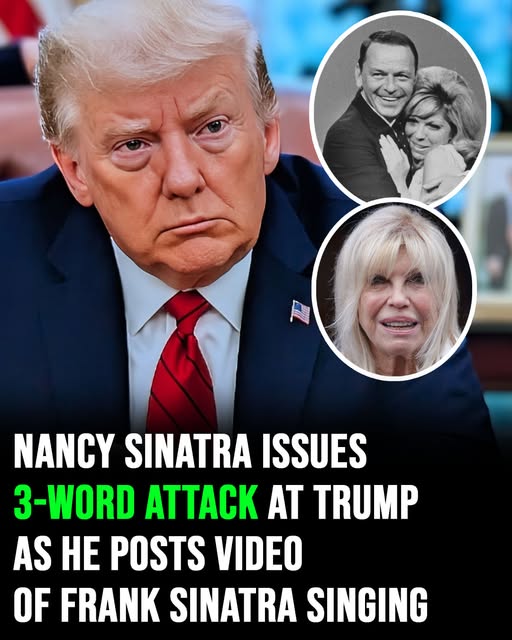
…changed the entire narrative. Nancy Sinatra’s reaction cut through the digital noise more sharply than any pundit’s take. Seeing her father’s most iconic anthem suddenly repurposed by a political figure she openly despises, she didn’t mince her words. She labeled the act “sacrilege”—a stinging indictment that framed Trump’s post not as a tribute, but as a violation of her father’s spirit. To Nancy, this wasn’t merely political theater; it was a deeply personal and moral line being crossed.
For Nancy, the issue was clear: the voice of a man who championed equality and civil rights was being used to amplify a leader she believes stands for the exact opposite. The clash highlighted a fundamental tension between legacy and appropriation. While Trump has long admired the Sinatra brand, Nancy was quick to set the record straight for her followers. She reminded the public that while Trump may have been a fan, “Sinatra did not love Trump.”
The singer admitted with palpable frustration that she lacks the legal power to stop the unauthorized use of her father’s music in political settings. Copyright law is a cold, clinical instrument that often fails to protect the soul of an artist’s legacy. However, what Nancy does possess is a voice—a powerful, authoritative platform she used to ensure the world understood that her father would never have allowed his artistry to be placed in Trump’s mouth.
In the end, the viral clip became more than just a cryptic signal from a former president. It transformed into a high-stakes battle over ownership and identity. It forced a conversation about who gets to claim the meaning of a song that was never meant to belong to the political arena. By speaking out, Nancy Sinatra reclaimed her father’s narrative, proving that while a song can be played by anyone, its true meaning remains under the protection of those who knew the man behind the microphone best.