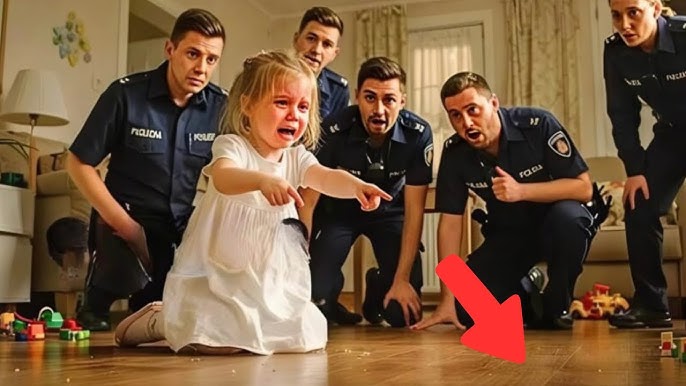
After a decade on emergency calls, you start to recognize patterns. Panic has a sound. So does imagination. Most late-night calls involving children fall somewhere between the two—fear shaped by shadows, noise, or the quiet exaggerations of the dark.
But that night was different.
The voice that came through wasn’t loud. It wasn’t frantic. It was careful.
Careful in a way that made every instinct sharpen.
“My parents aren’t home,” the little girl whispered. “Someone is hiding under my bed… please come.”
She wasn’t crying. She wasn’t guessing.
She was managing her fear.
That’s what made it serious.
We traced the address slowly, piece by piece, as she read it off a courier box. She moved through the house while we stayed on the line, her breathing shallow, each step measured. There was something in the background—soft, indistinct—but enough to make you sit straighter.
Alone child. Unknown presence. Missing adult.
That’s not imagination anymore. That’s a situation.
By the time we pulled up to the house on Willow Lane, everything felt too still. The kind of stillness that doesn’t reassure you—it warns you.
The door opened before we knocked.
She stood there in pink pajamas, gripping a worn teddy bear like it was holding her together. Her eyes went straight past us, toward the staircase.
“There’s someone under my bed,” she said again, quieter this time, like repeating it made it more real.
We cleared the house quickly. Living room, kitchen, back door—nothing. No signs of forced entry. No broken windows. No movement.
Everything looked… normal.
And that’s what made it worse.
Because fear that doesn’t match the environment is either imagined—or deeply misunderstood.
Luis gave me the look. The one that says, We’ve seen this before.
He knelt beside her. “You’re safe, sweetheart. We checked everything.”
Her face crumpled instantly.
“You didn’t look under the bed.”
That stopped me.
It would’ve been easy to dismiss it. We’d already cleared the house. The logical explanation was right there, waiting to be accepted.
But something about her insistence—the precision of it—felt different.
Children don’t always know what they’re seeing.
But they know where they saw it.
So I went back.
The room was small. Soft lighting. Toys neatly arranged. A bed slightly disturbed, like she had gotten out of it too fast.
I dropped to one knee and lifted the bed skirt.
At first, nothing.
Just darkness.
Then—
a breath.
Not mine.
Not the house settling.
A human breath, held too long and released too quietly.
Every nerve in my body locked.
I leaned in further.
And then I saw her.
Another child.
Curled tight against the wall, shaking, eyes wide and fixed on me like I was just another unknown.
For a second, my brain refused to catch up.
This wasn’t a break-in.
This wasn’t an intruder.
This was something else entirely.
“Luis,” I called, my voice lower than I expected. “You need to see this.”
We brought her out slowly. She was burning with fever, too weak to resist, too scared to speak. When I asked her name, she said nothing.
Her hands moved instead.
Fast. Urgent.
Sign language.
We were missing pieces of a story unfolding right in front of us.
The little girl—Mia—stood in the hallway, watching.
“That’s her,” she said softly.
That explained the fear.
But not the presence.
Not how she got there.
Not why she hid.
Then the door opened.
A woman rushed in, panic written across her face. The moment she saw the child in our arms, everything else disappeared for her.
“Polly!”
The truth followed quickly after that.
She was the nanny.
The sick child was her daughter.
And in a moment of rushed judgment—of trying to solve one urgent problem—she had left both children alone.
One wandered.
One woke up.
One hid.
And one saw a pair of eyes staring back at her from the dark.
What could have been dismissed as a “monster under the bed” call turned into something much heavier.
Not criminal.
But serious.
Because risk doesn’t need bad intentions. It only needs a gap in judgment.
Later, when things settled, the parents returned—fear turning into anger, anger into confrontation. The house filled with voices, explanations, consequences waiting to take shape.
But the moment that stayed with me wasn’t any of that.
It was earlier.
A five-year-old girl, alone in a quiet house, whispering into a phone so something under her bed wouldn’t hear her.
She didn’t scream.
She didn’t freeze.
She acted.
She remembered what she’d been told.
And she called for help.
That kind of clarity under fear—that’s not something you teach overnight.
That’s instinct meeting trust.
Before we left, I knelt in front of her again.
“You did everything right,” I told her.
She looked at me carefully. “Even though I was whispering?”
“Especially because you were whispering.”
Because she understood something most adults forget:
Fear doesn’t mean you’re wrong.
And sometimes, the bravest thing you can do… is speak anyway.