It didn’t feel real at first—just one sharp ring of the doorbell, and then silence.
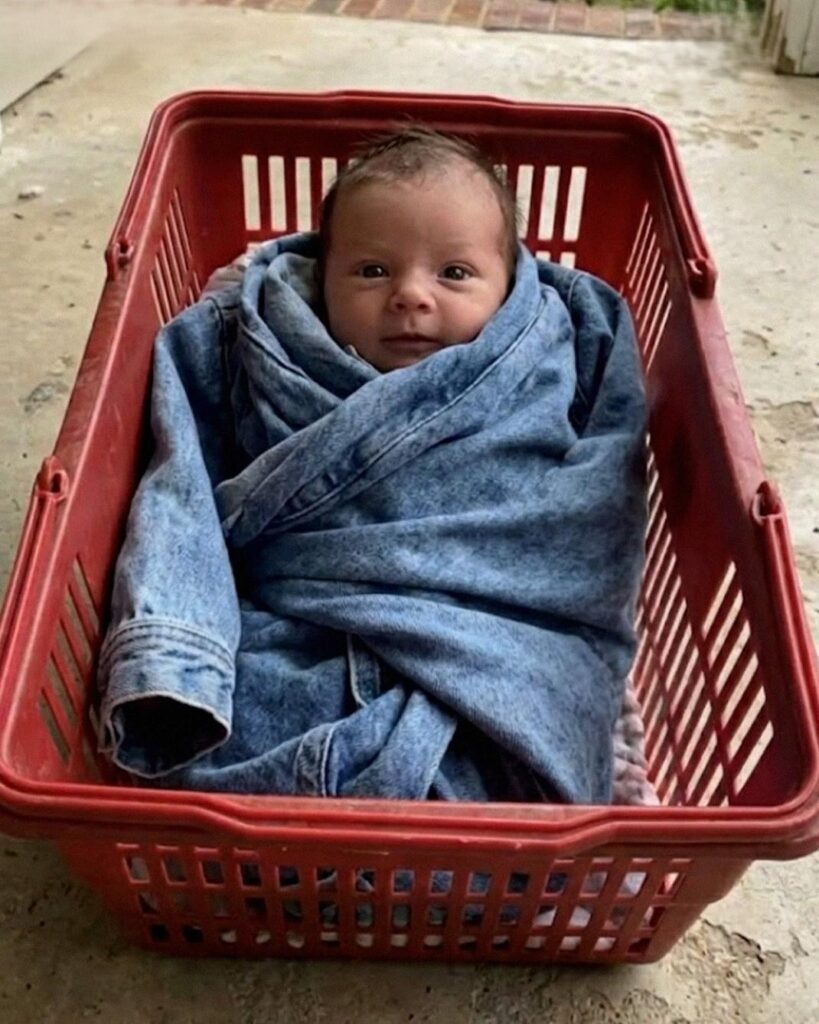
I opened the door with my coffee still in hand, expecting a delivery or a mistake. Instead, there was a baby on my porch.
A real baby. Small, blinking, wrapped tightly in a faded denim jacket I recognized before I even allowed myself to think.
For a second, my body forgot how to move. The coffee slipped from my hand, spilling across the floor as I crouched down, my fingers trembling when I touched her cheek. Warm. Alive. Breathing.
The jacket pulled the memory straight through me.
I had bought it for Jennifer when she was fifteen. She’d teased me about it—said it couldn’t be vintage if it still smelled like someone else’s perfume. The cuff was still frayed in the same place she used to chew when she was anxious.
Five years. Five years since she vanished at sixteen without a trace.
And now a baby sat in my kitchen wearing her jacket.
Inside the basket, everything was too careful to be careless—formula, clean clothes, wipes. This wasn’t abandonment. This was intention.
The note confirmed it.
“This is Hope. She’s Jennifer’s daughter. She’s mine too… There are things you don’t know. Things Paul kept from you.”
My hands shook so badly I could barely hold the paper.
For years, I had lived with silence. No answers. No leads. Just grief that hardened into something dull and constant. Paul had turned that silence into blame—first quietly, then publicly—until I began to believe I had failed my own child.
And now, suddenly, there was proof she had lived.
Not just lived—loved, built something, carried a life of her own.
I called him.
When he walked into the kitchen and saw the jacket, everything in his face collapsed. That was the moment I knew the truth wasn’t new—it had just been hidden.
He admitted it slowly, like each word cost him something.
“She called me once.”
Once. That was all it took to destroy the version of reality I had been forced to accept for five years. She had been alive. She had reached out. And he had chosen silence.
Not to protect her. Not to protect me.
To control the outcome.
He had told her to come back alone or not at all.
And when she didn’t return, he let me believe she was gone forever.
That kind of cruelty doesn’t shout. It settles into decisions that look reasonable from the outside and devastating from within.
The baby in my arms cried softly, and instinct took over where words failed. I held her, rocked her, grounded myself in something real.
Because for the first time in five years, I wasn’t holding grief.
I was holding what Jennifer had left behind.
At the clinic, the doctor said Hope was healthy, just small. A social worker helped me with emergency paperwork, asking if I had support.
I almost laughed.
Support had been something I learned to live without.
But by the afternoon, I understood something had shifted. I wasn’t alone anymore—not in the way I had been before.
When Andy walked into the diner, I recognized him immediately, not from memory but from the weight he carried. Grief has a way of reshaping people, making them look unfinished.
He didn’t come in with excuses. Just truth.
Jennifer had wanted to come home. More than once. But she believed her father’s words—that staying away was the only way to protect me from disappointment, from conflict, from her choices.
That lie had cost us five years.
And then came the part I hadn’t prepared for.
She was gone.
Complications after giving birth. Sudden, final, irreversible.
The kind of loss that doesn’t come with warning or time to make peace.
I sat there, hearing it, feeling something inside me fracture and settle at the same time. Because grief had returned—but it wasn’t empty anymore. It had shape. It had truth. It had a beginning and an end.
And it had Hope.
Andy didn’t leave her out of carelessness. He left her because he was breaking. Because exhaustion and fear had caught up to him. Because love, sometimes, means knowing when you need help.
“I waited across the street,” he said. “I didn’t leave until I saw you take her.”
That mattered.
Later, when Paul stood in the driveway, shouting, blaming, trying to reclaim control over something he had already destroyed, it didn’t land the same way anymore.
Because I finally understood.
Jennifer hadn’t disappeared.
She had been pushed out of a life that refused to make space for her choices.
“She was somewhere your pride couldn’t follow,” I told him.
And for once, he had nothing left to say.
That night, in the quiet kitchen, I watched Andy hold Hope while I warmed a bottle. He looked uncertain, exhausted—but present.
That mattered too.
Jennifer didn’t come home the way I had prayed she would.
But she had found a way back to me anyway.
Not with explanations. Not with apologies.
With a child who carried her forward.
And for the first time in years, the house didn’t feel empty.