
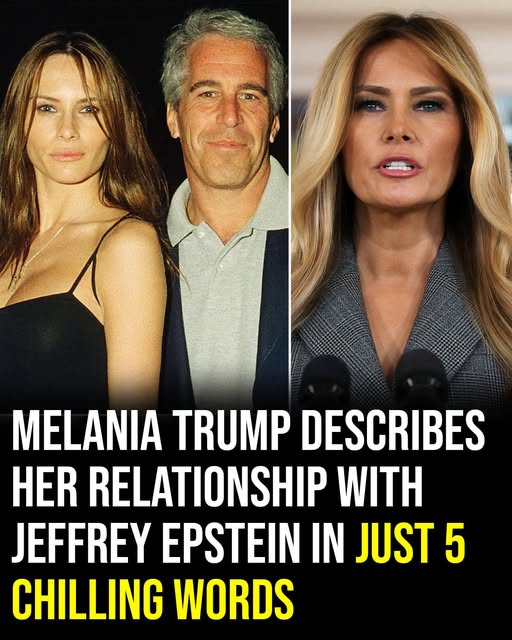
…ce, a resurfaced email to Ghislaine Maxwell, and a collection of old photographs have been weaponized by digital sleuths, creating a narrative that Melania Trump has finally decided to dismantle. Her statement was not merely a rebuttal; it was a calculated, forceful reclamation of her own identity. By addressing the rumors head-on, she shifted the power dynamic, moving from a passive subject of tabloid conjecture to an active architect of her own defense.
The timing of this announcement is far from coincidental. In the high-pressure cooker of Washington politics, where every association is scrutinized and every past interaction is magnified, the reappearance of these documents served as a catalyst. Her team framed the moment as a necessary intervention—a line drawn in the sand against a tide of misinformation that had, in her view, crossed the threshold from political criticism into personal defamation.
Yet, the very act of speaking out has inevitably invited a new wave of scrutiny. In the court of public opinion, silence is often interpreted as guilt, but a sudden, sharp denial is frequently met with the question: Why now? Critics and supporters alike are left to wonder if this was a preemptive strike against future revelations or a genuine refusal to let the ghosts of the past dictate her present narrative. The internet, a place where nuance goes to die, has predictably erupted, with some viewing her words as a definitive clearing of the air, while others see them as a desperate attempt to bury a ghost that refuses to stay in the grave.
Despite the noise, there remains a stark, objective reality that often gets lost in the fervor of the investigation: no evidence has ever surfaced to implicate Melania Trump in any of Epstein’s heinous crimes. She was never his victim, nor was she a participant in his inner circle. Her life, marked by intense privacy and the scrutiny of the global stage, has been subjected to a level of forensic examination that few could withstand. By demanding an end to the rumors, she is asserting a fundamental right to be judged by her own actions rather than the company she may have inadvertently kept in the periphery of a high-society life.
Ultimately, this moment is a testament to the burden of public life. It is a reminder that even those at the pinnacle of power are not immune to the corrosive effects of rumor. Whether this statement succeeds in silencing the critics remains to be seen, but it has undeniably achieved one thing: it has forced the conversation out of the shadows and into the light, where the truth—however mundane or complex—can finally be measured against the weight of the evidence.