What I Thought Needed Watching — And What Actually Needed Care
After my wife Seraphina died, the house didn’t feel like a home anymore. It felt preserved—too clean, too quiet, like everything meaningful had been paused. I was left with our newborn twins, Leo and Noah, and a kind of grief that doesn’t announce itself but changes how you see everything.
So I tried to control what I could.
I installed cameras. Everywhere. Twenty-six of them.
It felt like protection.
In truth, it was fear with resources.
When Doubt Finds a Voice
Beatrice, my sister-in-law, stayed close in those early days. Her words sounded like concern, but they carried a direction—what the boys needed, what I might not be able to give.
When Elena came to help, Beatrice was quick to question her. Said she was lazy. Said something wasn’t right.
And I listened.
Because listening to doubt is easier when you already feel unsure of yourself.
So I watched. Quietly. Waiting to confirm what I had been told.
What the Silence Revealed
For two weeks, I avoided the footage.
Then one night, I opened it.
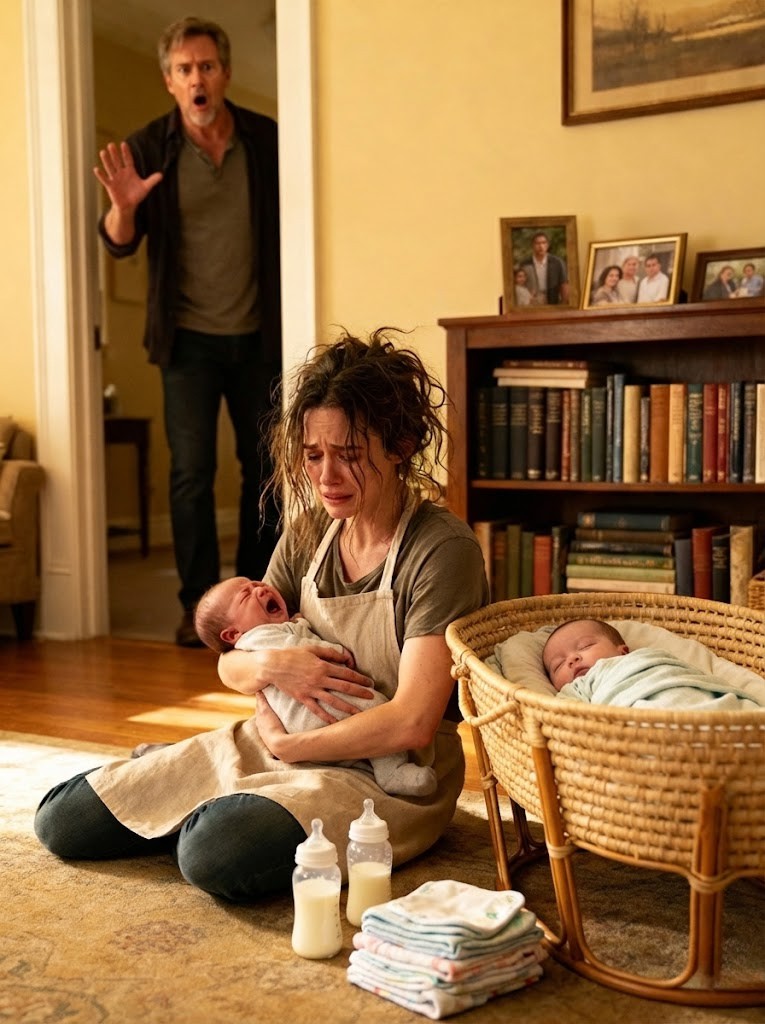
The nursery camera showed Elena sitting on the floor between the cribs, holding Leo. Not distracted. Not careless. Just present in a way that doesn’t draw attention to itself.
She was humming.
A simple melody.
One I recognized immediately.
Seraphina used to hum it in the hospital, when things felt uncertain and fragile.
That wasn’t something you guess.
It’s something you remember because you were there.
And in that moment, something shifted—not outside, but in me.
I had been looking for failure.
What I saw was care.
When the Shape Becomes Clear
Then another moment appeared.
Beatrice entered the room.
There was a confidence in how she moved—not loud, but certain.
Elena stood, calmly placing herself between her and the cribs. No panic. No raised voice.
Just clarity.
She told Beatrice to stop. Said she had been paying attention. That something wasn’t right, and she wouldn’t allow it to continue.
Beatrice dismissed her. Reduced her to a role. Assumed she wouldn’t be believed.
And that’s when I understood.
Not everything happening around me was grief.
Some of it was influence.
And I had let it shape what I saw.
Moving Without Delay
I went to the nursery.
Not to confront as someone in control—but as someone who had finally understood where he had been wrong.
I told Beatrice I had seen enough.
There was no argument after that.
Just a quiet shift in the room, like something had been uncovered that couldn’t be put back.
What Stayed
Afterward, I asked Elena about the song.
Her eyes filled, but she answered simply.
She had been in the hospital. Close enough to hear it. Close enough to remember.
That was all.
No claim. No expectation.
Just truth.
Letting Go of What Wasn’t Helping
Later, I sat on the same floor she had been sitting on, holding my sons.
The house felt different.
Not because it had changed—but because I had.
The cameras had given me visibility.
But they had also created distance.
And distance had almost made me miss what was right in front of me.
So I took them down.
Not because the world suddenly became safe.
But because I understood that protection isn’t always about watching more closely.
Sometimes, it’s about being present enough to see clearly without needing to look through something else.
Final Thought
Grief can blur things.
It can make you question your instincts, lean on the wrong voices, and look in the wrong direction.
But when clarity returns, even quietly, it brings responsibility with it.
To correct what was misunderstood.
To recognize what was overlooked.
And to protect what matters—not through control, but through presence.
In the end, what my sons needed wasn’t surveillance.
They needed a home that was awake.
{"post":98859,"page":1,"next":[{"id":98826,"title":"Greedy Ex Husband Takes Everything But Overlooks One Crucial Legal Detail","url":"https:\/\/new24.info\/98826"},{"id":98822,"title":"After battling cancer, a North Texas 9-year-old is on a mission to help other kids fight","url":"https:\/\/new24.info\/98822"},{"id":98820,"title":"Tiny Holes Near Human Ears Might Reveal Fascinating Ancient Evolutionary Secrets","url":"https:\/\/new24.info\/98820"},{"id":98809,"title":"Years After Learning My Son Wasn\u2019t Mine, He Showed Me the True Meaning of Family","url":"https:\/\/new24.info\/98809"},{"id":98806,"title":"What\u2019s Happening With Global Security? Here\u2019s the Latest","url":"https:\/\/new24.info\/98806"},{"id":98805,"title":"Warning signs you should never ignore on your skin","url":"https:\/\/new24.info\/98805"},{"id":98798,"title":"Viral Korea Attack Claim Debunked \u2014 What Really Happened","url":"https:\/\/new24.info\/98798"},{"id":98797,"title":"What Does a Blood Clot Feel Like? Experts Share Common Signs and Symptoms","url":"https:\/\/new24.info\/98797"},{"id":98796,"title":"Search Results for \u201cAircraft Incident Prompts Emergency Response\u2014Details Emerging-\u201d \u2013 SacForum","url":"https:\/\/new24.info\/98796"},{"id":98792,"title":"Pilot\u2019s 3-word message after Iran shot down F-15E revealed","url":"https:\/\/new24.info\/98792"},{"id":98786,"title":"Student \u0027burned alive\u0027 after being trapped by her Tesla","url":"https:\/\/new24.info\/98786"},{"id":98784,"title":"My inheritance came with a twist!","url":"https:\/\/new24.info\/98784"},{"id":98782,"title":"Pam Bondi speaks out as Donald Trump unexpectedly fires her as attorney general","url":"https:\/\/new24.info\/98782"},{"id":98780,"title":"Major Drug Bust Shakes Community \u2014 Families Feel Safer","url":"https:\/\/new24.info\/98780"}]}