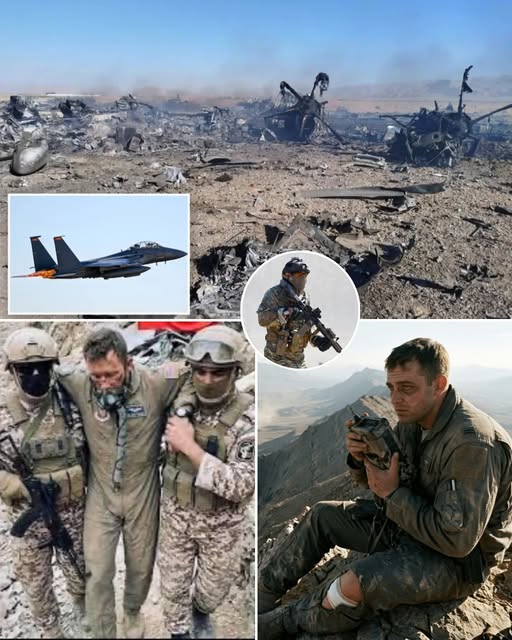
closed in from every direction, their boots scraping stone just yards below his position.
For thirty-six agonizing hours, he became part of the mountain itself. Freezing temperatures gnawed at his extremities while serious injuries—later described by U.S. officials as severe—threatened to betray him through involuntary gasps of pain or the slightest shift of gravel. Blood stained the rocks behind him, each drop a potential marker for trackers to follow. He pressed his palm against the worst of the wounds, applying pressure while his other hand gripped the handgun—not for offense, but as a final insurance against capture. Yet he did not move. Not when the wind shifted and carried the guttural commands of Iranian fighters sweeping the terrain. Not when the silence was broken by the crunch of boots on scree, growing louder, then fading, then returning with methodical persistence. Sleep was impossible; hallucination was the enemy. He counted heartbeats to stay present, focusing on the rhythm of survival rather than the symphony of pain radiating from his chest.
The psychological warfare was as brutal as the physical. Every sound could be the one that ended him: a dislodged pebble, a cough suppressed too late, the metallic click of his own weapon. But somewhere in that frozen hell, with hypothermia setting in and consciousness flickering, he activated an emergency beacon. The signal cut through hostile airspace to American command, yet salvation brought its own terror. Trump and his advisors initially feared the transmission might be a trap, a sophisticated lure to draw more U.S. forces into an ambush. To prove he was still alive and truly alone, the colonel transmitted a cryptic message over his radio: “God is good.” The phrase, phonetically echoing the Islamic “Allahu Akbar,” was calculated misdirection—a whisper that might confuse listeners, buy precious seconds, and keep him breathing in the shadows.
While he clung to life in the crevice, the CIA orchestrated a masterful deception that turned the hunter into the hunted. They planted false intelligence suggesting the airman had already been captured and was being spirited out of Iran in a vehicle convoy. The ruse worked, pulling searchers away from the mountain and toward phantom targets on distant roads, creating breathing room where none had existed. Meanwhile, military officials tracked his equipment to the exact coordinates of his rocky sanctuary, confirming what the beacon suggested: one American still held the high ground against impossible odds, his body broken but his spirit unyielding.
When the extraction finally came, it arrived with thunderous resolve. In broad daylight—defying every instinct to hide—dozens of aircraft filled the sky, establishing a protective perimeter two miles wide. MQ-9 Reaper drones circled like angry hornets, striking any hostile force that dared approach with lethal precision. On the ground, one hundred Special Operations forces descended, led by SEAL Team 6 with Delta Force commandos and Army Rangers standing ready in reserve. The colonel heard the rotors before he saw them, a distant thumping that grew into a hurricane of sound and salvation. He emerged from the crevice not as a victim, but as a warrior who had held the line alone, his uniform torn, his face hollow with exhaustion, but his eyes still sharp with awareness.
The complexity of the rescue was staggering: during the operation, two aircraft became stuck south of Isfahan, forcing commanders to dispatch three additional aircraft to rescue the stranded forces and destroy the trapped vehicles with explosives lest they fall into enemy hands. Flown immediately to Kuwait for medical treatment, the airman carried with him the knowledge that he had faced the abyss and chosen to climb rather than surrender. Days later, as the nation celebrated his return, Defense Secretary Pete Hegseth posted the same three words that had saved the colonel’s life: “God is good.” In the Oval Office, the President recounted how those words had sounded like something a Muslim fighter might say, a final layer of camouflage in a survival story that defied every odd. Three simple words, spoken in darkness, that had turned the tide and brought him home.