
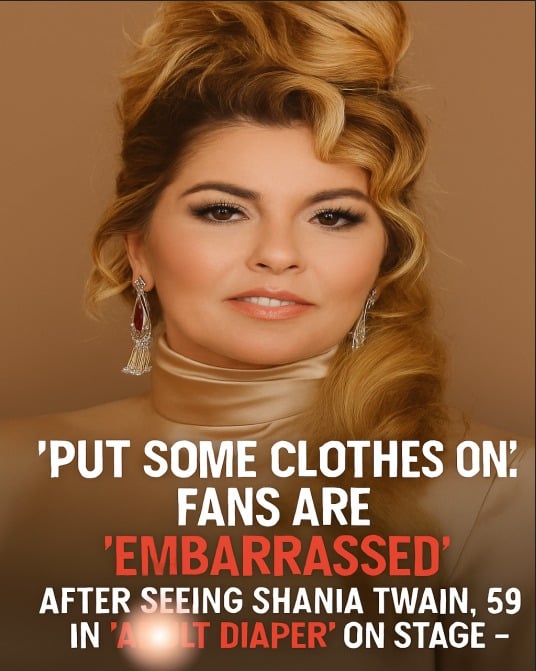
Shania Twain returned to the stage in Las Vegas and, within hours, found herself at the center of a familiar kind of modern spotlight—one shaped less by performance and more by reaction.
It wasn’t her voice or her catalog of hits that sparked the conversation this time. It was her outfit.
Clips of the 59-year-old artist wearing a metallic, form-fitting bodysuit spread rapidly across social media, triggering a wave of commentary. Some praised the look as bold and expressive. Others criticized it as excessive or inappropriate. What began as a stage costume quickly became a broader debate—about age, image, and who defines the boundaries of self-expression.
On stage, however, the intention seemed clear. The outfit was designed for performance: reflective textures, layered styling, and visual impact that aligned with the scale and energy of a Las Vegas residency. It was not subtle, nor was it meant to be. It was part of a production built on presence, movement, and spectacle.
The reaction revealed a deeper divide. Critics framed the look through expectations tied to age, suggesting limits on how performers—particularly women—should present themselves over time. Supporters, on the other hand, interpreted it differently: as a deliberate refusal to conform to those expectations. They pointed to her stage presence, endurance, and continued relevance as evidence that performance is not defined by age, but by ability and intent.
In that sense, the discussion moved beyond fashion. It became a reflection of how audiences interpret visibility. Public figures, especially those with long careers, often carry layered expectations—about how they should evolve, what they should represent, and when they should step back.
Twain’s appearance challenged some of those assumptions. Not through statements, but through action—by continuing to perform at a high level and choosing how she presents herself without apparent hesitation.
The intensity of the online response highlights how quickly individual moments can become symbolic. A single outfit, viewed through millions of screens, turns into a broader conversation shaped by personal values, cultural norms, and generational perspectives.
In the end, the moment says as much about the audience as it does about the artist. It reflects an ongoing negotiation between expectation and expression—one that continues to evolve every time someone steps into the spotlight and chooses not to follow a script.