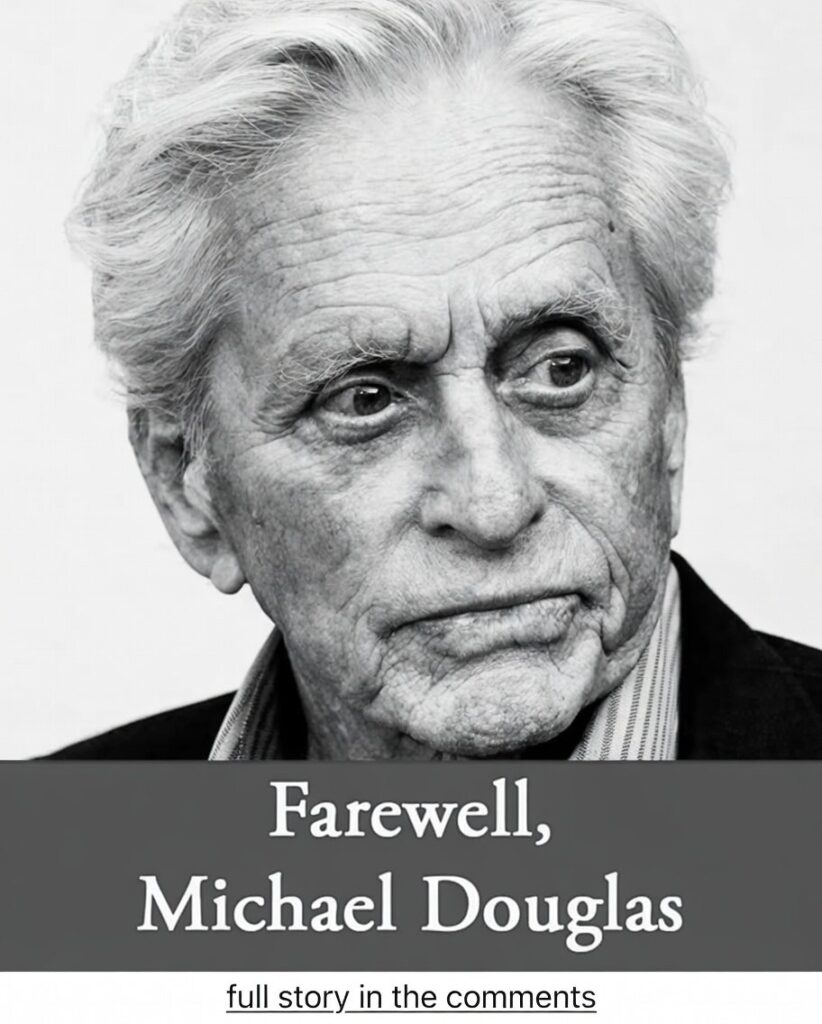
he chose to step away from acting—not through a public announcement or formal farewell, but in a private conversation with the people closest to him. It was a moment less about ending a career and more about redefining what the next chapter should look like.
For generations, Douglas has been a defining presence in film. From early breakout roles to award-winning performances and influential work behind the camera, he built a reputation grounded in consistency, range, and longevity. His career reflected not only talent, but an ability to remain relevant across changing eras in Hollywood.
Yet alongside that public success, his personal life followed a quieter priority. His marriage to Catherine Zeta-Jones, which began in 2000, became a central anchor. Together, they built a family environment that balanced public visibility with private stability. As their children grew—and later, as grandchildren became part of daily life—that focus only deepened.
In recent years, that balance began to shift. The physical demands of long filming schedules, combined with the natural realities of aging, made the pace of the industry more difficult to sustain. Rather than waiting for circumstances to dictate the change, Douglas chose to make a deliberate decision. He began to consider not only what he had accomplished, but how he wanted to spend the time ahead.
This transition was not only emotional, but practical. Reports indicate he had already taken steps to organize his personal affairs—ensuring that financial planning, property matters, and legal documents were in place to provide clarity and security for his family. These preparations reflect a broader perspective: that stepping back from one role often involves strengthening others.
The defining moment came during a family gathering, where the decision moved from internal reflection to shared understanding. It was less about leaving something behind and more about choosing where to be fully present. For Douglas, that meant prioritizing his role within the family over the demands of continued production work.
He also shared a personal message with his grandchildren—focusing on values that extend beyond professional achievement. The emphasis was not on fame or recognition, but on purpose, relationships, and the impact one leaves on others. It was a continuation of a theme that had quietly run alongside his public career: that legacy is shaped as much by personal conduct as by professional success.
The response has been twofold. For audiences, it marks the gradual closing of a long and influential chapter in film history. For his family, it represents a shift toward greater presence and shared time. While the industry may reflect on his body of work, those closest to him are preparing for a different kind of continuity—one rooted in daily life rather than public performance.
Douglas’s decision highlights a broader reality faced by many individuals at later stages of life. The question is not only what has been achieved, but how the remaining time is used. In stepping away, he is not distancing himself from his legacy, but placing it in context—recognizing that what comes next can carry equal, if not greater, significance.
As he transitions into this new phase, his focus becomes clearer: not the roles that defined his career, but the relationships that define his life.
{"post":98225,"page":2,"next":[{"id":98222,"title":"Sarah Palin was crushed after her 27-year role model marriage ended by email, now she is found love again","url":"https:\/\/new24.info\/98222"},{"id":98219,"title":"Star of Channel 4\u2019s The Hunt rushed to hospital after suffering 17","url":"https:\/\/new24.info\/98219"},{"id":98216,"title":"Big Family News from the Trump Household","url":"https:\/\/new24.info\/98216"},{"id":98180,"title":"Price per pack of cigarettes: tax, margin and increase","url":"https:\/\/new24.info\/98180"},{"id":98175,"title":"Swollen Feet: Common Causes, Warning Signs, and When to Seek Medical Advice","url":"https:\/\/new24.info\/98175"},{"id":98170,"title":"This woman was caught having \u2013 See! More!","url":"https:\/\/new24.info\/98170"},{"id":98167,"title":"Terrible Car Crash Involving My 19-Year-Old Son \u2014 The Passenger Revealed a Shocking Twist","url":"https:\/\/new24.info\/98167"},{"id":98164,"title":"Donald Trump has come under criticism after a social media post about rising tensions with Iran sparked attention\u2014not just for its message, but for noticeable writing errors.","url":"https:\/\/new24.info\/98164"},{"id":98161,"title":"A passenger who survived a tragic Air Canada incident has spoken publicly about the terrifying experience, describing how the pilots\u2019 actions may have prevented a far greater loss of life.","url":"https:\/\/new24.info\/98161"},{"id":98158,"title":"Heartbroken Mother Waits For Children Until Police Officer Delivers Shocking News","url":"https:\/\/new24.info\/98158"},{"id":98155,"title":"Digging In My Deceased Neighbors Yard Revealed A Hidden Forty Year Secret","url":"https:\/\/new24.info\/98155"},{"id":98152,"title":"Cruel Stepmother Changes Beach House Locks Before Discovering My Secret Trust","url":"https:\/\/new24.info\/98152"},{"id":98149,"title":"My Unfaithful Husband Took His Secretary On Vacation And Lost Our Penthouse","url":"https:\/\/new24.info\/98149"},{"id":98145,"title":"I thought my husband died \u2014 then, 3 years later, he moved into the apartment next door with ANOTHER WOMAN AND A CHILD.","url":"https:\/\/new24.info\/98145"},{"id":98140,"title":"Gone Before His Second Act","url":"https:\/\/new24.info\/98140"},{"id":98136,"title":"Selling An Old Family Necklace Revealed My True Hidden Identity","url":"https:\/\/new24.info\/98136"},{"id":98133,"title":"Mother Discovers Her Missing Triplets Working At A Local Farmers Market","url":"https:\/\/new24.info\/98133"},{"id":98127,"title":"Calling My Sister A Nobody Haunted Me After Discovering Her Heartbreaking Secret","url":"https:\/\/new24.info\/98127"},{"id":98124,"title":"With Love and Respect: Honoring a Beloved Icon\u2019s Legacy","url":"https:\/\/new24.info\/98124"},{"id":98118,"title":"Retired Military Pilot Rescues Commercial Flight From A Midair Hijacking","url":"https:\/\/new24.info\/98118"}]}