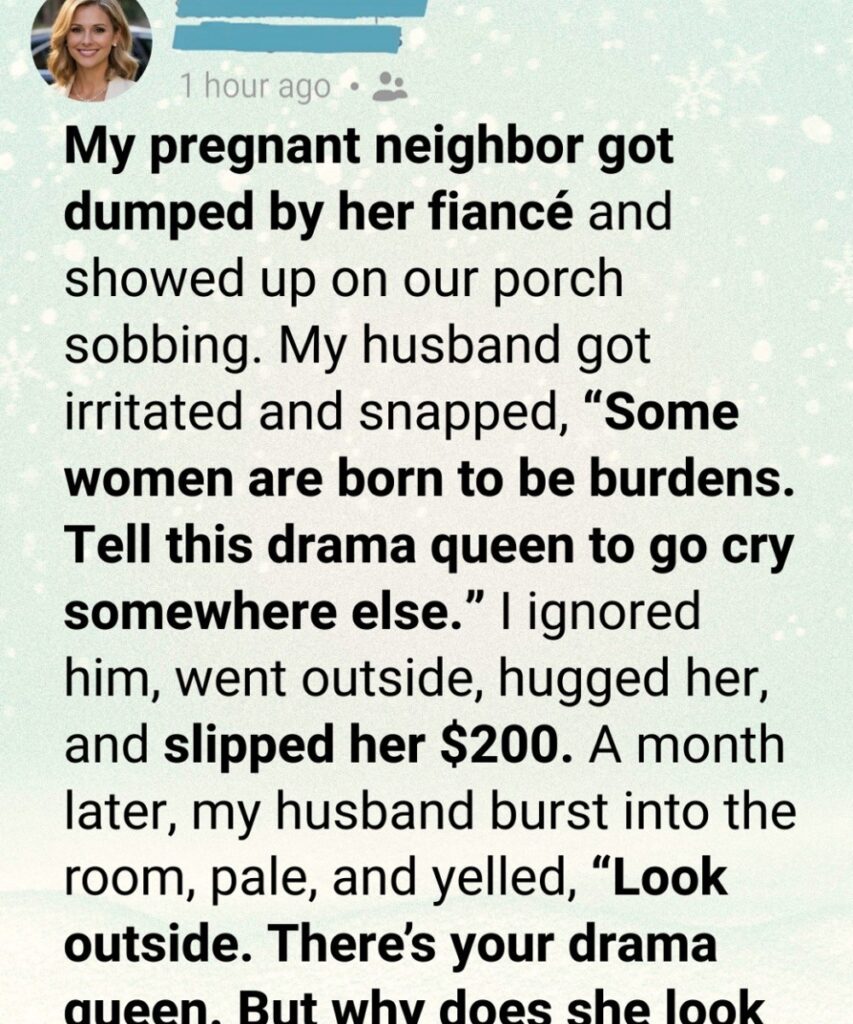
My pregnant neighbor from two houses down arrived on my porch just after sunset. She held the railing as if it were the only thing keeping her upright, one hand wrapped protectively around her belly. Her face was flushed from crying, and when she reached me, she didn’t say much at first—she simply collapsed into my arms, exhausted from holding herself together for too long.
I helped her sit on the bench and stayed close while she gathered her breath. Slowly, the words came. Her fiancé had packed his things that afternoon, told her the baby no longer fit into his plans, and left. Just like that. No family nearby, no one to call—only the sight of a lit porch in the growing dark.
Inside, my husband made his presence known with a sharp sigh. He didn’t try to understand the moment. He called her a burden and told her to take her tears elsewhere. His words landed harder than he seemed to realize. Not because they were loud, but because they were empty of care.
I asked him, quietly but firmly, to go inside. He did, though not without irritation. The door closed, and the silence that followed felt more honest.
I stayed with her.
She spoke about fear—not in dramatic terms, but in the quiet, real way it shows up when the future suddenly loses its shape. I didn’t try to fix anything. I just listened. Sometimes that is the only thing that does not fail.
Before she left, I pressed two hundred dollars into her hand. It was money meant for groceries, not easily replaced. But in that moment, it felt more misplaced in my wallet than in her hands. She hesitated, then accepted it with a kind of relief that didn’t need many words.
Life moved on, as it tends to do. But some moments don’t pass—they settle.
About a month later, on a calm Saturday morning, my husband came into the room, unusually unsettled. Outside, a sleek black car waited in front of our house. A driver stood by the door.
She stepped out.
The same woman—but not the same state. Composed, steady, dressed with quiet elegance. Not transformed into someone else, but returned to herself.
She came to the door and thanked me—not in an exaggerated way, but with a sincerity that carried weight. She handed back the same two hundred dollars. Then, after a pause, she explained: she had never been without means. But that night, she had been without support. And that is what she had needed.
From her bag, she took out a small velvet box and placed it in my hands. Inside was a necklace—beautiful, yes—but more than that, it was intentional. A gesture, not of repayment, but of recognition.
Before leaving, she said her door was open to me, anytime.
When the car pulled away, the street returned to its ordinary stillness.
Inside, my husband laughed. He found the situation amusing—almost foolish, as if kindness only makes sense when it’s calculated.
But something in me had already gone quiet.
Not angry. Not reactive. Just clear.
There are moments when you don’t argue, don’t explain, don’t defend. You simply see.
And once you truly see, something begins to separate—without noise, without drama, but with certainty.
For the first time, I allowed myself to consider that a life can be shared… yet not aligned. And that staying, just because you have stayed, is not always the same as choosing wisely.