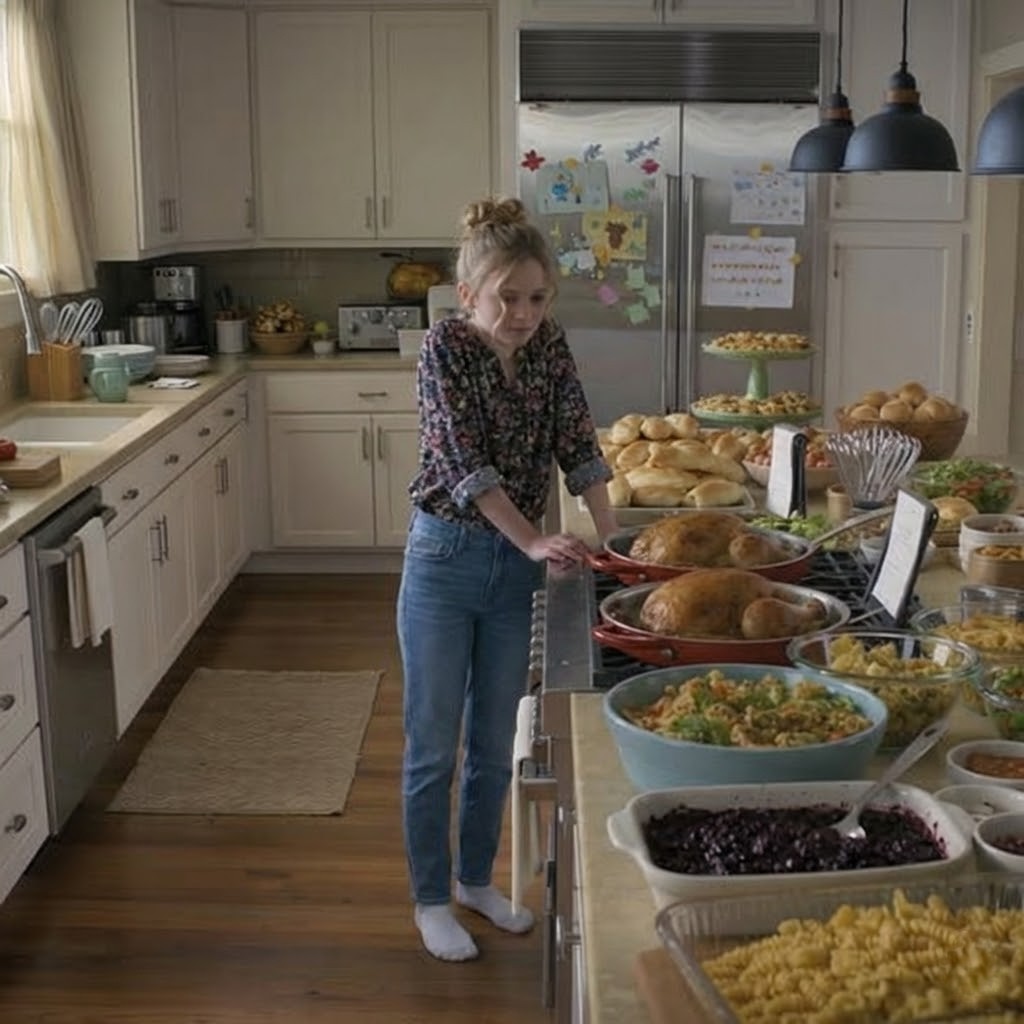
My name is Rachel Morgan, and something shifted inside me last weekend in a way I’m still trying to understand. My daughter Emily is seventeen, quiet and thoughtful, the kind of person who expresses herself most honestly through food. When my mother’s seventieth birthday approached, Emily insisted on preparing the entire meal herself for twenty-three guests—not just a dish or two, but the whole table. I told her it was far too much work and that she didn’t owe anyone that level of effort. She only smiled and said she wanted Grandma to feel special. For three days the kitchen became her universe—dough resting on towels, pots simmering late into the night, handwritten recipes scattered everywhere. She slept in short stretches on the couch, waking again to keep cooking.
By Saturday afternoon the house carried the comforting scent of hours of care and patience. Emily was carefully arranging trays, and the pride in her eyes tightened something in my chest. Then, at 4:12 p.m., my phone buzzed with a message from my father. He said they had decided to celebrate at a restaurant instead, and that it would be adults only. I read the message over and over, feeling heat rise to my face. It didn’t feel like a change of plans—it felt like a door quietly closing. When I told Emily, she went still. She took the phone from my hand and read the message once, her shoulders sinking as she looked around at everything she had made with nowhere to bring it. She didn’t cry. She simply asked, in a small voice, why they would do that. I didn’t have an answer that wouldn’t hurt more. I hugged her and promised that none of her work would be wasted, though inside I felt something deeper breaking—the hope that my parents knew how to love her the way she deserved.
That evening, while my parents were dining at their restaurant, we opened our own doors instead. I posted in a local community group offering a free homemade meal to anyone who might need one. Within an hour people began arriving—elderly neighbors, tired parents, strangers carrying quiet exhaustion in their eyes. Emily served every plate herself. At first she was shy, but with each thank-you and each compliment about the food, she seemed to stand a little straighter. Bit by bit, the pride that had faded returned. Watching her that night, I realized our kitchen had transformed from a place of disappointment into something meaningful. We had created a celebration far richer than the one my parents had chosen to attend.
The next morning my parents appeared at our door, angry—not because Emily had been hurt, but because the situation had made them look bad. My mother walked in criticizing the idea of feeding strangers and posting online, while my father hovered behind her trying to calm the situation. In that moment something inside me settled into clarity. When my mother dismissed Emily as just a child who would eventually forget, I saw plainly how easily she minimized my daughter’s feelings. I told them that the community had given Emily the appreciation they refused to offer, that respect was not optional, and that they would not be welcome back until they could treat her as a granddaughter rather than an inconvenience.
After they left, Emily asked quietly if everything had been her fault. I held her and told her it wasn’t, and that I was finished letting anyone decide whether she deserved to belong. In the days that followed, messages from neighbors continued to arrive praising her cooking. Emily began researching culinary schools with a new spark of hope. Eventually my father returned alone, offering a sincere apology and a small gift meant to support her future.
Through all of it, I came to understand something both painful and liberating: family can sometimes wound you, but it does not get to determine who your child becomes.