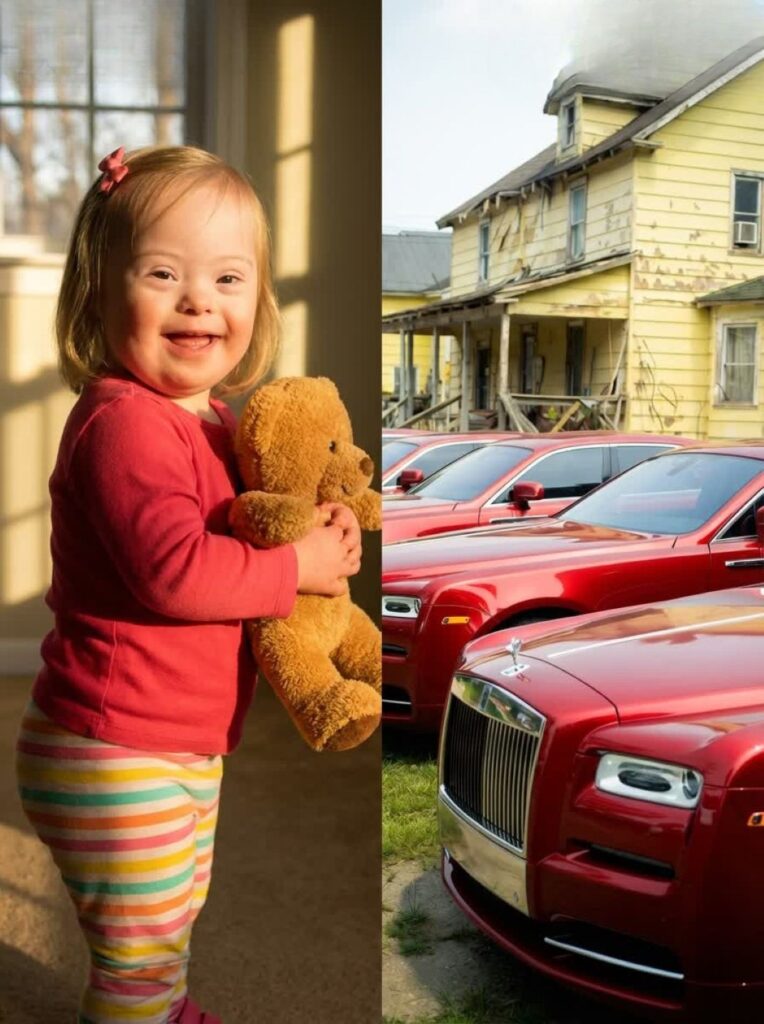
At seventy-three, I believed my life had already settled into its final chapter—a quiet widowhood in Illinois marked by afternoon tea, rescued animals, and the growing stillness of a house my children rarely visited. I was living beside grief more than truly living, until one Sunday morning at church when I overheard people speaking about a newborn girl with Down syndrome that no one wanted to adopt. In that moment, something inside me decided before my mind had time to calculate the practicalities. I brought her home and named her Clara, choosing to fill my silent rooms with life just when I thought my own purpose had already faded.
The decision created tension immediately, especially with my son, who could not understand why someone my age would take on such a responsibility. Yet the real shock arrived a week later when eleven black cars pulled up outside my small porch. Lawyers stepped out and revealed a truth none of us expected: Clara was the only heir to a vast fortune left behind by her wealthy biological parents. They described a future of grand houses and endless financial security. But as I held her close, I understood that marble halls and luxury were not the kind of shelter she truly needed. I refused the life they offered. Instead, I sold the assets and used the resources to create a foundation and an animal sanctuary—a place where abandoned animals and children like Clara could find safety and belonging.
The years that followed passed in a bright blur of laughter, painted walls, and muddy paws from the creatures we rescued. Clara grew beyond every doubt doctors once expressed. She became a joyful, confident young woman whose heart naturally gravitated toward caring for the animals at the sanctuary. There she met Evan, a gentle volunteer who shared her patience and kindness. When they married in our garden—surrounded by flowers, animals, and the people who had become our extended family—I realized that the absence of my biological children no longer had the power to wound me. My home was no longer quiet. It was alive with the love of a family we had created together.
Now my hair has turned silver and my steps have slowed, but each morning I sit on the porch and watch Clara and Evan moving through the sanctuary among the animals. The peace I feel now is deeper than anything I knew when I was younger. I have come to understand that the legacy we leave behind is not measured by wealth or comfort, but by the courage to offer love where others have turned away.
Choosing Clara did not only give her a home—it gave me purpose, community, and a life richer than anything I had imagined. And every day I am reminded that sometimes the most unexpected love is the very thing that changes everything.