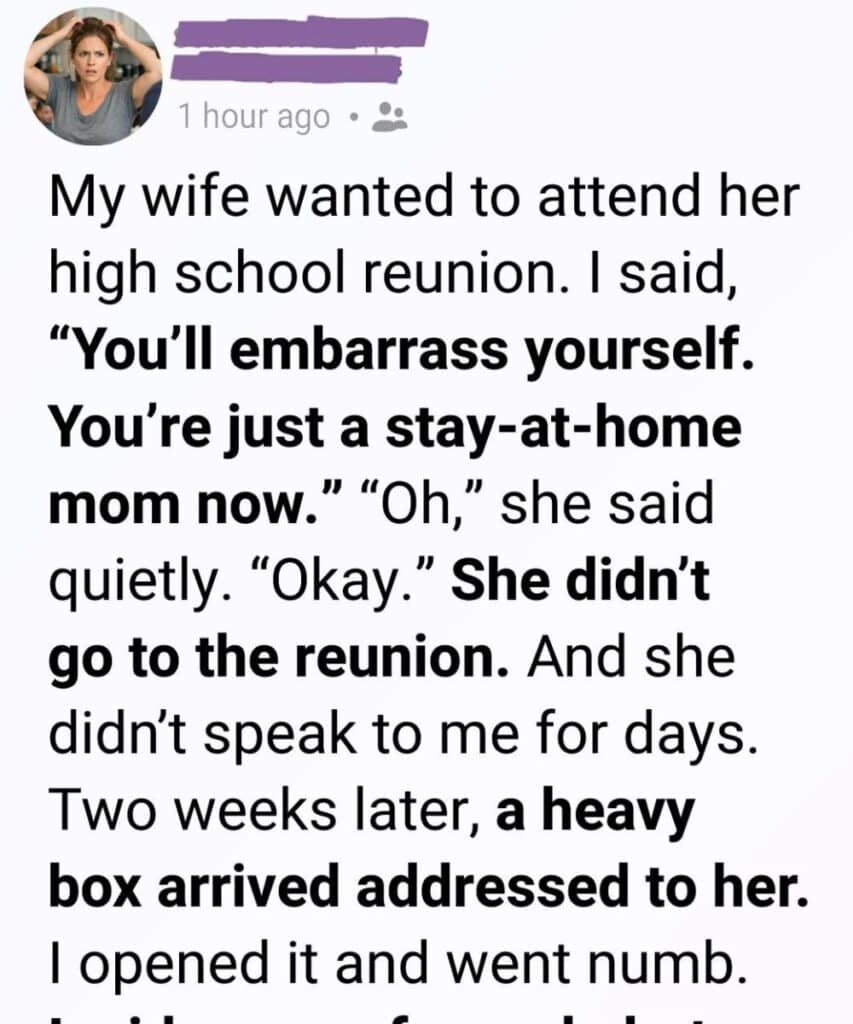
When Anna mentioned her high school reunion, I barely looked up.
The kitchen was loud — one child missing a shoe, another stuck on math homework, the baby drumming a spoon against the tray like he had somewhere important to be. It felt like our usual chaos. Full. Busy. Important in its own way.
“They’re doing a ten-year reunion next month,” she said, twisting her hair into that loose knot she ties when something matters more than she lets on. “I was thinking about going.”
I laughed.
“Why?” I asked.
She paused. “Why not?”
“So you can tell everyone you stay home with the kids all day?” I said. “Your friends are probably surgeons, lawyers, executives. What are you going to say? That you’re just a stay-at-home mom?”
The word landed heavier than I intended.
Just.
Her shoulders tightened. Her voice lowered. “Oh. Okay.”
No argument. No scene.
She didn’t go.
In the days that followed, she still ran the house like clockwork. Lunches appeared. Schedules flowed. Homework got done. But the warmth between us cooled. At night, she faced the wall. I told myself she was overreacting. I told myself I was being practical.
Then the box arrived.
Her name written neatly on top. No return address.
I opened it before she got home.
Inside was a framed photo of her graduating class — smiling faces, signatures written along the edges. On the back, a note:
We missed you. Maria told us what happened. Being a mom isn’t small — it’s massive. You’re raising three humans. That’s harder than any title we carry. Come next time. We’ll save you a seat.
Maria — the surgeon I had casually held up as a measure of “real success.”
I sat there longer than I expected.
Thinking about the nights Anna walked the floors with colicky babies so I could sleep before work. The birthday parties she organized with ridiculous precision. The tiny socks she matched. The endless patience she gave when no one was applauding.
I had taken something foundational and reduced it to a dismissive word.
When she came downstairs and saw the open box, she didn’t explode.
“You opened it,” she said quietly.
“I’m sorry,” I said. And I meant it in a way that felt uncomfortable and necessary. “What I said was careless. I forgot what actually keeps this family steady.”
She ran her fingers along the signatures.
“They didn’t forget me,” she whispered. “I thought they did.”
That sentence held more than pride. It held fear — the quiet fear of disappearing while serving everyone else.
“I won’t make you feel small again,” I told her.
She didn’t immediately smile. She didn’t rush to forgive. But she stepped closer. And that small movement felt like grace.
The photo hangs in our hallway now.
Not as proof that she could have been something else — but as proof that she never stopped being someone whole.
Next time there’s a reunion, I won’t make jokes.
I’ll make plans.
I’ll watch the kids. I’ll tell her to take her time. I’ll remind her that the work she does — unpaid, unseen, relentless — is not “just” anything.
Because respect isn’t about public titles.
It’s about recognizing the weight someone carries every day — and choosing never to belittle it again.