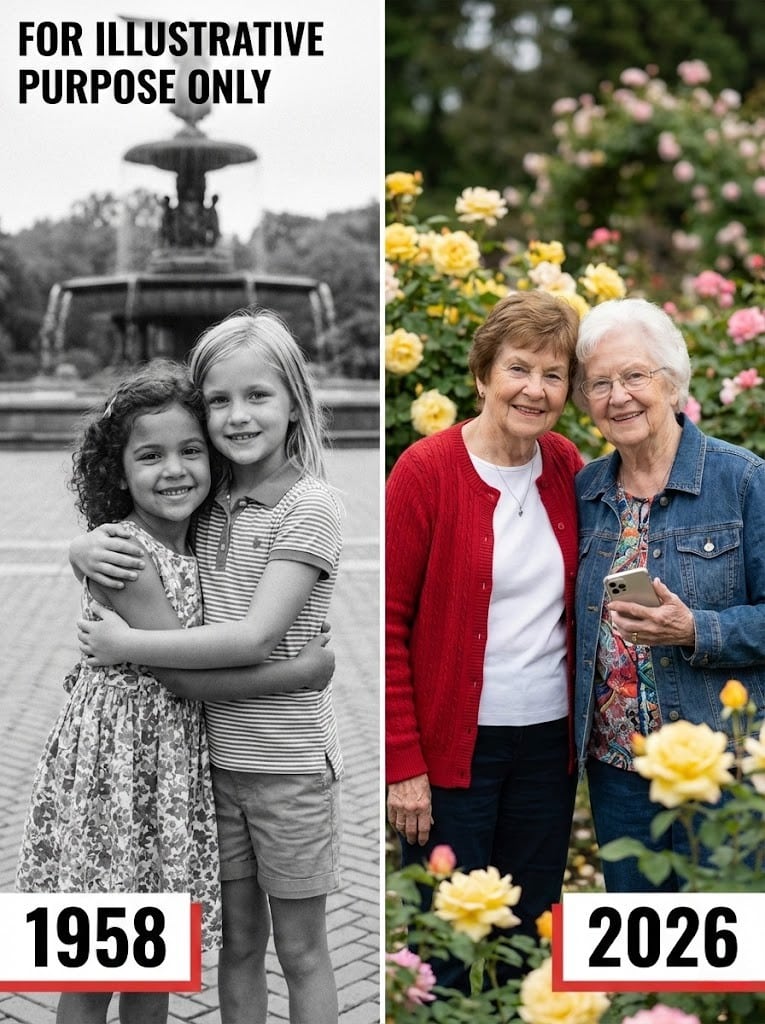
I am seventy-three years old, and my life has always carried the shape of someone missing.
When I was five, a fever kept me in bed at my grandmother’s house. My twin sister, Ella, was outside playing. At some point the house grew too quiet. By nightfall, police were searching the woods with flashlights. They found her red ball first. Later, they told my parents they had found her body.
There was no funeral. No grave. Her name disappeared from our home as if saying it might invite the loss all over again.
I learned early that grief was something to carry alone. When I asked questions, my mother closed herself off and said I was reopening wounds. So I stopped asking. I grew up careful, obedient, unfinished. Sometimes I set an extra plate at the table without realizing why.
I built a good life — a husband, children, years that passed as they should. Still, I often felt as though I was walking with only half of myself.
Then, years later, something shifted.
While visiting my granddaughter at college, I stopped at a small café. I heard a voice behind me that felt impossible. I turned and saw a woman who looked like my reflection — the same face, the same mannerisms, the same pause before speaking.
I approached her, shaken, and asked if her name was Ella.
She said no. Her name was Margaret. She told me she had been adopted.
We talked. Slowly. Carefully. Dates, places, fragments of memory. The similarities were too precise to dismiss.
When I returned home, I searched through old boxes my mother had kept untouched for decades. Inside was an adoption file dated five years before I was born. My mother had been young and unmarried. She had been made to give up her first child.
DNA confirmed what my heart already understood.
Margaret is my full older sister.
Ella was real.
Margaret was real.
And I was the one who stayed.
My mother had carried three daughters — one taken by circumstance, one lost to the woods, and one raised in silence. I do not tell this to accuse her. Fear and grief shaped her choices in ways she never learned how to name.
But silence has a cost.
Knowing the truth did not erase the pain of losing Ella. It did not undo a lifetime of wondering. What it gave me was something quieter and steadier: clarity.
I was never imagining the absence I felt.
There really was more love than I was allowed to know.
I am learning now — late, but honestly — that grief does not disappear when it is hidden. It only waits.
And sometimes, after a lifetime, it loosens its grip just enough to make room for truth.
I do not feel whole.
But I feel less alone.
And that, at this age, is a gift I did not know I would still be given.