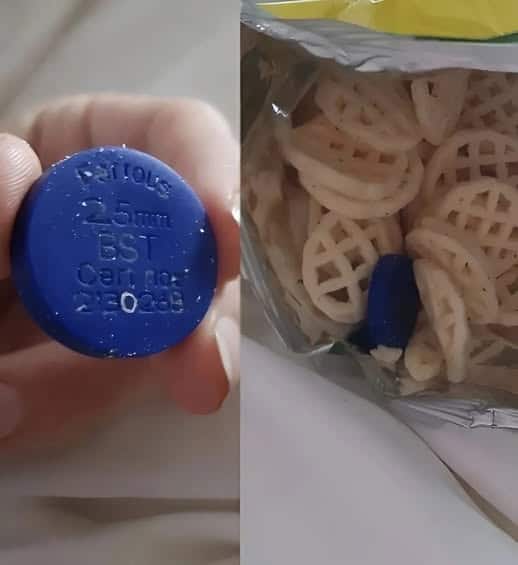
The familiar ritual of opening a snack bag rarely asks for attention. It’s a small, predictable comfort—salt, crunch, habit. For one family, though, a bag of sour cream chips disrupted that rhythm when a small blue disk appeared among the crisps. The object was unmistakably foreign, and the moment it surfaced, ease gave way to alertness. In a space where trust is assumed, its sudden breach triggered a natural instinct: stop, assess, protect.
Finding anything unexpected in packaged food unsettles for good reason. Modern consumers rely on invisible systems working correctly, and when something slips through, even briefly, it feels personal. The question wasn’t curiosity—it was safety.
Clarity came not through dismissal, but through investigation. After reaching out and consulting others, the object was identified as a HACCP validation device—part of a safety protocol used in food manufacturing. These small disks are intentionally run through production lines to confirm that metal detectors and X-ray systems are functioning properly. They are designed to be detected and rejected, ensuring that far more dangerous contaminants would never make it through unnoticed.
In this case, the system worked—but not perfectly. The test device was detected, yet one final step failed to divert the bag before it left the line. Rare, but possible. What appeared alarming at home was evidence of a safety mechanism doing most of its job.
“These objects are made to stand out, not to blend in,” the explanation went. Bright blue, food-grade plastic ensures visibility against almost any product. They function as internal audits—quiet checks that don’t rely on trust, but verification.
That doesn’t erase the discomfort of the moment. Discovering a piece of factory process in your food is jarring. It interrupts the assumption that safety is seamless. But it also reveals something else: how much effort is invested in preventing real harm. The safeguards are not symbolic. They are active, repetitive, and imperfect in the human way systems sometimes are.
The afternoon ended not with panic, but with understanding. The snack was discarded, the concern resolved, and the moment reframed. What first felt like a failure became a glimpse behind the curtain—a reminder that protection often works invisibly, and when it briefly shows itself, it deserves scrutiny, not denial.
Trust isn’t blind. It’s maintained by systems that are tested, questioned, and corrected. Even when a small blue disk slips through, the larger structure remains oriented toward care rather than neglect.