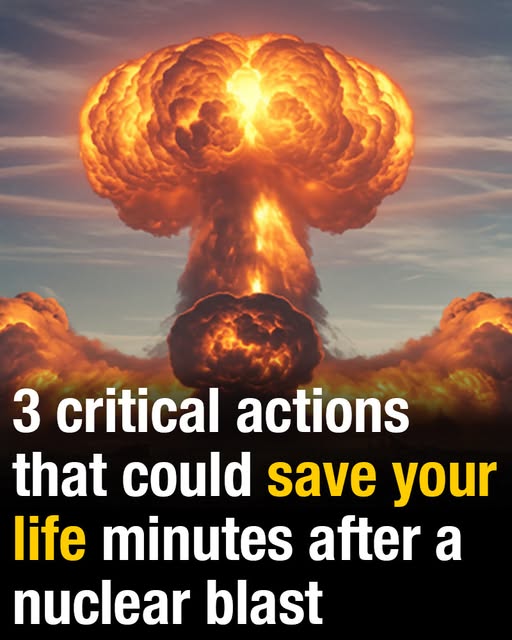
Understanding the Situation
In rare but high-impact emergencies, what matters most is not panic, but clarity. A nuclear event is extremely unlikely, yet knowing a few grounded steps can make a meaningful difference in how safely you respond.
This is not about fear—it’s about being prepared enough to act without hesitation if needed.
1. Avoid Looking at the Flash
A nuclear detonation produces an intense burst of light that can cause serious eye injury, even from a distance.
If you notice a sudden, unusually bright flash:
- Turn away immediately
- Shield your eyes with your hands or an object
- Drop down and seek cover
Windows are especially dangerous in these moments. The shockwave that follows can shatter glass, turning it into a hazard even indoors.
2. Get to Shelter Quickly
After the flash, a powerful shockwave may arrive within seconds.
The priority is simple: put solid barriers between you and the outside.
- Move into the nearest sturdy building
- Go to a basement if one is available
- If not, stay in the center of the structure, away from windows and exterior walls
Materials like concrete, brick, and earth provide better protection. The more layers between you and the outside, the safer you are.
3. Reduce Exposure and Stay Inside
Once you are sheltered, the next phase is about limiting exposure.
- Remove outer clothing to reduce contamination
- Wash exposed skin with clean water if possible
- Close windows, doors, and ventilation systems
Stay indoors for at least 24 hours, or until authorities confirm it is safe to leave. The period immediately after the event is the most sensitive.
Staying Grounded and Informed
In situations like this, reliable information matters more than speed.
Having basic supplies—water, non-perishable food, a flashlight, and a battery-powered radio—can help you remain steady while waiting for updates.
Follow official guidance from local authorities, and avoid acting on unverified information.
Final Thought
Preparation is not about expecting the worst.
It’s about reducing uncertainty if something unexpected happens.
When the situation is serious, the most effective response is often simple:
Act quickly.
Find shelter.
Stay where it’s safe until you’re guided otherwise.
Calm, informed decisions are what carry you through.
{"post":98909,"page":1,"next":[{"id":98889,"title":"My Teen Son Sold His Guitar to Buy a New Wheelchair for His Classmate \u2013 The Next Day, Officers Showed up at Our Door","url":"https:\/\/new24.info\/98889"},{"id":98887,"title":"CT scan: what it is, what it\u2019s used for, and why doctors are increasingly requesting it","url":"https:\/\/new24.info\/98887"},{"id":98878,"title":"Warning signs you should never ignore on your skin","url":"https:\/\/new24.info\/98878"},{"id":98871,"title":"Generous Son Protects Anniversary Seaside Home From Relatives Seeking Quick Profit","url":"https:\/\/new24.info\/98871"},{"id":98859,"title":"I Secretly Watched My Nanny to Catch Her Doing Nothing and What I Learned About My Family Broke Me","url":"https:\/\/new24.info\/98859"},{"id":98856,"title":"Mysterious Envelope Delivered At Funeral Reveals Decades Old Secret About Husband","url":"https:\/\/new24.info\/98856"},{"id":98845,"title":"In what\u2019s being described as an almost unbelievable survival story, a U.S. airman turned a devastating crash into a race against time in hostile terrain. Stranded high in the mountains, injured and alone, he managed to climb to a narrow rock crevice just moments before search teams began sweeping the area below. For the next 36 hours, he stayed completely still, hidden in freezing conditions as the sound of footsteps moved closer and closer. - Top News US UK","url":"https:\/\/new24.info\/98845"},{"id":98844,"title":"I Married My Friend\u0027s Wealthy Grandfather for His Inheritance \u2013 On Our Wedding Night, He Looked at Me and Said, \u0027Now That You\u0027re My Wife, I Can Finally Tell You the Truth\u0027","url":"https:\/\/new24.info\/98844"},{"id":98840,"title":"Tiger Woods\u0027 New Mugshot Sparks Concern over His Expression \u2014 Photo","url":"https:\/\/new24.info\/98840"},{"id":98837,"title":"Trapped Between Earth and Breath: A Story of Curiosity, Risk, and Survival -","url":"https:\/\/new24.info\/98837"},{"id":98831,"title":"How One Woman Turned A Sudden Separation Into A Major Financial Victory","url":"https:\/\/new24.info\/98831"},{"id":98826,"title":"Greedy Ex Husband Takes Everything But Overlooks One Crucial Legal Detail","url":"https:\/\/new24.info\/98826"},{"id":98822,"title":"After battling cancer, a North Texas 9-year-old is on a mission to help other kids fight","url":"https:\/\/new24.info\/98822"},{"id":98820,"title":"Tiny Holes Near Human Ears Might Reveal Fascinating Ancient Evolutionary Secrets","url":"https:\/\/new24.info\/98820"}]}