
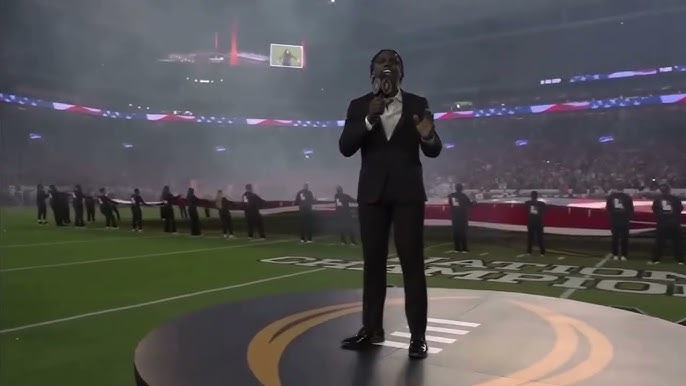
It was meant to be routine. Another pregame tradition. The championship crowd was already buzzing—every section on its feet, noise cascading from the upper decks, adrenaline peaking, phones raised, eyes fixed on kickoff.
Then Jamal Roberts stepped forward.
And in seconds, the atmosphere shifted.
The noise didn’t slowly die down—it vanished. As Roberts began the National Anthem, tens of thousands of fans fell into a silence so abrupt it felt almost tangible. Not the polite quiet expected before a big game, but a dense, electric stillness—the kind that makes you realize you’re sharing a moment far larger than football.
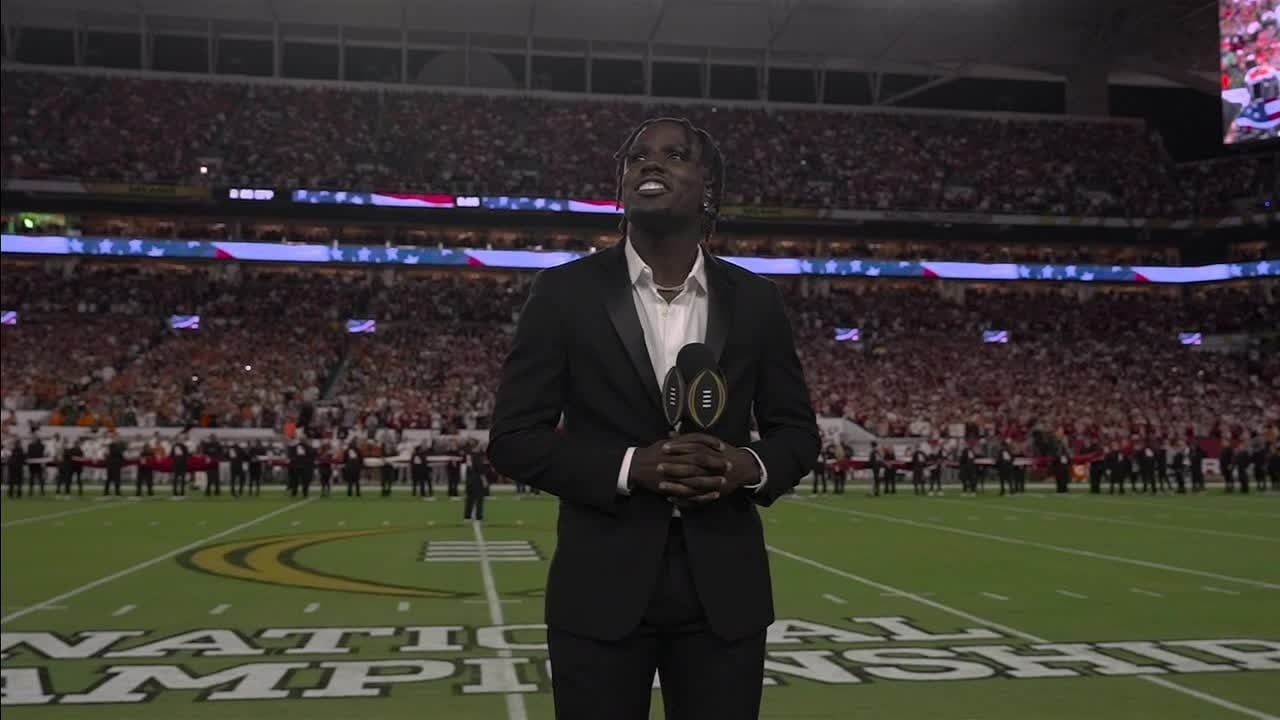
This wasn’t background ceremony.
This was commanding.
Roberts’ voice moved through the stadium with clarity and force—controlled, grounded, yet carrying a raw emotional edge. Every lyric landed with intention. Every pause lingered just long enough to pull the tension tighter. The emotion spread outward, seat by seat, like a single pulse moving through the crowd. Fans who moments earlier were screaming chants now stood motionless, hands on hearts, eyes locked forward.
What made it extraordinary, insiders say, was that none of it felt calculated. Roberts didn’t push the performance. He didn’t overreach. He trusted the song. He let it breathe. And that restraint—inside a stadium built for excess—made the moment hit even harder.
Cameras swept across the stands and captured what words struggled to explain. Hardened fans blinking away emotion. Players standing straighter, helmets tucked under their arms, visibly locked in. Even the sidelines—usually restless—were frozen. This wasn’t hype. This was weight.
For a brief stretch of time, the game itself felt secondary.
Online, the reaction was instant. Clips spread within minutes. Comments echoed the same disbelief: “I’ve never heard a stadium go that quiet.” Others called it haunting, spine-tingling, unforgettable. In an era crowded with spectacle, Roberts delivered something far rarer—an unfiltered sincerity that stopped people mid-scroll.
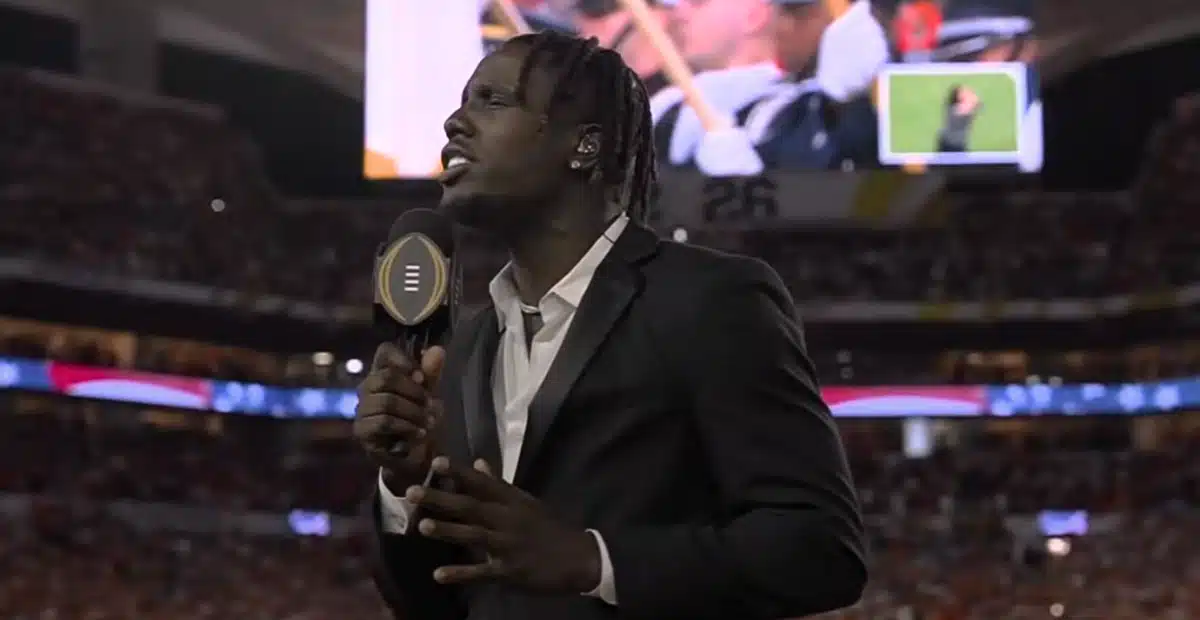
The setting only amplified it. Championship games are about dominance, volume, and spectacle. Yet here was a reminder that before competition, there’s shared identity, unity, and emotion. The sport didn’t disappear—it respectfully paused.
When the final note faded, there was a moment—just one heartbeat—where no one moved. No immediate cheers. No automatic applause. A collective second of processing what had just happened.
Then the stadium exploded—not in chaos, but in release.
Kickoff came. The game unfolded. The scoreboard would eventually decide a winner.
But the most powerful moment of the night had already passed.
Some performances start a game.
This one took hold of the entire stadium—and didn’t let go.