His face changed.
Melissa immediately looked away.
“What exactly is this?”
Brandon rubbed his jaw.
“It’s paperwork related to the estate.”
“No.”
I placed it back on the table.
“Tell me the truth.”
Silence.
Then Melissa finally said:
“A developer is interested in the land.”
My stomach tightened.
“What developer?”
“They want to build housing.”
I stared at her.
“You’re selling the orchard?”
“We’re considering it.”
“You don’t own the orchard.”
Brandon leaned forward.
“Mom, you’re seventy. How long are you realistically going to keep doing this?”
I couldn’t believe what I was hearing.
He continued.
“You’d be more comfortable somewhere else.”
“Where?”
Melissa answered quietly.
“A retirement community.”
I laughed.
Not because anything was funny.
Because the alternative was screaming.
“You’ve already picked one?”
Neither answered.
That told me enough.
The following morning, they arrived early.
Brandon had a suitcase.
My suitcase.
“What is that?”
“We’re going to drive into town,” he said.
“Why?”
“Just come with us.”
I should have refused.
But part of me was still thinking like their mother.
Part of me still believed there had to be an explanation that would make everything less cruel than it looked.
So I got into the car.
Melissa sat silently in the passenger seat.
Brandon drove.
Ten minutes later, I realized we weren’t heading toward town.
“Where are we going?”
No answer.
“Brandon.”
He finally pulled onto a quiet rural road.
Then he stopped.
My stomach turned.
“What are you doing?”
He looked straight ahead.
“Mom, you need to get out.”
I thought I had misheard him.
“What?”
“We can’t keep doing this.”
“Doing what?”
“Fighting.”
“You’re the one trying to sell my home.”
Melissa whispered:
“Please don’t make this harder.”
I looked at her.
“You’re telling your mother to get out of the car on the side of the road.”
She began crying.
But she didn’t stop him.
Brandon opened the trunk and placed my suitcase beside the shoulder.
Then he got back into the driver’s seat.
I stood there staring at them.
My son.
My daughter.
The children I had raised.
The children Nicholas would have crossed fire for.
Then the car pulled away.
For several seconds, I couldn’t move.
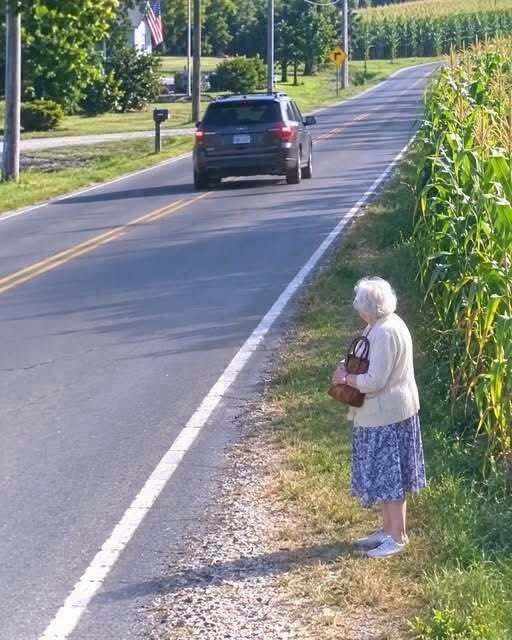
I was seventy years old, standing beside a suitcase on a country road, watching my children disappear.
Fortunately, Nicholas had taught me one habit I had sometimes teased him about.
“Always carry enough money to get yourself home.”
He kept emergency cash in his wallet.
He insisted I do the same.
That morning, his caution saved me.
I found my phone and called the one person I knew would not tell me what I wanted to hear simply because I was grieving.
Vincent Hargrove.
Our attorney.
Vincent had handled our legal work for decades.
When he heard my voice, he didn’t ask unnecessary questions.
“Where are you?”
I told him.
“I’ll send someone.”
Less than an hour later, I was sitting in his office drinking coffee I could barely taste.
The suspicious document lay between us.
Vincent studied it carefully.
Then he removed his glasses.
“Naomi, this is not the will Nicholas and I prepared.”
I closed my eyes.
I had known.
Still, hearing it aloud hurt.
“What is it?”
“I’m going to find out.”
We spent the next several days going through everything.
Estate records.
Bank documents.
Property filings.
Old business paperwork.
Then Vincent found something neither Brandon nor Melissa seemed to have considered.
An old deed.
The twenty acres on which the original orchard stood had been transferred to me before Nicholas and I married.
They were legally mine.
Not part of Nicholas’s estate.
Not something Brandon and Melissa could simply inherit and sell.
I stared at the document.
“Nicholas remembered this?”
“Of course he did.”
Vincent smiled slightly.
“He was very particular about property.”
That sounded exactly like my husband.
For the first time since his death, I almost laughed.
Then the legal work began.
Vincent challenged the proposed sale.
The developer was informed that the ownership was disputed and that my consent had never been given.
Without clear title, the transaction stopped.
Immediately.
Brandon called me that evening.
“Mom, what did you do?”
I sat in Nicholas’s rocking chair.
“I hired a lawyer.”
“You didn’t need to escalate this.”
I couldn’t believe the irony.
“You left me on the side of a road.”
“That wasn’t—”
“Don’t.”
He went silent.
For weeks, lawyers did most of the talking.
That was probably best.
Eventually, Brandon and Melissa admitted what had really driven everything.
Money.
Both were struggling financially.
Debts.
Mortgage pressure.
Bad investments.
They had convinced themselves that selling the orchard would solve everything.
Then, somewhere along the way, convincing themselves became convincing each other that they were entitled to do it.
They came to see me together.
This time, they sat across from me at the same kitchen table where they had first placed that false document.
Melissa cried.
“We’re sorry.”
I believed she was sorry.
That didn’t mean I trusted her.
Brandon looked older than he had only months earlier.
“We panicked.”
I nodded.
“And I paid for that panic.”
He lowered his eyes.
“We thought the orchard would eventually come to us anyway.”
There was the truth.
Eventually.
As though my life were simply a waiting period before their inheritance.
I looked at both of them.
“I am still here.”
Neither spoke.
“And while I am here, my life is not something you get to divide.”
They apologized again.
I did not forgive them that day.
Forgiveness isn’t an emergency response.
It doesn’t have to happen simply because somebody asks.
With Vincent’s help, everything was clarified legally.
My ownership.
The business structure.
Access to accounts.
Future authority.
Brandon and Melissa stopped trying to control the property because, finally, they understood they had no right to.
For the first time since Nicholas died, I was able to grieve him without simultaneously defending the life we had built together.
And once the fear settled, I had to decide what came next.
I could spend the rest of my life angry.
Some days, I wanted to.
Instead, I hired an experienced manager to help run the orchard.
That gave me enough freedom to keep the parts of the work I loved without pretending I still had the energy I possessed at forty.
We expanded our school visits.
Children came in autumn to learn how apples grew.
We added small workshops about pollination, soil care, and local agriculture.
Then I created something Nicholas would have loved.
A scholarship fund in his name for local students interested in agriculture or environmental studies.
The first time I saw **Nicholas Canton Memorial Scholarship** printed on paper, I cried.
But they were good tears.
Months later, Melissa called.
“Can we talk?”
I almost said no.
Instead, I invited her to the orchard.
We walked between the trees.
For a while, neither of us mentioned what had happened.
Then she stopped.
“I don’t expect things to go back to normal.”
“Good.”
She looked surprised.
I continued.
“Because they can’t.”
Tears filled her eyes.
“But that doesn’t mean there can’t eventually be something new.”
She nodded.
“I’ll take that.”
So did I.
Rebuilding trust was slow.
It still is.
Some wounds don’t disappear because someone finally understands how much damage they caused.
But I decided I did not want betrayal to become the final chapter of my relationship with my children.
I also decided reconciliation would happen on my terms.
Not because I was their mother.
Not because they were sorry.
Because trust, if it returned, had to be earned.
Today, Canton Family Orchards still blooms every spring.
The trees Nicholas and I planted decades ago are older now.
So am I.
Some mornings, I sit in his rocking chair on the porch with coffee and watch the branches move in the wind.
I still miss him every day.
Sometimes I catch myself turning toward the kitchen because I think I hear his footsteps.
Then I remember.
But grief has changed.
It no longer feels like something trying to swallow me.
It feels more like proof that we built something worth missing.
I learned several things after Nicholas died.
Forgiveness does not mean forgetting.
Love does not erase consequences.
And family is not permission to betray someone simply because you expect them to forgive you afterward.
Nicholas and I spent more than forty years planting trees.
But the orchard was never just land.
It was early mornings.
Dirty hands.
Bills we worried about.
Harvests we celebrated.
Children running between rows.
Arguments.
Laughter.
A marriage.
A life.
That is the inheritance I care about most.
And as long as I’m here, I intend to keep it growing.
{"post":110216,"page":2,"next":[{"id":110392,"title":"I Thought I Lost My Son Forever\u2014Until I Learned Who Really Raised Him","url":"https:\/\/new24.info\/110392"},{"id":110390,"title":"Echoes of a Simpler Era: Reflecting on the Aesthetic and Social Landscapes of the 1970s","url":"https:\/\/new24.info\/110390"},{"id":110387,"title":"A Husband\u0027s Desperate Search for Truth After His Wife Abandons Their Family Without Warning","url":"https:\/\/new24.info\/110387"},{"id":110384,"title":"The Simple Water Bottle Hack That Smart Travelers Use to Inspect Their Hotel Room Bedding","url":"https:\/\/new24.info\/110384"},{"id":110378,"title":"He Lived Out Of A Van With His Homeless Family And Dropped Out To Become A Janitor But Today He\u2019s Everyone\u2019s Favorite Actor","url":"https:\/\/new24.info\/110378"},{"id":110353,"title":"This 84-Year-Old Legend Battles Dementia Beside Her Husband, Who Is Over Two Decades Younger \u2013 Their Love Story","url":"https:\/\/new24.info\/110353"},{"id":110350,"title":"I Finally Got My Driver\u0027s License at 62, Right After My Husband\u0027s Funeral \u2013 But When I Checked the Saved \u0027Home\u0027 Address on His GPS, My Heart Completely Stopped","url":"https:\/\/new24.info\/110350"},{"id":110342,"title":"He lost his family \u0026 became homeless - From teen heartthrob to homeless, the unbelievable life of Willie Aames","url":"https:\/\/new24.info\/110342"},{"id":110340,"title":"The Enduring Southern Tradition of Salted Peanuts in a Cold Coca-Cola","url":"https:\/\/new24.info\/110340"},{"id":110337,"title":"Echoes of 1975: Why the Academy Awards Ceremony Remains a Flashpoint of Hollywood History","url":"https:\/\/new24.info\/110337"},{"id":110334,"title":"Willie Aames and the Quiet Strength Required to Rebuild a Life After Public Success","url":"https:\/\/new24.info\/110334"},{"id":110331,"title":"The Curious Practice of Placing Soap Under Bedsheets for Nighttime Leg Cramps and Restless Legs","url":"https:\/\/new24.info\/110331"},{"id":110328,"title":"Evaluating the Practicality and Efficiency of Leaving Kitchen Range Hood Lights On Throughout the Night","url":"https:\/\/new24.info\/110328"},{"id":110324,"title":"The Mysterious Green Object a Stranger Gave Him","url":"https:\/\/new24.info\/110324"},{"id":110321,"title":"I Gave Birth and Brought My Baby to Meet the Grandpa Who Raised Me for the First Time \u2013 The Moment He Saw Her Face, He Burst Into Tears","url":"https:\/\/new24.info\/110321"},{"id":110317,"title":"On Our Anniversary, I Flew on My Flight Attendant Wife\u0027s Flight to Surprise Her \u2013 Then the Pilot\u0027s Announcement Left Me Frozen","url":"https:\/\/new24.info\/110317"},{"id":110312,"title":"I Adopted Twin Baby Girls I Found Wrapped in Towels in a Beach Changing Cubicle \u2013 On Their 18th Birthday, They Handed Me the Same Towels and Whispered, \u0027Dad... We Owe You the Truth\u0027","url":"https:\/\/new24.info\/110312"},{"id":110308,"title":"Teen Mom Leah Messer shows her 3 grown-up kids and everyone is saying the same thing","url":"https:\/\/new24.info\/110308"},{"id":110305,"title":"Just Weeks After I Gave Birth, My MIL Told Me to Step Out of the Family Photo, Saying, \u2018Otherwise, No One Else Will Fit in the Frame\u2019 \u2013 But 10 Minutes Later, She Rushed over in Panic Because of What I\u2019d Done","url":"https:\/\/new24.info\/110305"},{"id":110300,"title":"This \u002770s Hollywood Icon Married a Close Friend of Her Ex-Husband \u0026 They\u0027ve Been Together for 45 Years \u2013 Their Story","url":"https:\/\/new24.info\/110300"}]}