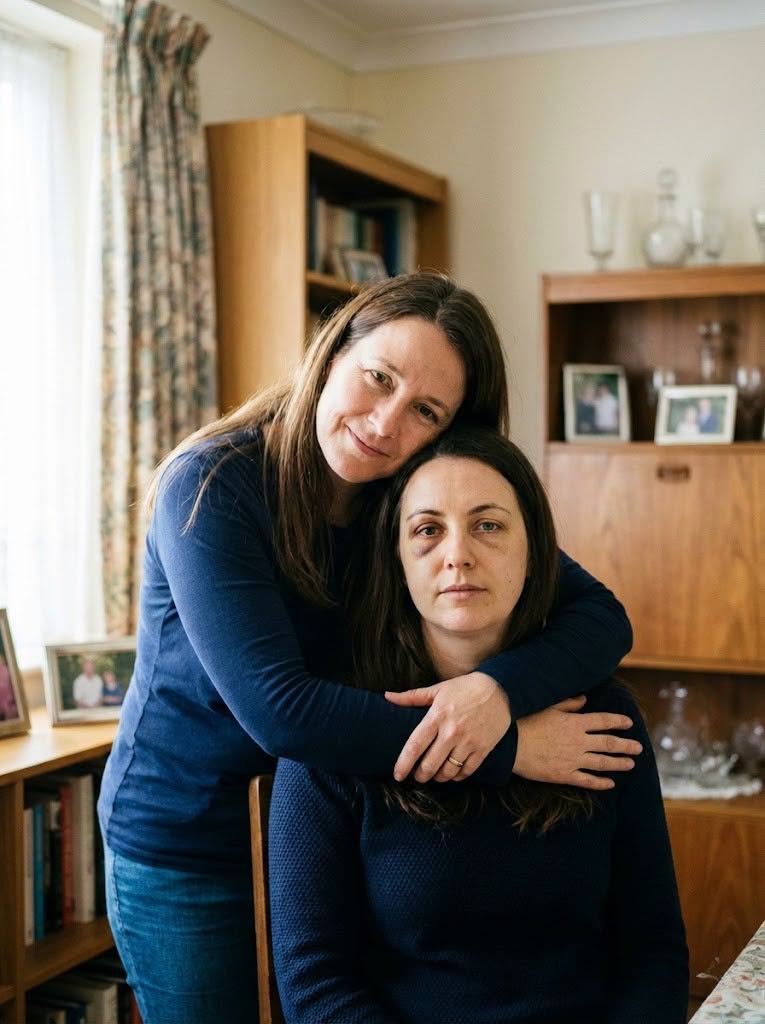
We spent hours talking.
For the first time, Emma described the pattern of intimidation she had endured for years.
The insults.
The control.
The isolation.
The violence.
Like many people living in abusive relationships, she had begun to believe she had nowhere else to go.
That night, we made a different plan.
Instead of confronting her husband ourselves, we documented her injuries, gathered important documents, contacted a trusted attorney, and reached out to local authorities and a domestic violence support service.
We also arranged for Emma to remain somewhere he could not easily find her.
Each step felt small.
Together, they became the beginning of freedom.
The Courage to Tell the Truth
Leaving was not easy.
Abusive relationships often become complicated through fear, financial dependence, and emotional manipulation.
Emma worried that no one would believe her.
She feared what might happen if she spoke openly.
Yet every truthful conversation helped loosen the hold that fear had maintained for so long.
Medical professionals documented her injuries.
Witnesses provided statements where appropriate.
Legal protections were put in place.
The process required patience.
It also restored something she had slowly lost.
Her voice.
Strength Takes Many Forms
People often imagine courage as a dramatic confrontation.
Sometimes it is.
More often, courage looks quieter.
Making a difficult phone call.
Accepting help.
Speaking honestly after years of silence.
Choosing safety even when the future feels uncertain.
Watching Emma take those steps reminded me that real strength is not measured by the ability to overpower another person.
It is measured by the willingness to walk toward truth despite fear.
A New Beginning
In time, Emma filed for divorce and began rebuilding her life.
Recovery did not happen all at once.
There were difficult days.
Moments of doubt.
Long conversations.
Gradually, however, she began discovering parts of herself that fear had hidden for many years.
She laughed more easily.
She made decisions without asking permission.
She began believing that peace was not something reserved for other people.
It could belong to her as well.
What I Learned
Looking back, I understand why my first instinct was to confront the man who had hurt my sister.
Love naturally wants to protect.
Yet lasting protection required something greater than anger.
It required wisdom.
It required community.
It required lawful accountability.
Most of all, it required helping Emma reclaim the ability to make her own choices again.
Today, when I think about that rainy night, I no longer remember it primarily as the night she escaped.
I remember it as the night she stopped facing her suffering alone.
No one should endure abuse in silence.
And no one should have to choose between safety and dignity.
Sometimes the strongest act of love is not defeating another person.
It is remaining faithfully beside someone until they are able to stand in freedom again.
{"post":105555,"page":2,"next":[{"id":105581,"title":"My mother-in-law demanded the wedding-gift safe to pay my brother-in-law\u2019s debts. \u201cThat money belongs to both my husband and me,\u201d I said. The groom sla:p:ped me across the face before hundreds of guests.","url":"https:\/\/new24.info\/105581"},{"id":105578,"title":"We froze when we found Mom sleeping on newspapers beneath a highway overpass. \u201cWhat happened to your $450,000 house?\u201d","url":"https:\/\/new24.info\/105578"},{"id":105572,"title":"My sister told parents I dropped out of medical school\u2014a lie that got me cut off for 5 years. They didn\u2019t attend my residency graduation or my wedding.","url":"https:\/\/new24.info\/105572"},{"id":105574,"title":"Public Reacts as Judges Break Silence in Political Warning","url":"https:\/\/new24.info\/105574"},{"id":105567,"title":"Karoline Leavitt, 28, Makes Her First Public Appearance 8 Weeks After Welcoming Baby \u2014 and Fans Can\u2019t Stop Talking About How She Looks \u2014 Photos","url":"https:\/\/new24.info\/105567"},{"id":105564,"title":"Influencer\u2019s two-year-old drowns after \u2018thinking she could swim\u2019 \u2013 family shares heartbreaking update","url":"https:\/\/new24.info\/105564"},{"id":105561,"title":"From Doubt to Trust: A Housekeeper\u2019s Unexpected Moment - trendynews1.com","url":"https:\/\/new24.info\/105561"},{"id":105557,"title":"My Husband of 22 Years Refused to Take His Long-Sleeve Shirt off at the Water Park \u2013 When Our 9-Year-Old Son Yanked It Up, I Discovered the Devastating Truth","url":"https:\/\/new24.info\/105557"},{"id":105553,"title":"My Grandma Asked Me to Find Her High School Sweetheart So She Could Dance One Last Dance with Him","url":"https:\/\/new24.info\/105553"},{"id":105548,"title":"Decades After Losing My Twin I Met A Stranger With My Face","url":"https:\/\/new24.info\/105548"},{"id":105543,"title":"Trump and Obama Exchange Heated Words During Live Appearance","url":"https:\/\/new24.info\/105543"},{"id":105539,"title":"Military Veterans Surprise Young Boy Who Carried His Disabled Friend Through Trail","url":"https:\/\/new24.info\/105539"},{"id":105534,"title":"Arrogant Husband Agreed To Divorce Before Discovering My Secret Billionaire Status","url":"https:\/\/new24.info\/105534"},{"id":105476,"title":"My Senior Prom Dance Unlocked A Stunning Police Secret Eight Years Later","url":"https:\/\/new24.info\/105476"},{"id":105529,"title":"Why More People Are Rethinking Toilet Paper and Choosing Greener Bathroom Habits","url":"https:\/\/new24.info\/105529"},{"id":105526,"title":"kaylestore.net","url":"https:\/\/new24.info\/105526"},{"id":105523,"title":"HOA Neighbor Had Our Cars Towed to Teach Us a Lesson\u2014She Had No Idea They Were Part of a Federal Assignment","url":"https:\/\/new24.info\/105523"},{"id":105517,"title":"\u2018I have a suite in his head\u2019: Barack Obama shares brutal verdict on Trump\u2019s \u201cobsession\u201d with him","url":"https:\/\/new24.info\/105517"},{"id":105513,"title":"My Maid of Honor Refused to Walk Down the Aisle 10 Minutes Before the Ceremony \u2013 When She Finally Told Me Why, I Canceled the Whole Thing","url":"https:\/\/new24.info\/105513"},{"id":105510,"title":"My husband d:ied 4 days before I gave birth to twins. Then my family stormed into my hospital room, my dad stole my newborn son, and handed him to my brother","url":"https:\/\/new24.info\/105510"}]}