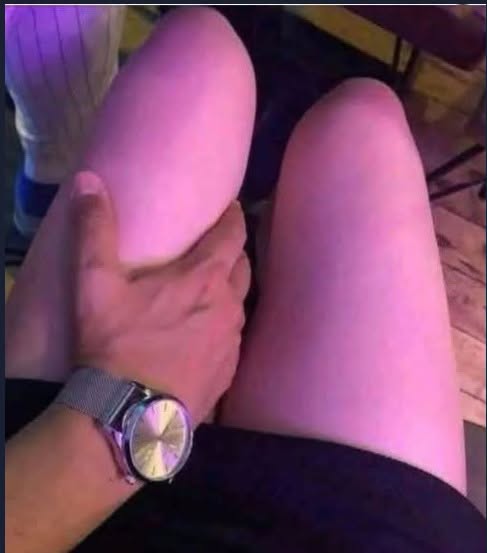
Human beings have always relied on more than words.
Facial expressions, tone of voice, gestures, and physical presence help communicate feelings that may never be spoken directly. These signals can strengthen relationships, provide reassurance, and help people respond appropriately to one another’s needs.
Many people have experienced moments when they sensed tension before anyone admitted it, or comfort before a reassuring word was spoken.
Such experiences remind us that communication often occurs on several levels at once.
The Temptation to Overinterpret
Because body language is meaningful, many people are tempted to treat it as a hidden code waiting to be deciphered.
A brief touch, prolonged eye contact, or a particular gesture can quickly become the subject of speculation. Social media often amplifies this tendency by presenting simple explanations for complex human behavior.
Yet people are rarely so predictable.
The same gesture may express affection, reassurance, habit, nervousness, empathy, cultural custom, or nothing especially significant at all.
Human behavior cannot be reduced to a list of universal signals.
What Touch Can Communicate
In healthy relationships and social settings, gentle physical gestures sometimes serve as expressions of connection.
A touch on the shoulder may offer encouragement.
A hand on an arm may communicate attention and concern.
A brief gesture between friends or family members may simply reflect familiarity developed over years of trust.
None of these meanings should be assumed automatically.
The significance of a gesture depends largely on the people involved and the circumstances surrounding it.
Context Matters More Than Individual Gestures
Communication experts consistently emphasize that isolated actions rarely tell the whole story.
Understanding another person’s behavior requires attention to the broader context:
- The nature of the relationship
- The setting in which the interaction occurs
- Cultural expectations
- Individual personality
- Emotional circumstances
- Established patterns of behavior
A gesture that feels natural in one context may feel entirely different in another.
This is why thoughtful observation is generally more reliable than quick conclusions.
The Value of Humility
Perhaps the most overlooked principle in interpreting body language is humility.
No matter how observant we believe ourselves to be, we rarely possess complete knowledge of another person’s thoughts, intentions, or circumstances.
It is easy to project our assumptions onto a gesture and convince ourselves we understand what it means.
More often than not, the reality is more complicated.
Humility reminds us that understanding people requires patience. Sometimes the wisest response is not certainty but curiosity.
Respecting Boundaries
While touch and nonverbal communication can foster connection, respect remains essential.
Different people have different comfort levels regarding personal space, physical contact, and emotional expression. What feels natural to one person may feel intrusive to another.
Healthy communication involves not only expressing ourselves but remaining attentive to the comfort and dignity of those around us.
Connection grows best where respect is present.
Beyond Decoding
In the end, the purpose of understanding body language is not to uncover hidden secrets or gain control over social interactions.
It is to become more attentive, compassionate, and responsive in our relationships.
The most meaningful lesson is not that every gesture contains a secret meaning.
It is that people often communicate in ways that extend beyond words alone.
Approaching those moments with empathy rather than suspicion, and with understanding rather than certainty, allows us to relate to others more wisely.
Sometimes a gesture carries deep significance.
Sometimes it means very little.
And often, the most respectful response is to recognize that understanding another person begins not with decoding them, but with listening carefully and treating them with care.
When humility, attentiveness, and respect accompany our observations, nonverbal communication becomes less about analysis and more about genuine human connection.
{"post":105307,"page":2,"next":[{"id":105303,"title":"Her Fianc\u00e9 Kept Asking About Money, So She Set a Test","url":"https:\/\/new24.info\/105303"},{"id":105299,"title":"What Investigators Have Revealed About a Tragic Family Case Is Drawing Attention","url":"https:\/\/new24.info\/105299"},{"id":105295,"title":"Barron Trump\u2019s Rare Appearance Has People Looking Twice-","url":"https:\/\/new24.info\/105295"},{"id":105289,"title":"My Daughter Cut Ties with Me After Marrying a Wealthy Man \u2013 7 Years Later, a Little Girl Knocked on My Door and Said, \u0027Only You Can Help Mommy. Please, Go with Me\u0027","url":"https:\/\/new24.info\/105289"},{"id":105286,"title":"When the seamstress unzipped my daughter\u2019s custom silk wedding dress, the champagne glass slipped from my hand and shattered on the floor.","url":"https:\/\/new24.info\/105286"},{"id":105283,"title":"At 3 a.m., my phone rang. My eight-months-pregnant twin was sobbing. \u201cSis\u2026 come get me.\u201d","url":"https:\/\/new24.info\/105283"},{"id":105280,"title":"My 5-Year-Old Daughter Tugged My Wedding Dress and Whispered, \u201cMommy, New Daddy Did Something Bad\u201d \u2014 Minutes Later, I Stopped the Wedding","url":"https:\/\/new24.info\/105280"},{"id":105276,"title":"Disgusting act death row inmate did after murder as US state prepares to execute first woman in over 200 years","url":"https:\/\/new24.info\/105276"},{"id":105265,"title":"Shock poll reveals how many Americans would want Barron Trump as future President","url":"https:\/\/new24.info\/105265"},{"id":105272,"title":"todaystories.feji.io","url":"https:\/\/new24.info\/105272"},{"id":105267,"title":"My Coworkers Teased Me for Eating Lunch with the Lonely Janitor Every Day for 11 Years \u2013 At His Funeral, His Lawyer Pulled Me Aside and Said, \u2018Mr. Wilson Left This for You\u2019","url":"https:\/\/new24.info\/105267"},{"id":105263,"title":"My Family Told Me To Leave Grandma\u2019s Lake Geneva Anniversary Trip Because A Preschool Teacher Couldn\u2019t Afford A Five-Star Resort","url":"https:\/\/new24.info\/105263"},{"id":105256,"title":"My parents told everyone in town that my 12-year-old is a thief. She lost all her friends and got kicked off her school teams. \u201cShe should learn respect,\u201d my mom said. So, I made one call to my grandpa\u2019s former lawyer and their lives started to unravel\u2026","url":"https:\/\/new24.info\/105256"},{"id":105253,"title":"Key sepsis warning signs after child star Daveigh Chase dies at 35","url":"https:\/\/new24.info\/105253"},{"id":105249,"title":"My Husband Bet He Could Run Our Household Better While I Became the Family\u0027s Breadwinner \u2013 But One Week Later, I Came Home to a House I Hardly Recognized","url":"https:\/\/new24.info\/105249"},{"id":105245,"title":"My Grandma Left Two Identical Blue Velvet Boxes for My Sister and Me \u2013 When My Sister Opened Hers, She Went Pale","url":"https:\/\/new24.info\/105245"},{"id":105242,"title":"My Husband Bought Me an Expensive Bracelet for Our Anniversary \u2013 When I Went Back to Have It Resized, the Saleswoman Said, \u0027He Bought Two of These Last Week\u0027","url":"https:\/\/new24.info\/105242"},{"id":105238,"title":"My Family Didn\u0027t Come to My College Graduation Because They Were Embarrassed by My Age \u2013 Then a Professor Brought Me Onto the Stage and What He Did Made My Knees Tremble","url":"https:\/\/new24.info\/105238"},{"id":105234,"title":"Billionaire Grandmother Arrives On Christmas Eve To Evict My Cruel Father","url":"https:\/\/new24.info\/105234"},{"id":105229,"title":"Fans Are Asking Questions About Kelly Ripa\u2019s Recent Update","url":"https:\/\/new24.info\/105229"}]}