
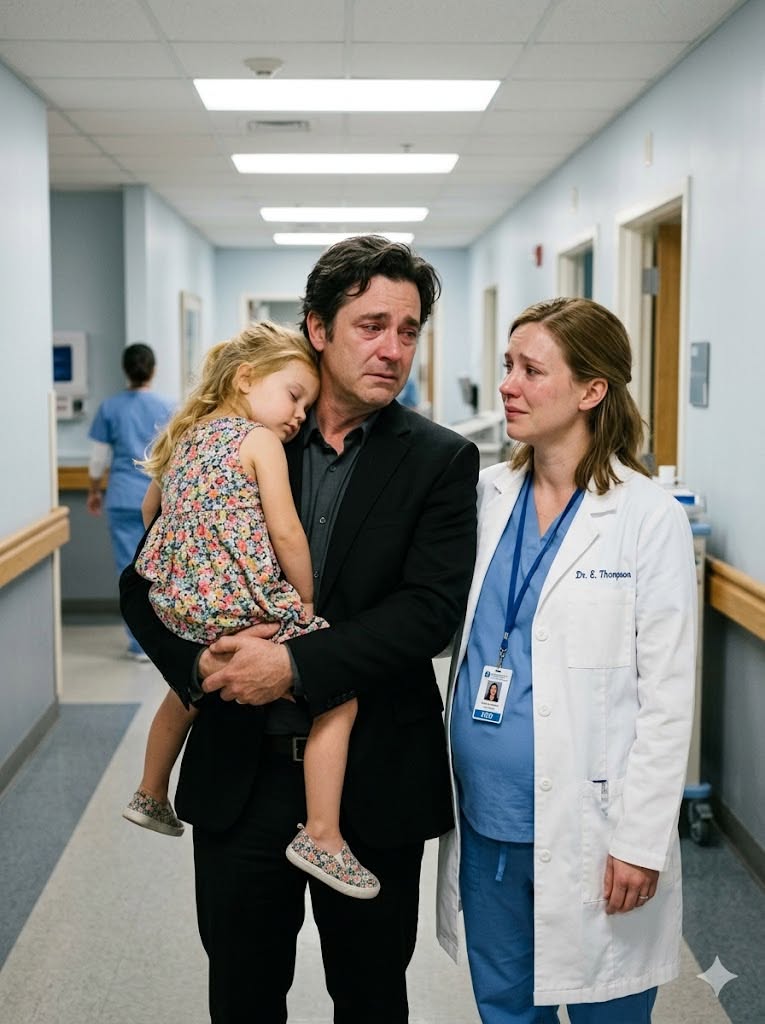
As I stepped forward to assess her condition, he immediately noticed what I could no longer conceal: I was pregnant.
For a brief moment, surprise seemed to replace every other thought on his face.
Yet the emergency room has a way of clarifying priorities.
Sophie needed care, reassurance, and calm attention. Whatever questions existed between Elias and me would have to wait.
The examination revealed a minor fracture. Once Sophie was comfortable and appropriate treatment had been arranged, the immediate crisis passed.
Only then did the silence between us begin to feel heavier.
Later, in a quiet hallway, Elias tried to ask the questions that had clearly been building in his mind. I listened, but I also understood that some conversations require more than urgency. They require honesty, patience, and a willingness to confront what has been avoided.
The reasons our relationship had ended had not disappeared simply because circumstances had changed.
In the weeks that followed, Elias made several attempts to reconnect.
What mattered most was not the gestures themselves, but the consistency behind them.
People often speak about forgiveness as though it is a single decision. In reality, trust is usually rebuilt through many small actions repeated over time. Accountability is not proven through promises. It is demonstrated through conduct.
Even those closest to him encouraged that approach.
Rather than asking me to overlook the past, they encouraged him to face it honestly and accept responsibility for his choices.
Life, however, had its own plans.
Partway through my pregnancy, serious medical complications emerged. My obstetrician diagnosed preeclampsia, a condition that required careful monitoring and significant lifestyle changes.
Suddenly, questions about old wounds became secondary to more immediate concerns.
During that difficult season, Elias chose to be present.
Not perfectly.
Not dramatically.
Simply consistently.
He attended appointments, helped with practical needs, listened when fear became overwhelming, and remained steady during moments when uncertainty felt larger than either of us.
Then came the night everything changed.
An unexpected medical emergency forced us into circumstances neither of us could have anticipated. Fear stripped away pride, old grievances, and carefully rehearsed conversations. What remained was trust, cooperation, and a shared determination to protect a vulnerable new life.
Our daughter, Hope, arrived earlier than expected.
The weeks that followed in the neonatal intensive care unit tested everyone involved. Progress came slowly. Some days brought relief. Others brought worry.
Yet those weeks also revealed something important.
Love is easiest to declare during comfortable seasons.
Its true character often emerges during hardship.
As we sat beside incubators, waited for updates, and celebrated small improvements, I saw a version of Elias that was no longer running from responsibility. He was learning to remain present even when situations could not be controlled or fixed immediately.
That growth mattered more than any apology.
Years later, when people ask about our story, they often focus on dramatic moments.
I remember different things.
I remember quiet conversations in hospital corridors.
I remember exhausted gratitude after difficult nights.
I remember watching someone choose responsibility repeatedly, even when no one was watching.
The strongest foundations are rarely built through grand declarations alone.
They are built through ordinary acts of care performed faithfully over time.
And perhaps that is what lasting love really is: not the absence of difficulty, but the willingness to walk through difficulty together without turning away.