
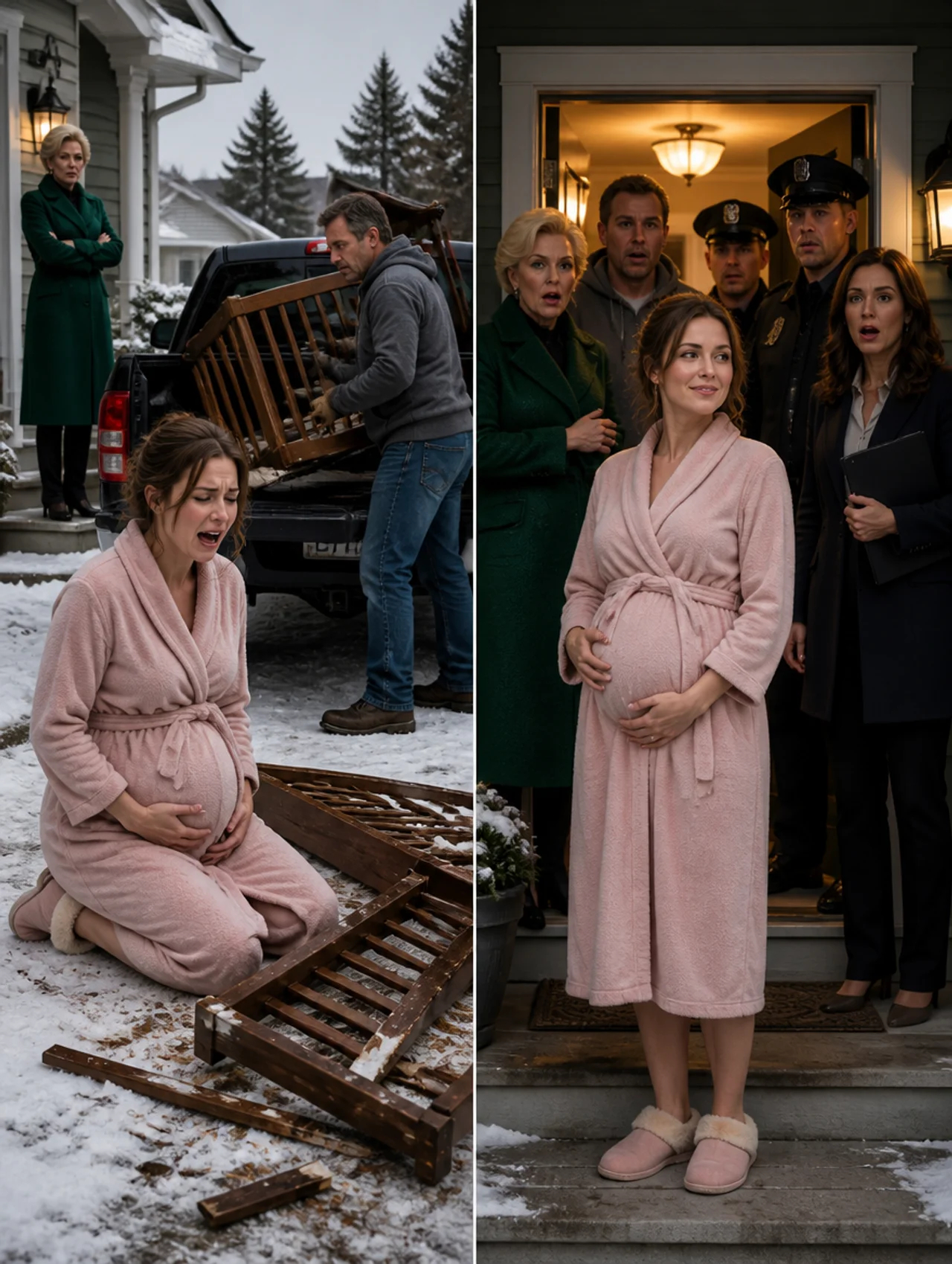
There wasn’t.
Evan calmly explained that his sister Claire was expecting twins and needed the crib more than we did. His mother, Patricia, stood nearby agreeing with him, treating the decision as if it were completely reasonable. As they gathered other family items—including a blanket that had been passed down through generations—I felt something deeper than anger.
I felt unseen.
It wasn’t only about the crib. It was about the complete absence of respect for my feelings, my family history, and the child I was about to bring into the world.
I followed them outside, hoping someone would stop and reconsider.
Instead, the situation escalated.
In the freezing weather, amid raised voices and growing tension, I lost my footing on the icy steps and suffered a serious fall. What I remember most clearly isn’t the pain—it is the realization that the people I expected to care for me were no longer acting like people I could depend on.
As they left, I was forced to focus on what mattered most: getting help and protecting my baby.
Thankfully, emergency services arrived, and despite a frightening medical emergency, my daughter Nora entered the world safely.
For that alone, I remain grateful.
When Evan later appeared at the hospital, accompanied by Patricia, they seemed eager to move past what had happened. They spoke as though the events leading to my hospitalization were simply an unfortunate misunderstanding.
But some moments reveal truths that cannot be ignored.
Lying in that hospital bed, holding my newborn daughter, I understood something clearly: trust, once broken deeply enough, cannot be restored through excuses alone.
I asked them to leave.
Not out of anger.
Out of clarity.
Over the following days, I focused my attention where it belonged—on healing, caring for Nora, and documenting events carefully. My professional experience taught me the importance of facts, records, and patience. Emotional reactions fade; evidence remains.
I preserved messages, gathered documentation, and sought legal guidance.
As more information surfaced, difficult realities emerged. Financial problems that had been hidden for years came into view. Decisions that once seemed confusing suddenly made more sense.
What saddened me most was not the discovery itself.
It was realizing how long honesty had been absent.
Claire, when she eventually learned the full situation, was deeply upset. She had not understood what had happened or where the crib had come from. Her apology was sincere, and I accepted it. Sometimes people become part of painful situations without knowing the whole truth.
The legal process that followed was neither quick nor enjoyable.
Despite what people often imagine, there is very little satisfaction in watching a family unravel. There is only the sober understanding that actions have consequences, and that accountability matters.
Over time, the marriage ended.
The courts resolved the financial and property issues.
Life moved forward.
The greatest victory was not a legal one.
It was peace.
A year later, Nora and I stood together on the porch while snow drifted quietly from the sky. The same season that had once brought fear now felt calm.
Looking at her, I realized that healing does not come from revenge. It comes from rebuilding a life rooted in truth, safety, and self-respect.
Some people leave your life because circumstances change.
Others leave because they reveal who they truly are.
And sometimes the most loving thing you can do—for yourself and for your children—is accept that truth, stop fighting it, and walk forward with dignity.
The crib was never the real loss.
The real loss was trust.
And the real gift that followed was the clarity to build something better.