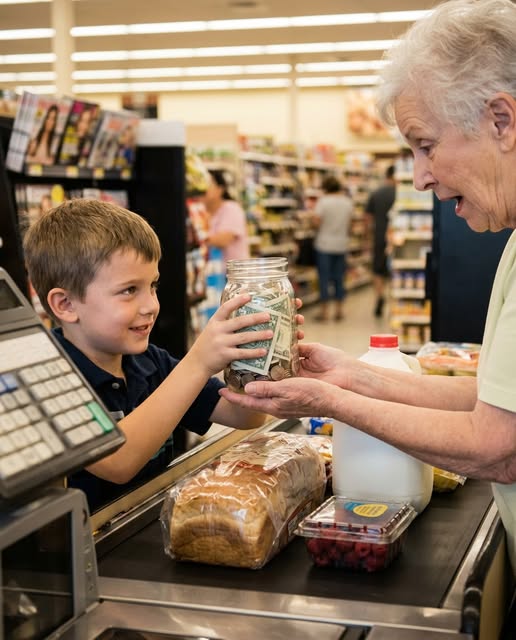
The store was bustling, but everything changed when we reached the checkout line. An elderly woman stood ahead of us, her shoulders shaking as the cashier repeatedly scanned her items—bread, milk, and a small carton of strawberries—only for her card to decline again and again. She whispered an apology, her face a mask of quiet devastation. Before I could even reach for my wallet, Eli stepped forward. With the uncomplicated sincerity only a child possesses, he placed his jelly jar on the belt and asked, “I have four dollars and seventy-five cents. Is that enough for the strawberries?”
The silence that fell over the checkout lane was absolute. The woman dropped to her knees, pulling Eli into a desperate, tearful embrace. She thanked him with a voice broken by grief, and then she was gone, clutching those strawberries as if they were gold. I thought it was a beautiful, fleeting moment. I was wrong.
Three days later, I opened my front door to find a worn, crimson leather suitcase sitting on the welcome mat. A white envelope was taped to the handle, addressed to Eli in shaky, uneven handwriting. Then, I heard it: a faint, steady ticking emanating from within. My heart hammered against my ribs. I kept Eli back, my mind racing with worst-case scenarios, before finally deciding to open the bag. Inside, there was no danger—only an old brass clock, its hands moving in a rhythmic heartbeat, surrounded by a collection of beloved toys and children’s books.
I tore open the envelope. The first line stopped my breath: “Your son saved my grandson that day.”
The letter was from Margaret, the woman from the store. She explained that her seven-year-old grandson, Leo, was in his final days. He had been craving strawberries, the only thing he could stomach, but her bank account had been drained by medical bills. Eli’s small act of kindness had allowed Leo to have his final wish. He had passed away peacefully that very night, but not before spending his last hours talking about the kind boy who had shared his treasure. Leo wanted Eli to have his favorite things, and the clock—a family heirloom—was included because, as Margaret wrote, “Every tick reminded me of a heartbeat. Leo’s time ran out, but kindness keeps people alive long after they’re gone.”
We eventually met Margaret, and our families became inseparable. The brass clock still sits on Eli’s nightstand today. Whenever someone asks about it, he tells them the story of a boy he never met, a boy who loved strawberries, and a gift that traveled across a lifetime. It is a constant, rhythmic reminder that we never truly know how far a small act of love will go, or how it might return to our doorstep when we least expect it, carrying a heartbeat that refuses to stop.