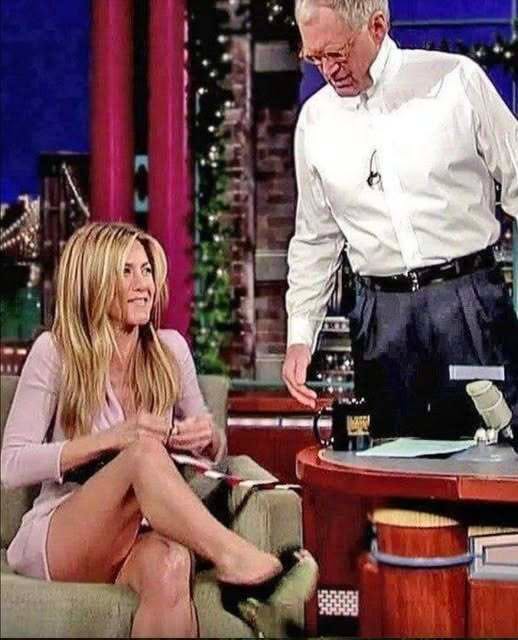
At the time, Aniston was appearing to promote The Break-Up, her film with Vince Vaughn.
What began as a standard promotional interview gradually shifted into a conversation many people now describe as uncomfortable. Letterman repeatedly commented on Aniston’s legs during the segment, returning to the subject several times even after she attempted to move past it with humor and brief responses. While she remained composed and professional, viewers revisiting the clip today often point to the imbalance in tone—between a guest trying to promote her work and a host focusing attention on her appearance.
As the interview continued, the questions reportedly moved into more personal territory, including speculation about her relationship with Vaughn and comments related to scenes in the film. Aniston largely handled the exchange with calm deflection, redirecting where she could without escalating the moment.
The clip has sparked broader conversation not only because of what was said, but because it reflects how celebrity interviews were often conducted during that era—particularly with female guests, who were frequently asked to navigate personal or appearance-based commentary while remaining publicly gracious.
Viewers also frequently reference an earlier 1998 appearance on The Late Show, which has circulated online for similar reasons. Together, those interviews have become part of a larger reevaluation of how talk-show culture operated in past decades, especially regarding boundaries, guest comfort, and what audiences once accepted as entertainment.
Jennifer Aniston later returned to the program again while promoting Marley & Me, in an appearance that included a playful on-air gift exchange. Even that segment, while lighter in tone, continues to be discussed by fans revisiting older television moments through current cultural expectations.
What makes these clips resonate now is not only nostalgia—but perspective.
Conversations around professionalism, consent, media treatment of women, and interview etiquette have changed significantly. Moments once dismissed as harmless late-night banter are now more likely to be examined through questions of power dynamics, respect, and whether the guest appeared genuinely at ease.
Jennifer Aniston herself has not publicly centered these appearances as controversy. But the interviews continue to circulate because many viewers see them as reflecting a broader shift in entertainment culture—showing how much expectations around celebrity interviews, personal boundaries, and public discourse have evolved over time.
{"post":103298,"page":2,"next":[{"id":103303,"title":"My sister threw a hot skillet at my 4-year-old\u2019s face because she sat in the wrong chair. My mom told ME to stop screaming while my daughter lay unconscious. My dad called her a burden. I rushed her to the hospital\u2014that\u2019s where the true nightmare began. Spotlight8","url":"https:\/\/new24.info\/103303"},{"id":103300,"title":"Cemetery is demanding headstone be removed over obscene \u2018hidden message\u2019","url":"https:\/\/new24.info\/103300"},{"id":103294,"title":"At Prom, Only One Boy Asked Me to Dance Because I Was in a Wheelchair","url":"https:\/\/new24.info\/103294"},{"id":103290,"title":"A Teen\u2019s Sentence Sparks Debate About Justice, Choices, and Consequences","url":"https:\/\/new24.info\/103290"},{"id":103286,"title":"This legendary actress made a rare public appearance at 90","url":"https:\/\/new24.info\/103286"},{"id":103281,"title":"Inside the life of a global superstar: Love, loss, and the fight to keep performing","url":"https:\/\/new24.info\/103281"},{"id":103278,"title":"\u00abWhat is the reason of Gwen Stefani\u2019s tears?\ud83d\ude2b SHe shared her horrible emotions with us in her recent post!\u00bb\ud83d\udc94","url":"https:\/\/new24.info\/103278"},{"id":103275,"title":"Search Results for \u201cInside the life of a global superstar: Love, loss, and the fight to keep performing\u201d \u2013 Tbdig Divaxo","url":"https:\/\/new24.info\/103275"},{"id":103270,"title":"The entertainment world is mourning the sudden loss of a beloved television personality","url":"https:\/\/new24.info\/103270"},{"id":103266,"title":"What to Do If You Find Ticks in Your Child\u2019s Hair (Without Panicking)","url":"https:\/\/new24.info\/103266"},{"id":103261,"title":"FDA approves many drugs that predictably increase heart and stroke risk","url":"https:\/\/new24.info\/103261"},{"id":103257,"title":"Young woman puts both babies inside the fir\u2026 See more","url":"https:\/\/new24.info\/103257"},{"id":103240,"title":"You would watch the clip, your heart thudding dully against your ribs like a trapped bird","url":"https:\/\/new24.info\/103240"},{"id":103237,"title":"The life and career of Brian Connolly: from fame to later years - Terbv","url":"https:\/\/new24.info\/103237"},{"id":103234,"title":"Terrifying moment gunshots rang out outside White House captured on camera","url":"https:\/\/new24.info\/103234"},{"id":103231,"title":"The Case That Still Leaves One Painful Question No One Can Fully Answer","url":"https:\/\/new24.info\/103231"},{"id":103226,"title":"These are the consequences of sleeping with the\u2026See more","url":"https:\/\/new24.info\/103226"},{"id":103222,"title":"Police Arrest Suspect in Unusual Wildlife Case in U.S. Woodland Region","url":"https:\/\/new24.info\/103222"},{"id":103217,"title":"20 Minutes ago in New York City, Kelly Ripa was confirmed as\u2026See more","url":"https:\/\/new24.info\/103217"},{"id":103215,"title":"kaylestore.net","url":"https:\/\/new24.info\/103215"}]}