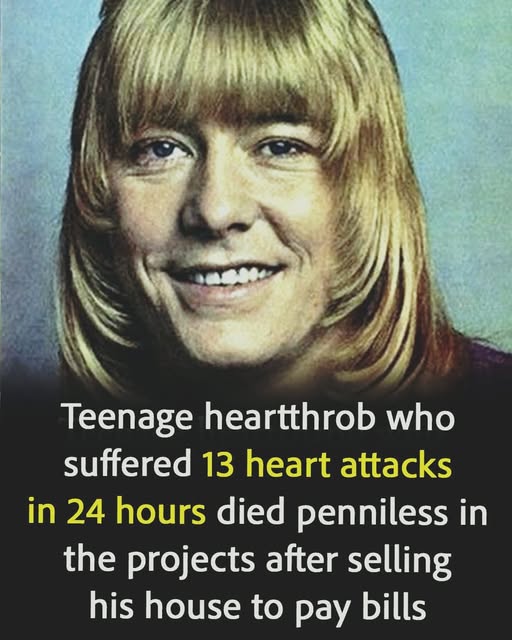
The descent from superstardom was not sudden, but a slow, agonizing erosion of the man who had once been the face of British rock. Born Brian MacManus in Scotland and raised by adoptive parents, Connolly carried the weight of a complex identity long before he stepped into the spotlight. By the late 1970s, the intoxicating pressures of fame, combined with the relentless grind of international touring, began to take a toll that no amount of stage lights could hide.
As internal band tensions reached a breaking point, Connolly’s departure from The Sweet in 1979 served as the catalyst for a downward spiral. The transition to a solo career proved brutal; without the machinery of the band, he found himself adrift in an industry that had already begun to move on. Financial ruin soon followed, forcing him to sell his personal assets just to survive, while his health—ravaged by years of substance abuse and the physical toll of rock stardom—began to collapse in earnest.
A Legacy of Resilience and Regret
Throughout the 1980s and 90s, Connolly became a tragic figure, a man fighting to maintain his dignity while his body betrayed him. Despite suffering multiple heart attacks and debilitating neurological symptoms, he refused to leave the stage entirely. He performed in various iterations of “The Sweet,” appearing in his final years as a shadow of the vibrant idol he once was. Fans who witnessed these later shows often spoke of the raw, painful courage it took for him to stand behind the microphone, his voice still holding a flicker of the power that had once captivated millions.
In 1995, he attempted a final comeback with the album “Let’s Go,” but the commercial world remained indifferent. It was in these twilight years that Connolly found a new, quiet meaning in life through the birth of his son—a stark contrast to the hollow roar of the arenas he had once filled. He spoke openly in interviews about his regrets, acknowledging that the lifestyle he had embraced had ultimately cost him everything.
When Brian Connolly passed away on February 9, 1997, at the age of 51, the world lost more than just a singer; it lost a symbol of an era that burned bright and fast. His death, caused by kidney and liver failure compounded by years of cardiovascular disease, was a somber reminder of the hidden costs of fame. Today, he is remembered not just for the hits, but for the humanity he displayed in his final, fragile years, leaving behind a legacy that serves as both a celebration of glam rock’s peak and a cautionary tale of its darkest shadows.
{"post":103237,"page":2,"next":[{"id":103234,"title":"Terrifying moment gunshots rang out outside White House captured on camera","url":"https:\/\/new24.info\/103234"},{"id":103231,"title":"The Case That Still Leaves One Painful Question No One Can Fully Answer","url":"https:\/\/new24.info\/103231"},{"id":103226,"title":"These are the consequences of sleeping with the\u2026See more","url":"https:\/\/new24.info\/103226"},{"id":103222,"title":"Police Arrest Suspect in Unusual Wildlife Case in U.S. Woodland Region","url":"https:\/\/new24.info\/103222"},{"id":103217,"title":"20 Minutes ago in New York City, Kelly Ripa was confirmed as\u2026See more","url":"https:\/\/new24.info\/103217"},{"id":103215,"title":"kaylestore.net","url":"https:\/\/new24.info\/103215"},{"id":103212,"title":"Why Stretching Your Ring Finger Might Feel Surprisingly Good","url":"https:\/\/new24.info\/103212"},{"id":103209,"title":"Former AG Pam Bondi diagnosed with cancer weeks after being fired by Trump: report","url":"https:\/\/new24.info\/103209"},{"id":103203,"title":"Here\u2019s what the sticker says. What do you think??\u2026\u2026","url":"https:\/\/new24.info\/103203"},{"id":103199,"title":"Valerie Bertinelli Opens Up About Emotional Career Change and What Comes Next","url":"https:\/\/new24.info\/103199"},{"id":103190,"title":"After My Father Hid My Grandmother Away for Four Years and Lied That She Had Forgotten Me","url":"https:\/\/new24.info\/103190"},{"id":103188,"title":"Millionaire CEO Came to Buy an Engagement Ring for Another Woman\u2014Until the Jeweler Said, \u201cThat Design Belongs to the Baby You Abandoned\u201d.... Then Saw His Ex Behind the Counter Holding a Child - News","url":"https:\/\/new24.info\/103188"},{"id":103179,"title":"The seven-hour drive from Minneapolis to Chicago felt like I was crossing the entire country with a jagged blade pressed against my ribs","url":"https:\/\/new24.info\/103179"},{"id":103174,"title":"At 10:03 p.m., ninety-three days after Luke Mercer signed the divorce papers and told Elena he no longer loved her, the phone","url":"https:\/\/new24.info\/103174"},{"id":103172,"title":"The contraction hit like a freight train, splitting my world into jagged shards of agony","url":"https:\/\/new24.info\/103172"},{"id":103165,"title":"Five minutes after the ink dried on my divorce papers, Adrian Castillo was already racing toward a private clinic to celebrate his mistress\u2019s pregnancy, leaving me with nothing but the children he deemed dead weight","url":"https:\/\/new24.info\/103165"},{"id":103163,"title":"For four seconds, Ethan Carlisle thought the baby was dead","url":"https:\/\/new24.info\/103163"},{"id":103159,"title":"Search Results for \u201cWhen Love Means Letting Go: A Mother\u2019s Hardest Lesson in Accountability\u0027\u201d \u2013 Tbdig Divaxo","url":"https:\/\/new24.info\/103159"},{"id":103156,"title":"My Astonishing Playground Discovery Reunited Me With My Missing Twin Son","url":"https:\/\/new24.info\/103156"},{"id":103153,"title":"I brought a baseball bat to confront the biker who\u2019d been harassing my daughter. I left his driveway twenty minutes later crying so hard I couldn\u2019t drive.","url":"https:\/\/new24.info\/103153"}]}