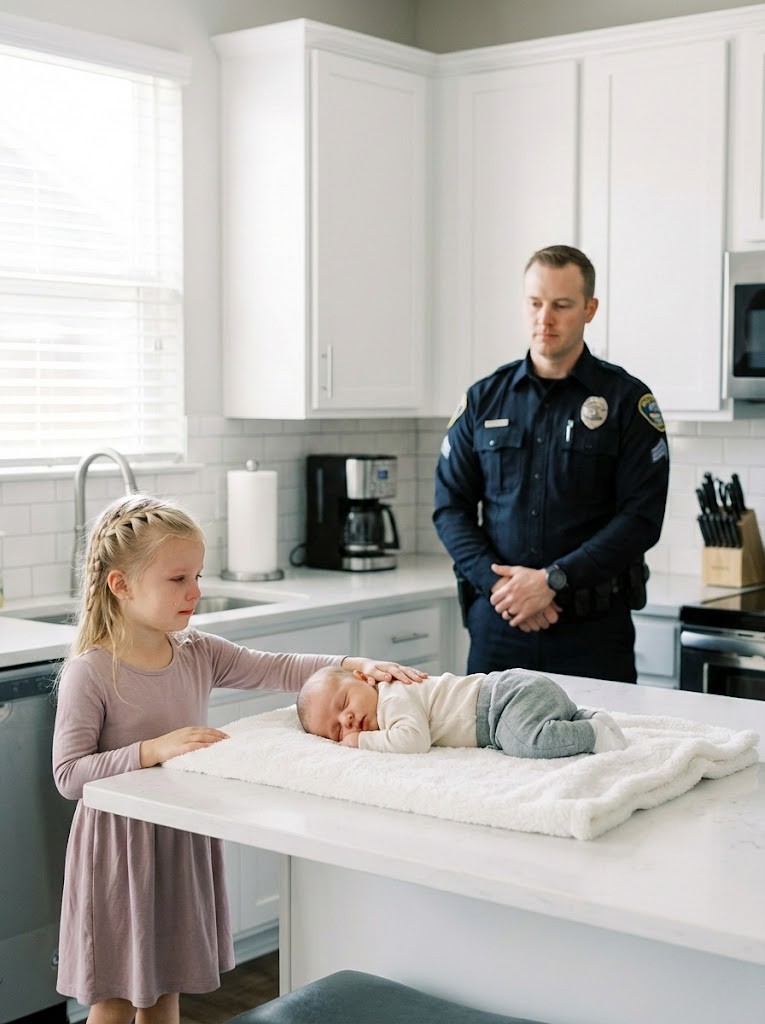
Inside the dim living room sat Juniper, clutching four-month-old Rowan against her chest with the protective instinct of someone trying desperately to hold her family together. The baby looked weak and dangerously thin, while old blankets and bottles surrounded them in quiet evidence of struggle. Juniper explained that she cared for Rowan while their mother, Tessa, slept in the back room because she was always tired from working. What Owen discovered was not neglect born from indifference, but a family crushed under exhaustion and isolation. Tessa had been working punishing double shifts simply to keep rent paid and food on the table, until her body finally gave out beneath the strain.
At the hospital, doctors began urgent evaluations while Juniper followed Officer Owen through bright hallways she clearly found overwhelming. She held tightly to his hand, less like a stranger seeking comfort and more like a child who had not felt safe enough to let go in a very long time. Medical testing eventually revealed that Rowan was suffering from spinal muscular atrophy, a severe genetic condition weakening his muscles and threatening his ability to survive without immediate treatment. The therapy he needed was extraordinarily expensive, and the family had neither the money nor the support system to navigate it alone.
As social workers reviewed the case, they uncovered a painful truth: earlier warnings about the family’s condition had been overlooked or dismissed. There had been signs of struggle long before Juniper made that call, but hardship often remains invisible when people are too overwhelmed to ask loudly enough for help. Owen could have simply filed reports and stepped away once the immediate danger passed. Instead, he chose to remain present. He signed temporary guardianship paperwork so Rowan could receive medical care without delay and continued visiting Juniper regularly while she stayed in foster placement. His actions were not dramatic heroics so much as steady human responsibility — the decision to stop treating suffering like someone else’s problem.
The insurance company initially denied coverage for the gene therapy, creating another wave of fear and uncertainty. Yet the people around the family continued pushing forward. Doctors advocated. Social workers persisted. Owen refused to let the case disappear into paperwork. During the final hearing, Judge Elaine Carver watched a simple video recorded by Juniper. The little girl did not ask for wealth or sympathy. She only asked for her family to stay together and for her baby brother to have a chance to live. Her words carried the kind of honesty adults sometimes lose beneath pride and procedure.
The court ultimately approved the guardianship arrangement needed for Rowan’s treatment, while Tessa entered a recovery and support program designed to help her rebuild stability without carrying every burden alone. Slowly, Rowan began gaining strength. Juniper started sounding less like a frightened caretaker and more like the child she still deserved to be.
Months later, the family reunited in a park scattered with autumn leaves. Rowan laughed in his stroller while Juniper ran nearby without constantly looking over her shoulder in fear. Owen watched quietly from a bench, not as a savior, but as someone who finally helped ensure they would no longer face hardship unseen. Sometimes healing does not arrive through grand gestures. Sometimes it begins the moment a frightened child realizes that someone finally heard her call for help — and stayed.