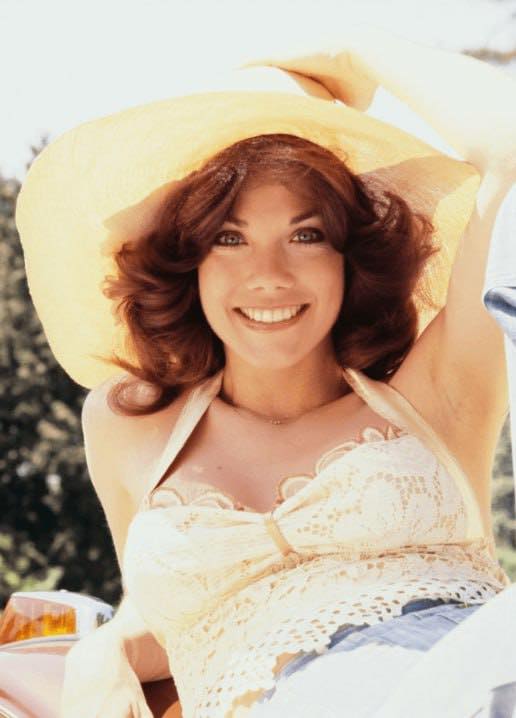
The woman in question is Barbi Benton, born Barbara Lynn Klein. Raised in California, she possessed a rare blend of ambition and adaptability that allowed her to thrive in an era that often demanded performers be one thing and one thing only. While many of her contemporaries were trapped by the rigid expectations of the industry, Benton refused to be categorized. She was the quintessential multi-hyphenate, a model who could hold her own in a comedy sketch and a singer who could find her footing on the country music charts.
Her tenure on the hit variety show Hee Haw remains one of the most memorable chapters of her career. It was there that she proved her comedic timing was just as sharp as her screen presence. She wasn’t just a guest; she was a fixture, a performer who understood that the secret to longevity in Hollywood wasn’t just beauty, but the ability to connect with an audience through genuine warmth and humor. Her hit single, “Brass Buckles,” further cemented her status as an artist who could cross boundaries, proving that she was more than just a face on a page.
Perhaps the most compelling aspect of Benton’s journey is how she eventually chose to step away from the noise. While many stars of her generation struggled to maintain their relevance as the cultural tides shifted, Benton pivoted with grace. She traded the flashbulbs for the quiet majesty of Aspen, Colorado, where she and her husband, George Gradow, embarked on a project that would become her true masterpiece: the “Copper Palace.”
This architectural marvel was more than just a home; it was a physical manifestation of her evolution. It was a space designed with an eye for detail and a soul for creativity, reflecting her transition from a public entertainer to a private entrepreneur. In designing the Copper Palace, Benton proved that her greatest talent wasn’t just being seen—it was the ability to create something lasting, something that stood as a testament to her own vision rather than the projections of the media.
Today, Barbi Benton remains a touchstone for those who remember the 1970s as a time of vibrant, unfiltered creativity. She represents a bygone era of celebrity, one where stars were allowed to be multifaceted and where reinvention was a personal journey rather than a public relations strategy. Her legacy isn’t found in the archives of magazine features or the reruns of variety shows, but in the quiet dignity with which she walked away from the fame that once defined her, choosing instead to build a life on her own terms.
In an age of digital noise and constant surveillance, her story serves as a reminder that the most successful career is the one that leads you back to yourself. She didn’t just survive the 1970s; she mastered the art of living beyond them, proving that true star power isn’t about how bright you shine in the moment, but how long your light continues to glow when the cameras are finally turned off.