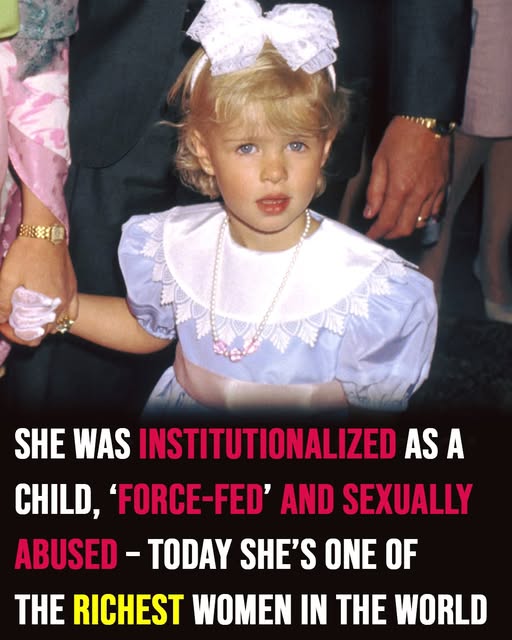
The truth was far darker than the tabloid headlines suggested. Born into the legendary Hilton hotel dynasty, Paris grew up in a world of immense wealth, but it was a world where her autonomy was systematically dismantled. Her parents imposed rigid, suffocating rules that governed every aspect of her life—forbidding her from dating, controlling her wardrobe, and monitoring her every move. She was a bird in a golden cage, and as she entered her teenage years, the pressure to conform became a catalyst for a desperate, rebellious search for freedom.
Her parents, alarmed by her attempts to break free from their control, made a decision that would haunt Paris for the rest of her life. She was sent away to a series of boarding schools and treatment facilities for “troubled” teenagers. These were not places of healing, but, as she would later reveal, environments of terror. In the halls of these institutions, she was subjected to psychological abuse, forced to take unidentified medication, and kept in a state of constant, paralyzing fear. The staff, she claimed, broke her spirit with humiliation and isolation, leaving her with deep-seated trauma that would manifest as chronic anxiety and recurring nightmares well into her adulthood.
For years, she kept the truth buried under the weight of her celebrity persona. She played the part of the “party girl” because it was the only armor she had; it was a way to hide the broken, terrified girl who was still trapped in the memories of those facilities. She believed, as her captors had told her, that no one would ever believe the heiress who had everything.
But the silence eventually became a burden she could no longer carry. Recognizing that her platform could be used to protect other vulnerable children from the same systemic abuse, Paris made the courageous decision to speak out. Her transformation from a misunderstood socialite to a fierce advocate for institutional reform shocked the world. She began testifying before lawmakers, demanding accountability for the industry that had profited from her pain. By turning her trauma into a tool for systemic change, she didn’t just reclaim her narrative—she became a voice for the voiceless, proving that her resilience was far more powerful than the image the world had once projected onto her.
{"post":102378,"page":2,"next":[{"id":102375,"title":"Search Results for \u201cWhy the 1972 Oscars remains one of the the best ever\u201d \u2013 Tbdig","url":"https:\/\/new24.info\/102375"},{"id":102371,"title":"My family forced me to sleep in a freezing garage while I was pregnant, just months after my husband Marine\u2019s funeral \u2014 but less than 12 hours later, black military SUVs pulled into the driveway, armed soldiers saluted me by name, and the same people who had humili:ated me realized they had just destr0yed their own lives.","url":"https:\/\/new24.info\/102371"},{"id":102367,"title":"My 4-Year-Old Pointed at My Husband\u0027s Boss\u0027s Wife and Said, \u0027That\u0027s the Lady Who Bites\u0027","url":"https:\/\/new24.info\/102367"},{"id":102363,"title":"The Middle East Teeters On The Brink Of Absolute Chaos After Iran Vows Devastating Revenge For Operation Epic Fury Strikes On Nuclear Infrastructure","url":"https:\/\/new24.info\/102363"},{"id":102356,"title":"My New Babysitter Was Secretly Wearing A Wig To Hide Her Identity And The Truth I Discovered On My Hidden Camera Changed My Family Forever","url":"https:\/\/new24.info\/102356"},{"id":102355,"title":"I Married My Ex\u0027s Father for the Sake of My Kids \u2013 After the Wedding, He Said, \u0027Now That There\u0027s No Going Back, I Can Finally Tell You Why I Married You\u0027","url":"https:\/\/new24.info\/102355"},{"id":102351,"title":"Neighbors Rush To Save Two Little Girls After Father Puts Them In A Locked Car And Lights A Fire Just Feet Away In A Horrifying Scene That Has Shaken The Entire Nation","url":"https:\/\/new24.info\/102351"},{"id":102347,"title":"THE HARVARD PRODIGY WHO BECAME THE WORLDS MOST WANTED TERRORIST AND THE SHOCKING TRUTH BEHIND THE WALKING BRAIN WHO TERRORIZED A NATION FROM A TINY CABIN IN THE WILDERNESS","url":"https:\/\/new24.info\/102347"},{"id":102344,"title":"These Are Consequences of Sleeping With\u2026","url":"https:\/\/new24.info\/102344"},{"id":102341,"title":"I Sewed a Dress From My Dad\u0027s Shirts for Prom in His Honor \u2013 My Classmates Laughed Until the Principal Took the Mic and the Room Fell Silent","url":"https:\/\/new24.info\/102341"},{"id":102332,"title":"Blue Hawaii bloopers: The funny Elvis moments you didn\u2019t catch","url":"https:\/\/new24.info\/102332"},{"id":102325,"title":"\u2018PATHETIC\u2019 \u2014 Obama Does the Unthinkable as Trump Begins Key China Meeting","url":"https:\/\/new24.info\/102325"},{"id":102322,"title":"Unusual Large Bird Sighted In South Texas: Scientists And Birdwatchers Investigate An Intriguing Observation","url":"https:\/\/new24.info\/102322"},{"id":102307,"title":"Donald Trump Shocks The World With A Massive Two Word Claim That Could Signal The Final Chapter Of The Conflict In Iran","url":"https:\/\/new24.info\/102307"},{"id":102303,"title":"Why you shouldn\u2019t leave a charger in an outlet when not in use","url":"https:\/\/new24.info\/102303"},{"id":102299,"title":"Sally Field\u2019s worst on-screen kiss might be a surprise","url":"https:\/\/new24.info\/102299"},{"id":102295,"title":"I signed the divorce papers \u2013 and my mother-in-law immediately threw a banquet to introduce my replacement. But as soon as the bill came, she called me in a panic: \u201cWhy was my card\u2026 declined?\u2026","url":"https:\/\/new24.info\/102295"},{"id":102291,"title":"I Adopted a 3-Year-Old Girl After a Fatal Crash \u2013 13 Years Later, My Girlfriend Showed Me What My Daughter Was \u0027Hiding\u0027","url":"https:\/\/new24.info\/102291"},{"id":102286,"title":"Your gynecologist will probably never tell you, but the mind find this disgusting","url":"https:\/\/new24.info\/102286"},{"id":102258,"title":"People are coming out as \u2018Berrisexual\u2019 \u2013 here\u2019s what it means","url":"https:\/\/new24.info\/102258"}]}