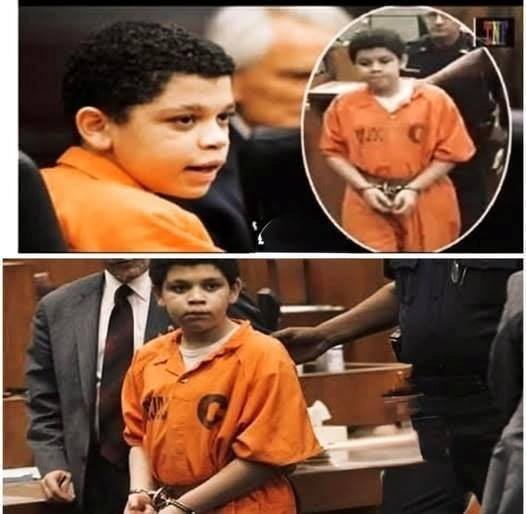
According to reporting and legal advocacy records, dozens of individuals who were under fourteen years old at the time of their offenses have received life sentences without parole in the United States. In practical terms, that means a child can be told by the legal system that they will spend the remainder of their life in prison with no guaranteed opportunity for release or meaningful review.
Whatever one’s views on punishment, that reality forces society to confront uncomfortable questions about childhood, accountability, and the possibility of human change.
At the center of the debate is not whether serious crimes committed by minors should carry consequences. They should. Victims, families, and communities deserve justice and protection. The deeper question is whether a child’s worst act should permanently define the entirety of their future before emotional maturity itself has even fully developed.
Modern neuroscience increasingly complicates older assumptions about juvenile responsibility. Research consistently shows that the parts of the brain connected to impulse control, long-term planning, emotional regulation, and risk assessment continue developing well into early adulthood. Young adolescents are especially vulnerable to peer influence, unstable environments, fear, trauma, and emotionally reactive decision-making.
Recognizing this does not erase harm caused by violent acts.
But it does challenge the idea that a twelve- or thirteen-year-old possesses the same psychological stability, foresight, and fixed identity expected of a mature adult.
Many of the cases behind these sentences also emerge from environments already shaped by instability. Histories of abuse, neglect, family violence, untreated mental health struggles, poverty, or chronic exposure to danger appear repeatedly in juvenile sentencing records. These circumstances do not excuse harmful behavior, yet they often help explain how deeply damaged environments can shape damaged decisions.
One reason these cases remain controversial is because the legal system sometimes treats childhood inconsistently. A young teenager may be considered too immature to vote, sign contracts, live independently, or make many basic adult decisions — yet still be prosecuted in adult court under statutes designed for hardened criminal conduct.
Legal doctrines such as felony murder intensify that tension further. Under such laws, minors can sometimes receive severe sentences connected to deaths occurring during criminal activity even if they were not the direct actor or did not intend lethal harm themselves. In practice, this can transform reckless adolescent participation into permanent punishment.
The case of Lionel Tate became one of the most widely discussed examples nationally. Arrested at age twelve after the death of a younger child, Tate initially received a life-without-parole sentence before later legal reconsideration. The case drew intense public attention not only because of the tragedy involved, but because it forced many Americans to ask whether the justice system had crossed a line separating accountability from hopelessness.
And hopelessness is perhaps the deepest issue at stake in juvenile life-without-parole sentencing.
A prison sentence can remove freedom.
A life-without-parole sentence removes expectation.
For adults, such punishment already carries enormous moral weight. For children, it introduces another troubling question: what does it mean for society to declare a person permanently irredeemable before they have even reached emotional maturity?
Supporters of these harsh sentences often point to the severity of certain crimes and the irreversible suffering endured by victims and their families. Those concerns are real and deserve respect. Some acts committed by juveniles are profoundly violent and devastating. Public safety matters. Communities require protection from dangerous behavior regardless of age.
Yet even within that reality, many legal scholars, psychologists, and faith leaders argue that punishment and redemption need not exist as opposites. A system can impose serious consequences while still preserving the possibility that a human being — especially a child — may become fundamentally different over decades of growth, reflection, education, treatment, and maturity.
This debate has slowly influenced legal reform. In Miller v. Alabama, the U.S. Supreme Court ruled that mandatory life-without-parole sentences for juveniles violate constitutional protections against cruel and unusual punishment. However, the ruling stopped short of banning such sentences entirely, leaving judges discretion in exceptional cases.
That remaining discretion continues fueling debate because judgments about whether a child is “beyond rehabilitation” can depend heavily on geography, judicial philosophy, legal representation, and the narratives presented during trial.
Internationally, many countries approach juvenile justice from a different philosophical starting point — one emphasizing rehabilitation and reintegration over permanent exclusion. The assumption underlying those systems is not that children are incapable of harm, but that childhood itself implies capacity for change.
Perhaps that is the deeper question beneath all statistics and legal doctrine:
What should justice seek when dealing with children?
Protection?
Punishment?
Deterrence?
Mercy?
Transformation?
In reality, mature justice likely requires balancing all of these imperfectly rather than choosing only one.
A society reveals something important about itself not by how it treats the innocent, but by how it responds to those who have caused harm — especially when the person responsible is still young enough that identity itself remains unfinished.
And perhaps the most difficult truth is this:
believing in accountability and believing in the possibility of redemption do not necessarily contradict one another.
Sometimes wisdom requires holding both at the same time.
{"post":102179,"page":2,"next":[{"id":102175,"title":"My Husband Asked for a Divorce the Same Night I Found Out I Was Pregnant\u2014But When Our Daughter Walked Into the Gala Two Years Later, His Mistress Finally Understood What He Had Lost\u2026","url":"https:\/\/new24.info\/102175"},{"id":102172,"title":"I Became a Dad at 18 After My Mom Abandoned My Twin Sisters \u2013 7 Years Later, She Returned with a Shocking Demand","url":"https:\/\/new24.info\/102172"},{"id":102170,"title":"I Noticed My 65-Year-Old Neighbor Hadn\u2019t Left Her House in 5 Days \u2014 One Day, I Decided to Check If She Was Okay","url":"https:\/\/new24.info\/102170"},{"id":102167,"title":"My Twelve Year Old Son Carried His Disabled Best Friend Through A Dangerous Trail And The Next Morning The School Called Me In A Panic","url":"https:\/\/new24.info\/102167"},{"id":102164,"title":"My mother threw scalding soup in my face for saying no to her stepdaughter. \u0022Give her all your things \u2014 or get out!\u0022","url":"https:\/\/new24.info\/102164"},{"id":102158,"title":"The Tragic Loss Of A Screen Legend Jennifer Harmon Dies At 82 Leaving Fans And Broadway In Total Devastation","url":"https:\/\/new24.info\/102158"},{"id":102153,"title":"How Spotting An Old Patched Jacket Led Me To My Missing Son","url":"https:\/\/new24.info\/102153"},{"id":102150,"title":"These are the consequences of sleeping with\u2026","url":"https:\/\/new24.info\/102150"},{"id":102148,"title":"Brad Pitt\u2019s Daughter Shares a Personal Reflection That Has Fans Talking","url":"https:\/\/new24.info\/102148"},{"id":102144,"title":"More Details Released On Man Who Opened Fire Near Vance Motorcade","url":"https:\/\/new24.info\/102144"},{"id":102138,"title":"Sunbathers Shocked As Giant Predatory Silhouette In The Shallows Triggers Immediate Beach Evacuation And Frenzied Chaos","url":"https:\/\/new24.info\/102138"},{"id":102134,"title":"This Devastating Twenty Five Year Old Secret Instantly Collapsed When A Daughter Confronted Her Biological Surrogate Mother With A Shocking Legal Demand","url":"https:\/\/new24.info\/102134"},{"id":102130,"title":"The Miraculous Medical Miracle That Shocked An Entire Hospital After A Grieving Son Pressed Play On A Hidden Voice Recorder","url":"https:\/\/new24.info\/102130"},{"id":102126,"title":"My Simple Ancestry DNA Test Revealed A Shocking Secret Family Fortune","url":"https:\/\/new24.info\/102126"},{"id":102123,"title":"Doctors reveal that eating eggs in the evening causes \u2026","url":"https:\/\/new24.info\/102123"},{"id":102115,"title":"The refrigerator was empty. My wife\u2019s hands were trembling. And upstairs, my daughter was livestreaming her new designer bag, bought with the money meant for food. \u201cDad won\u2019t do anything,\u201d Mia whispered to her boyfriend.","url":"https:\/\/new24.info\/102115"},{"id":102118,"title":"Hidden Danger in Dried Fruit","url":"https:\/\/new24.info\/102118"},{"id":102110,"title":"Been dating this woman I met at Walmart and after finally getting some I woke up with these on my face what is this?","url":"https:\/\/new24.info\/102110"},{"id":102106,"title":"The Hidden Medical Emergency That Shocked The Music World And Suddenly Took The Life Of Legendary Icon Neil Sedaka","url":"https:\/\/new24.info\/102106"},{"id":102103,"title":"I Traded My $130,000 Job to Give My Husband a Child \u2013 When I Asked for $30 for Baby Formula, His Answer Left Me Speechless","url":"https:\/\/new24.info\/102103"}]}