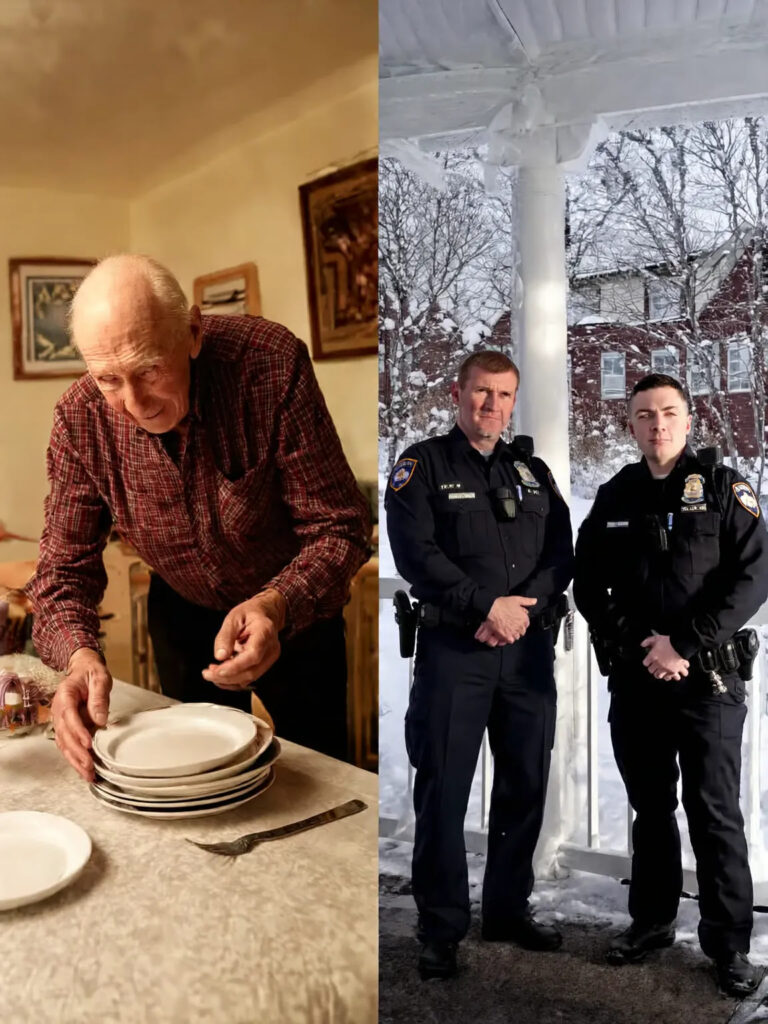
I stood there for a long moment, looking at the place settings Margaret always insisted should make people feel welcomed. Grief has a way of widening silence. It was not anger I felt most deeply that night, but the quiet ache of realizing how easily life continues moving for others while one heart remains standing still.
Then came a heavy knock at the door.
Two police officers stood outside. Within minutes, I was being handcuffed for an aggravated assault from 1992 in Wisconsin — a place I had never even visited. The accusation itself felt unreal, but what pierced me most was not fear. It was the humiliation of being led down my driveway while my neighbors could see straight into the dining room: the untouched feast, the empty chairs, the evidence of a gathering that never happened.
At the station, confusion slowly gave way to clarity. A mistaken identity. Papers mixed with another man’s name. But before that truth surfaced, something else did.
The people who arrived for me were not my children.
My neighbor Linda came first. Then the local pastor. Then the owner of the hardware store who had known me for years. They spoke calmly, firmly, and without hesitation about the man they knew. Eventually, the sergeant admitted the error and removed the cuffs.
My children finally arrived afterward, breathless and irritated rather than concerned. To my surprise, they accused me of somehow arranging the situation to guilt them into attending dinner.
In that moment, something inside me settled.
Not with bitterness. Not with rage. Just clarity.
A person can spend years trying to hold a family together out of love, but love cannot be sustained by obligation alone. Sometimes people drift not because they are cruel, but because they become consumed by their own pace of life. Still, neglect leaves its mark, even when unintentional.
“I don’t need to force anyone to eat with me,” I told them quietly. “And if that’s what it takes to bring everyone together, then I would rather leave the chairs empty.”
I went home with the people who had truly shown up.
The food was reheated. The table finally filled. Laughter returned to the rooms Margaret once kept warm with her presence. No one there shared my blood, yet every conversation carried sincerity, and every chair held someone who wanted to be there freely.
As the evening unfolded, I realized something grief had been slowly teaching me all along: family is not measured only by history or obligation, but by presence. By who comes when things are difficult. By who remains when there is nothing to gain.
And for the first time since Margaret’s passing, the house felt alive again.