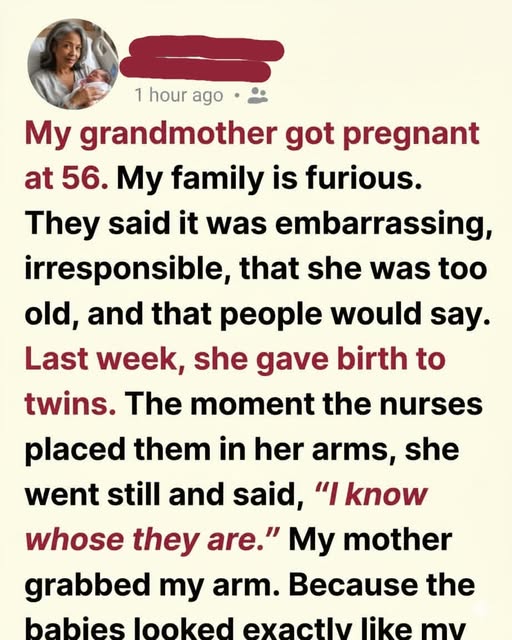
…e.” The truth settled over us slowly, like light returning after a long, brutal storm. In that sterile hospital room, every cruel argument we had thrown at her suddenly felt small and hollow. The babies’ faces carried our late grandfather’s features so clearly—the arch of the brow, the specific set of the jaw—that it physically hurt to look at them. It didn’t matter whether it was a quirk of genetics, a bizarre coincidence, or something we simply had no language for; what we saw was a promise kept.
For months, our family had been a battlefield. We had called her selfish, delusional, and reckless. We had stayed away, convinced that she was losing her grip on reality, leaving her to navigate her pregnancy in a home that felt like a tomb of our own making. But as we stood around those plastic bassinets, the anger evaporated, replaced by a profound, trembling awe. We were looking at a legacy we thought had been buried with our grandfather years ago.
Back at her house, the same rooms we had once abandoned began to breathe again. The silence was replaced by the soft, rhythmic sounds of newborn life. Someone fixed the porch light that had been flickering for months; someone else started washing dishes without being asked. People who hadn’t spoken to one another in half a year found themselves passing a sleeping baby between them, their hands brushing, their defenses dropping, all without thinking about which side of the argument they were supposed to be on.
My grandmother didn’t gloat. She didn’t say “I told you so,” even though she had every right to. She simply watched us with a quiet, knowing grace, holding both boys as if she had always trusted that our love would eventually catch up to the choice she made long before we were ready to understand it. In the end, we realized that she hadn’t been acting out of madness, but out of a deep, singular faith that life—and love—could find a way back to us, even when we were the ones trying hardest to lock the door.