The first time I saw my father sewing in the living room, I genuinely thought something had gone wrong.
He was a plumber—hands rough from years of work, boots worn down to memory, a man who fixed leaks and stretched meals without complaint. Fabric, lace, delicate stitching… none of that belonged to him. And yet there he was, bent over ivory cloth under the dim lamp, reading glasses slipping down his nose as he guided it carefully through a sewing machine.
“Go to bed, Syd,” he said without looking up.
I leaned in the doorway. “Since when do you sew?”
“Since YouTube and your mom’s old kit,” he muttered.
“That’s… not reassuring.”
He finally pointed toward my room. “Bed.”
At the time, I didn’t understand what I was looking at. I didn’t know that every late night, every hidden package, every pricked finger was leading to the most important thing I would ever wear.
After my mother died, it was just us. He filled the space the best he could—working long hours, making jokes where silence threatened to settle, and quietly absorbing every worry I didn’t say out loud. By senior year, I had already learned the difference between what other girls could ask for and what I should pretend not to want.
Prom made that difference louder.
Girls talked about dresses that cost more than our rent, about perfect nights and perfect photos. One evening, while washing dishes, I mentioned I might borrow something.
He didn’t miss the meaning behind it.
“Leave the dress to me,” he said.
I laughed. “That sentence should scare me.”
But after that, the house changed.
Closet doors stayed shut. Packages appeared and disappeared. And at night, the hum of the sewing machine became a quiet, stubborn rhythm in the dark.
I caught him more than once, bent over that same ivory fabric, treating it with a kind of care I had only ever seen him use on old photographs of my mother.
“You’re being weird,” I told him once.
He smiled tiredly. “Go to bed, baby.”
Weeks passed like that—thread on the couch, burned dinners, bandages on his fingers. Something was happening, something gentle and determined, and I could feel it even before I understood it.
Around the same time, school became heavier.
Mrs. Tilmot didn’t shout or insult outright. She didn’t need to. Her voice carried that quiet precision that cuts deeper than anger.
“Sydney, do try to look awake.”
“That essay feels… sentimental.”
“You’re upset? How exhausting.”
I learned to laugh it off. It was easier than explaining how it felt. Easier than admitting that sometimes the smallest comments stayed with me long after the classroom emptied.
But my father noticed.
One night, when I was rewriting the same paper again, he asked, “Was your first version bad?”
“No.”
“Then stop doing extra work for someone who enjoys watching you bleed.”
A week before prom, he knocked on my door holding a garment bag.
He looked nervous, which I had almost never seen before.
“It’s not perfect,” he said quickly. “And the zipper and I… we had a disagreement.”
I was already crying.
He sighed. “You haven’t even seen it yet.”
Then he unzipped the bag.
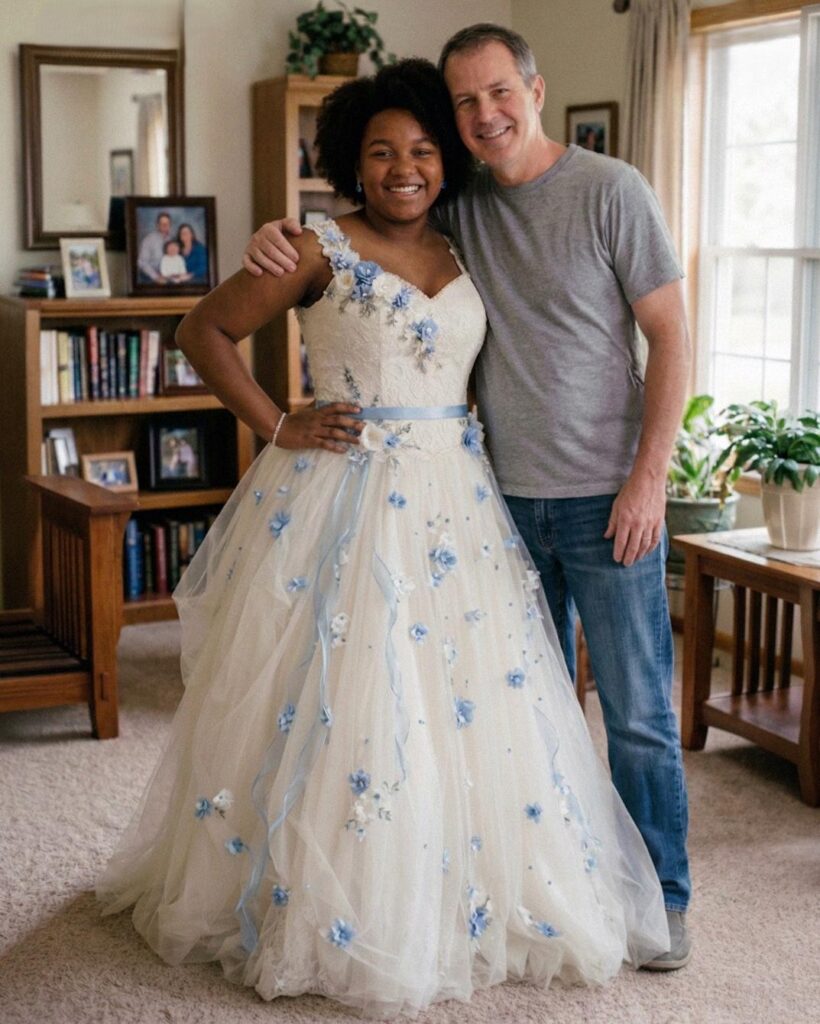
The dress was soft ivory, glowing in a way that felt almost alive, with delicate blue flowers curling across the fabric and tiny stitches so careful they felt like whispers.
I couldn’t speak.
“Your mom’s dress had good bones,” he said quietly. “Just needed adjusting.”
I looked at him. “You used Mom’s wedding dress?”
He nodded.
That was when everything broke open inside me.
He stepped forward immediately. “If you don’t like it—”
“I love it,” I said, barely able to get the words out.
He looked at me then, really looked, and something in his expression shifted.
“Your mom would’ve wanted to be there,” he said. “I couldn’t give you that. But… maybe this is close.”
I hugged him so hard he laughed in surprise.
When I tried it on, he didn’t say anything at first.
Then, softly, “You look like someone who deserves everything good.”
Prom night felt different from the moment I stepped into that dress.
Not because it made me look like someone else—but because it made me feel like myself, whole and carried by something bigger than just that night.
My mother in the fabric.
My father in every stitch.
For a moment, I let myself believe it would be enough.
Then Mrs. Tilmot approached.
She didn’t raise her voice, but she didn’t need to.
“Well,” she said, looking me over slowly, “if the theme was attic clearance, you’ve certainly committed.”
The room went quiet.
“It looks like someone turned old curtains into a project,” she added lightly.
Something inside me froze.
Then she reached toward my shoulder, touching the blue flowers.
“What are these? Hand-stitched pity?”
“Mrs. Tilmot?”
The voice behind her changed everything.
I turned before she did.
Officer Warren stood at the edge of the room, the assistant principal beside him.
And just like that, the balance shifted.
“This didn’t start tonight,” he said calmly. “We’ve had multiple reports.”
The assistant principal stepped forward. “We warned you to keep your distance.”
Mrs. Tilmot laughed it off at first. Then she saw the room watching.
And for the first time, she hesitated.
“You need to come with us,” the officer said.
As they led her away, he glanced back at me.
“Enjoy your night.”
And suddenly, the silence broke.
Not into whispers, but into something softer. Lila squeezed my hand. Someone told me I looked beautiful. Another asked if my dad really made the dress.
“Yes,” I said.
“He’s incredible,” they replied.
And that was it.
Not pity. Not judgment.
Just truth, spoken out loud.
When I got home, Dad was still awake.
“Well?” he asked. “Did the zipper survive?”
“It did,” I said, smiling.
He nodded seriously. “That’s what matters.”
I looked at him—at the man who had taken grief, love, exhaustion, and something old and turned it into something new.
“Tonight,” I said softly, “everyone saw what I already knew.”
He raised an eyebrow. “What’s that?”
“That love looks better on me than shame ever could.”