I bought my father a truck six weeks before his sixtieth birthday, and even while signing the paperwork, I knew I was probably making a mistake.
Not because he wouldn’t like it.
He loved trucks the way some men love status—loudly, proudly, and with endless opinions no one had asked for. He had been hinting at this exact model for years: a black King Ranch F-250 with leather seats, custom wheels, a towing package, and the engine he had described at three separate Thanksgivings while pretending he “didn’t need anything fancy.”
So I bought it.
Cash.
Through my company’s auto broker.
But because I knew my family, I kept the title transfer pending until the birthday dinner. In my world, paperwork mattered. In my family, insults always came wrapped as jokes. I had learned to protect myself from both.
The dinner was at my parents’ house outside Fort Worth. Expensive steaks, red wine, relatives from Plano and Arlington, my brother Dean already bragging about his bonus before the salad plates were cleared. My mother wore emerald silk and the kind of smile she used when she wanted everyone to admire the family more than we deserved.
When I slid the key box across the table, the room went silent.
My father opened it.
For one perfect second, his face changed.
He looked surprised. Truly surprised.
Outside, the truck waited under the driveway lights with a red bow across the hood. My uncle whistled. Dean muttered something impressed under his breath. Even my mother looked pleased, which was as close to applause as she ever came.
My father walked around it slowly, touching the paint.
“This is mine?” he asked.
I smiled. “Happy birthday, Dad.”
For one hour, I thought maybe I had finally done something he couldn’t twist.
I should have left while the moment still looked beautiful.
Instead, I stayed for dessert.
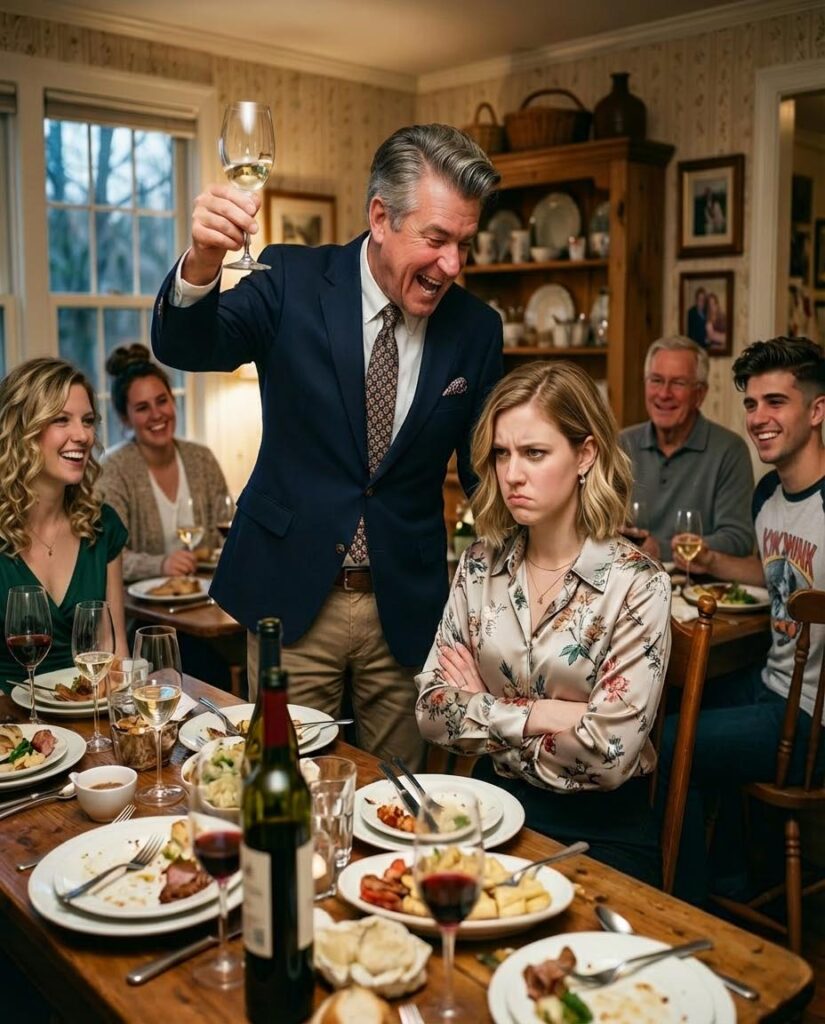
Halfway through, my father stood with his glass raised. Everyone quieted.
“Well,” he said, smiling in that hard, amused way of his, “here’s to my idiot daughter.”
The room froze.
Then people laughed.
He pointed his glass toward me.
“Trying to buy love with money.”
Dean laughed the loudest. My aunt covered her mouth like she was embarrassed but still entertained. My mother looked down at her plate, waiting to see how I reacted before choosing which version of the story she would support later.
I sat there feeling every eye on me.
And suddenly, the truck wasn’t a gift anymore.
It was a test.
A very expensive test.
I stood slowly, folded my napkin, smiled at my father, and left without saying a word.
The next morning, his driveway was empty.
By 8:12 a.m., I had 108 missed calls.
The first voicemail was from my mother.
“Savannah, call me right now.”
The second was Dean.
“What the hell did you do?”
I didn’t need to listen to the rest.
I had not stolen the truck.
I had simply taken back what was still legally mine.
Because the title transfer hadn’t been completed. My father hadn’t signed anything. The vehicle was delivered under my company’s temporary insurance and still attached to my broker’s paperwork. So at 6:40 that morning, I called the broker, the dealership’s delivery coordinator, and the transport service I used for company fleet assets.
By 7:30, the truck was gone.
Quietly.
Professionally.
Legally.
When I finally answered Dean, he didn’t bother saying hello.
“You took Dad’s truck.”
“No,” I said. “I took back mine.”
“You’re insane.”
“Was Dad insane when he called me an idiot in front of thirty people?”
“It was a joke.”
“Then he should still be laughing.”
Silence.
Then he said what they always said when someone finally reacted to their cruelty.
“You embarrassed him.”
“Good,” I said. “Maybe now he remembers what it feels like.”
My mother called next.
Her voice was cold. “Bring it back.”
“No.”
“Your father is humiliated.”
“Now he cares?”
“You do not punish your father over one stupid toast.”
I walked to the window and looked out at the pale Texas morning.
“No,” I said. “I’m responding to a lifetime of them.”
She went quiet because she knew.
She knew about the scholarship he mocked when I was fourteen. She knew about the condo he turned into a joke. She knew about the medical bill I paid after his surgery, only for him to tell relatives I was “auditioning for sainthood.” She knew every achievement I had ever made became luck, overcompensation, or emotional bribery.
The toast wasn’t new.
It was just public enough to end something.
By noon, my father showed up at my house.
I opened the door but didn’t let him in.
He stood there in pressed jeans, polished boots, and a starched shirt, trying to look like authority still worked on me.
“You made your point,” he said.
“No,” I replied. “You did last night.”
His jaw tightened. “I was drinking.”
“There’s always a reason when it’s you.”
He glanced past me into the house. “You really had it taken?”
“It was still mine.”
“Over a joke?”
I crossed my arms. “Call it that again and we’re done.”
That stopped him.
Not because he understood.
Because he realized I wasn’t afraid.
He told me the neighbors had seen the truck loaded. My aunt was already talking. My mother was upset.
There it was.
Not regret.
Optics.
“You humiliated me in public,” I said. “Now you get to experience community.”
He looked away first.
“What do you want from me?” he asked.
And the strange thing was, once he asked, I realized I didn’t want anything.
Not an apology forced by embarrassment.
Not a public correction.
Not some performance of remorse because the neighbors saw a transport truck.
So I said, “Nothing.”
He frowned. “That’s not true.”
“It is,” I said. “I don’t want to spend another decade buying expensive things for people who treat me cheaply.”
He stared at me.
“So that’s it?”
“The truck is going back to the dealer,” I said. “I’m canceling the purchase. Dean can buy you one if he thinks you deserve it.”
His face hardened.
Dean couldn’t afford it.
Then my father said the closest thing to honesty I had ever heard from him.
“You’re punishing me.”
I shook my head.
“No, Dad. I’m ending the discount.”
He stood there a few seconds longer, still searching for a way to win. When he couldn’t find one, he put his sunglasses back on and walked away.
By evening, the family story had already started spreading.
I had overreacted.
I couldn’t take a joke.
I caused a scene.
Let them say it.
People who depend on humiliation always need softer language once there are consequences.
A week later, my father sent me one message.
“Shouldn’t have said that at dinner.”
For him, that was practically a confession.
I read it once, set my phone down, and went back to work.
I never bought him another gift.
And every time I passed a black King Ranch on the highway after that, I felt the same quiet satisfaction.
Not because I took something from him.
Because, for once, I kept what was mine.