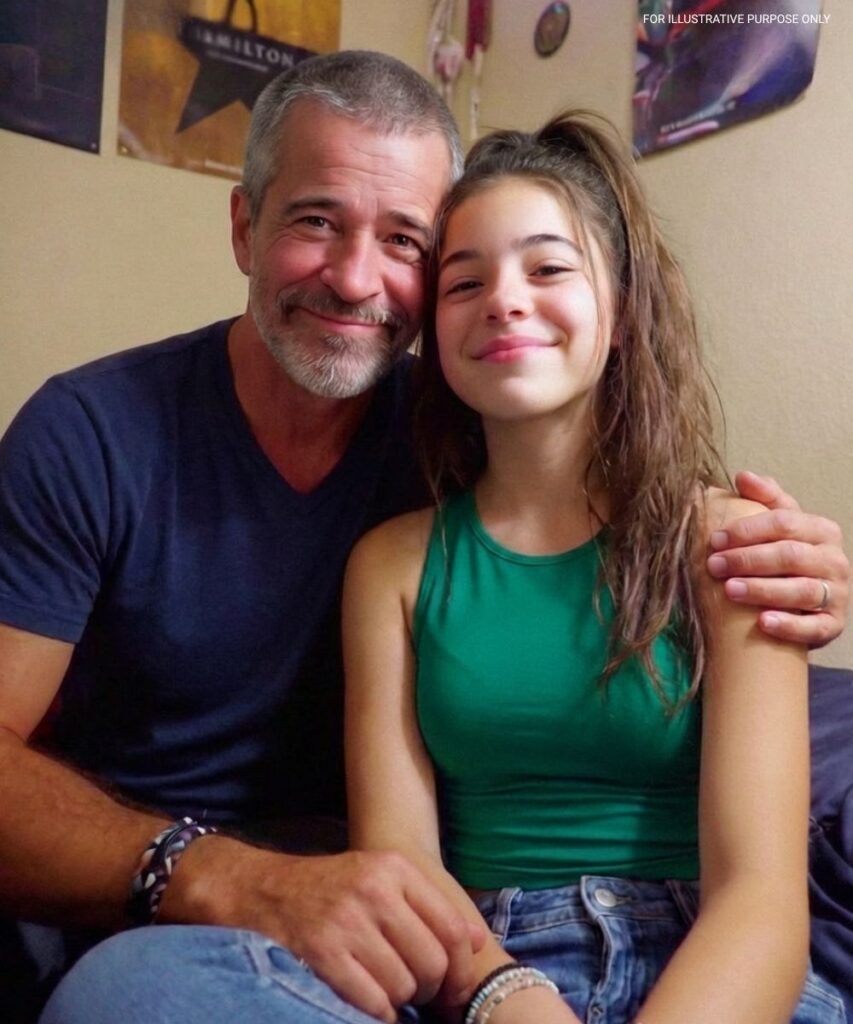
I truly believed I had done it—that after everything we’d survived, I had finally built a home where my daughter could feel safe.
Not perfect. Not untouched by the past. But steady. Protected.
After my first marriage ended, I made myself a promise I never broke: no one would ever hurt Mellie again. She had already seen more than a child should, and I carried that knowledge like a quiet responsibility in everything I did.
Then Oliver entered our lives.
He didn’t arrive with grand gestures or loud declarations. He was calm, patient, careful. He never tried to replace Mellie’s father, never forced closeness. Instead, he showed up in small, consistent ways—remembering how she liked her tea, leaving food for her when she studied late, giving her space when she needed it.
For three years, it felt like something solid. Something real.
Something safe.
And then, slowly, something shifted.
It started with Oliver sleeping on the couch.
At first, it sounded harmless. A bad back. A joke about snoring. One night turned into two, then into a quiet pattern. He would lie beside me until I fell asleep, and by morning, he’d be gone.
Around the same time, Mellie began to change too.
She looked tired in a way that went beyond late-night studying. There was a heaviness to her, something unspoken. And strangely, she seemed calmer when Oliver was nearby.
That should have reassured me.
Instead, it unsettled me.
The feeling crept in slowly, the kind you try to ignore because you don’t want to believe it’s there. I told myself I was overthinking, that trauma has a way of distorting perception.
But then came that night.
I woke up suddenly, the kind of waking that feels pulled rather than natural. The bed beside me was empty. The house was silent.
And then I saw it—a thin line of light under Mellie’s bedroom door.
Something inside me tightened instantly.
I walked down the hallway, every step heavier than the last, and pushed the door open just enough to see inside.
And then I froze.
Oliver was sitting on her bed, leaning back against the headboard.
Mellie was asleep beside him.
Her hand was wrapped around his.
The fear didn’t arrive slowly. It hit all at once—sharp, overwhelming, undeniable. Every instinct I had built over years of trying to protect her came roaring back.
I didn’t think. I reacted.
When I confronted him, he didn’t argue. He didn’t raise his voice. He just looked at me, calm but tired, and said she’d had a nightmare. That she didn’t want to wake me. That she had asked for him.
That explanation should have eased something.
Instead, it hurt in a different way.
Why hadn’t she come to me?
Over the next few days, that question turned into something heavier. Suspicion grew where trust had been. I hated myself for it, but I couldn’t silence it.
And instead of doing the right thing—asking, talking, trusting—I made a choice I’m not proud of.
I installed a camera in her room.
Even now, admitting that feels like reopening a wound.
I told myself it was for her safety. That I needed certainty. That I couldn’t risk missing something important.
But deep down, I knew it was fear.
When I finally sat down and watched the footage, I expected to feel justified.
Instead, I felt myself unravel.
Night after night, the same pattern unfolded.
Mellie would wake up, restless, sometimes crying quietly. She would reach for her phone. Minutes later, Oliver would appear at her door. He would sit beside her—not touching her beyond what was necessary, never crossing a line—just being there.
Sometimes she talked. Sometimes she cried. Sometimes she just held his hand until her breathing slowed.
And then he would leave.
Over and over again.
It wasn’t what I feared.
It was something else entirely.
Something softer. Sadder.
Then I saw the moment that changed everything.
Oliver was speaking to her gently, his voice low. He told her he couldn’t keep this from me anymore. That I deserved to know.
Mellie shook her head, panicked. She begged him not to say anything.
Not because she was hiding something wrong.
Because she was afraid.
Afraid that telling me would ruin the happiness she thought I had finally found.
That was the moment everything inside me broke.
There was no betrayal.
No hidden darkness.
Just a child carrying fear alone… and a man trying, imperfectly, to help her carry it.
I had spent so long guarding against danger from the outside that I had completely missed the pain living quietly inside my own home.
The next day, I told them everything.
Even about the camera.
Mellie’s reaction was immediate, and it was justified. She was hurt. Angry. Violated. I didn’t argue. I didn’t defend myself. I apologized, fully and without excuse.
Trust doesn’t survive being watched in secret. I knew that.
And I knew I had damaged it.
But then, slowly, the truth came out.
Her nightmares hadn’t stopped after we left my first marriage. She had just learned how to hide them. She didn’t come to me because she thought I needed rest, needed peace, needed a break from worry.
Oliver admitted he should have told me. That he thought he was helping, that he didn’t want to betray her trust.
We were all wrong in different ways.
And we were all trying, in our own ways, to protect each other.
That night, Mellie slept in my room.
For the first time in years.
The next morning, I made three calls—therapy for her, therapy for me, and counseling for all of us together.
We didn’t pretend things would fix themselves.
We chose to face them.
It wasn’t easy. Mellie stayed distant for a while, especially with me. The camera had crossed a line, and rebuilding that trust took time.
But slowly, things changed.
She started speaking when something bothered her instead of holding it in.
I learned that silence isn’t strength—it’s often just fear without a voice.
Oliver stopped trying to carry everything alone.
And our home became something different.
Not perfect.
But honest.
Months later, she said it casually, like it was nothing.
“I slept through the whole night.”
I had to turn away so she wouldn’t see my eyes fill with tears.
I still believe I’m a good mother.
Not because I got everything right.
But because when the truth became uncomfortable—when it forced me to confront my own fear, my own mistakes—I didn’t look away.
I stayed.
And this time, I listened.