My Husband Told His Mom to “Start Packing” for Our Luxury Penthouse—Then My Family Uncovered the Truth
The moment my husband leaned toward his mother and said, almost casually, “Mom, you’ll soon be able to move your things into your new place,” something shifted in the room. It wasn’t loud or dramatic. It was quieter than that—the kind of shift you feel before you fully understand it.
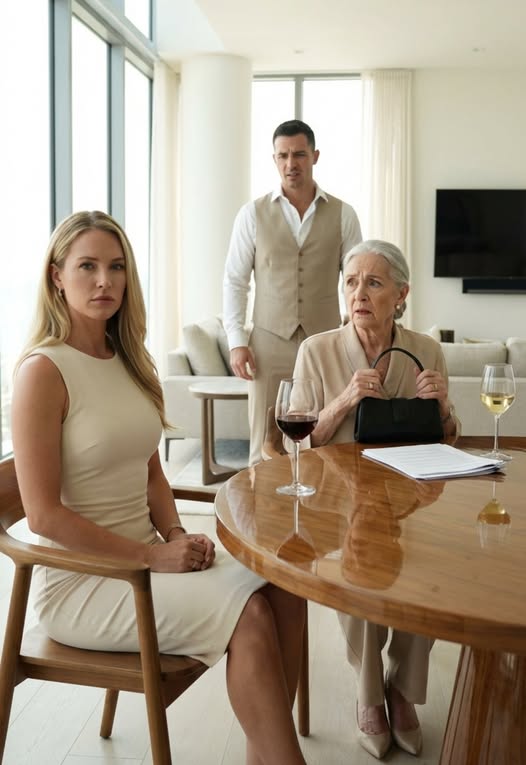
We were sitting at my parents’ dining table, gathered for what was meant to be a celebration. The penthouse in San Diego had been presented as a new beginning for our marriage, something my parents had arranged with care and intention. It was supposed to mark a step forward.
Instead, in one sentence, it became something else.
Sandra smiled as if everything had already been agreed upon. “Once you two move in, I’ll help keep everything organized,” she said, her tone smooth, almost reassuring. “It’ll be easier if I’m there.”
I paused, trying to make sense of what I had just heard. “What do you mean… your things?” I asked, more quietly than I intended.
Austin didn’t hesitate. “It’s a large place,” he replied, as if explaining something obvious. “She’ll be more comfortable there.”
That was the moment it became clear—they weren’t asking. They had already decided.
I looked around the table, expecting someone to interrupt, to correct it, to turn it into a misunderstanding. My mother’s hands had gone still. My father remained silent, but not absent. There was a kind of patience in his stillness, as if he was waiting for the right moment rather than reacting too early.
Sandra leaned back, satisfied, already speaking as though her place in that home had been secured. “You won’t need to hire anyone,” she added. “I’ll manage the household.”
I turned to Austin, hoping—still—that there was something I had missed.
He sighed, irritation creeping in. “Don’t start,” he muttered. “You’re acting like this is a problem.”
My father stood then.
There was no urgency in the movement, no raised voice. He simply adjusted his jacket and spoke with a calm that carried more weight than anger ever could.
“Before anyone packs a single box,” he said, “there’s something you all need to understand about that property.”
Sandra smiled wider, as if she expected confirmation.
“You won’t be placing anything there,” he continued, looking directly at her. “You won’t be stepping foot inside that penthouse.”
The reaction was immediate.
Austin pushed his chair back, his tone sharp now. “What is that supposed to mean? It was a gift. For us.”
My father didn’t raise his voice.
“It was a gift for my daughter,” he said. “And for a man with integrity. Not for someone trying to take control quietly.”
Something tightened in my chest as pieces began to fall into place—small moments I had dismissed before. The private phone calls. The subtle shifts in decisions. The way things seemed to move without me fully being part of them.
Then the folder appeared.
“I received a call from the notary this morning,” my father said, placing it on the table. “Someone attempted to file power of attorney over the property.”
I turned to Austin. “Tell me that isn’t true.”
He hesitated.
That hesitation carried more truth than any explanation that followed.
“It was just paperwork,” he said quickly. “A formality—for convenience.”
My mother spoke then, her voice steady but unmistakably firm.
“We also found emails,” she said. “To a rental agency.”
I felt something drop inside me.
“They were discussing leasing rooms in the penthouse,” she continued, “in case the marriage didn’t work out.”
I looked at him, trying to reconcile the person I thought I knew with the one sitting in front of me. “You were planning to rent out my home… before we even moved in?”
Sandra stepped in, trying to regain control of the situation, but the effort felt thin now.
“There’s nothing to explain away,” I said, cutting through it. “This is exactly what it is.”
My father opened the folder again and pulled out the final document.
“A bank statement,” he said. “The property was listed as collateral.”
Austin’s posture changed.
“I had debts,” he admitted, his voice losing its certainty. “I was trying to manage them. It was temporary.”
“Temporary?” I repeated. “You were willing to risk everything my parents built—for something you never even told me about.”
Sandra bristled, still clinging to a version of control. “Watch your tone. He gave you his name—”
I met her gaze without raising my voice.
“That name is exactly why I should have paid closer attention,” I said.
My father didn’t argue further. He didn’t need to.
“The keys are revoked,” he said. “All authorizations are canceled. You will leave this house tonight.”
There was no shouting after that.
No dramatic ending.
Just clarity.
I walked to the table, removed my wedding ring, and placed it down beside the keys.
“I’m not going to defend my life against someone trying to take it,” I said. “Not anymore.”
Sandra’s voice rose, but it no longer carried weight.
“This is a misunderstanding!”
“No,” I replied. “This is exactly what it is.”
When they left, it wasn’t chaotic. It was quiet. The kind of quiet that follows when something false finally collapses under its own weight.
The door closed behind them, and for the first time in a long while, I felt something settle inside me.
Not victory.
Not anger.
Just relief.
Final Thought
Sometimes the truth doesn’t arrive loudly.
It unfolds, piece by piece, until there’s nothing left to question.
And in that moment, choosing yourself isn’t dramatic—it’s simply necessary.